
Bitcoin Mining Network Resilience and Geopolitical Shifts: Assessing Long-Term Investment Implications of China's Xinjiang Shutdowns and Hashrate Reallocation
The BitcoinBTC-- mining landscape in 2025 has been profoundly reshaped by China's abrupt shutdown of operations in Xinjiang, a region that had quietly regained a 14% share of the global hashrate despite the 2021 nationwide ban. This event, which saw 400,000 mining machines-equivalent to 100 exahashes per second (EH/s)-go offline, triggered an 8% drop in the global hashrate. The sudden disruption underscores the fragility of mining operations in jurisdictions with inconsistent regulatory frameworks and highlights a critical inflection point for the industry: the reallocation of capital and hashpower to more stable, policy-friendly regions.
The Xinjiang Shutdowns: A Wake-Up Call for Network Resilience
The Xinjiang shutdowns, attributed to renewed enforcement actions, exposed the vulnerabilities of China's mining ecosystem. Historically, the region's low-cost coal-based electricity and industrial infrastructure made it a hub for cost-competitive mining. However, the absence of national-level regulatory clarity has left miners exposed to periodic crackdowns, as seen in 2021 and now in 2025. This volatility has forced investors to reevaluate the long-term viability of China as a mining destination, even as the country's underground industry continues to grow.
The immediate impact of the shutdowns was a sharp decline in network security and miner profitability, though Bitcoin's difficulty adjustment mechanism is expected to mitigate these effects over time. For investors, the event serves as a stark reminder that geopolitical risks can override cost advantages, necessitating a strategic shift toward jurisdictions with stable energy markets and transparent regulatory environments.
Hashrate Reallocation: The Rise of North America and ESG-Driven Hubs
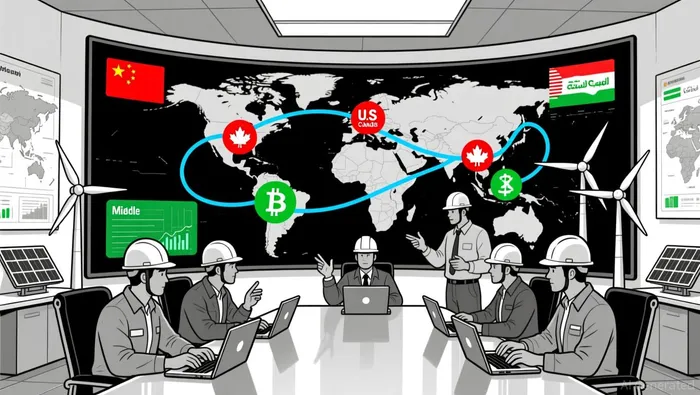
The exodus of hashpower from Xinjiang has accelerated the migration of mining operations to regions with favorable energy and policy conditions. North America, particularly the United States, has emerged as a dominant beneficiary. States like Texas, North Dakota, and Georgia offer deregulated energy markets, access to renewable resources (wind, solar), and stranded natural gas infrastructure, enabling cost-competitive mining. American BitcoinABTC--, a leading U.S. miner, exemplifies this trend, with revenue quadrupling in Q3 2025 and mining capacity expanding to 25 EH/s.
Beyond the U.S., countries like Canada, El Salvador, and Paraguay are attracting ESG-conscious capital by leveraging renewable energy sources. The Middle East, particularly the UAE and Oman, is also capitalizing on excess natural gas to power mining operations. These regions collectively represent a shift toward sustainability-a critical factor as global regulators increasingly mandate carbon reporting and emissions standards.
Geopolitical Stability and Regulatory Evolution
The reallocation of hashrate is not merely a response to cost but a strategic adaptation to evolving regulatory landscapes. In contrast to the U.S. and Canada, regions like Kazakhstan and Europe face headwinds. Kazakhstan, once a post-2021 mining haven, is now grappling with energy rationing and stringent regulations. Meanwhile, much of Europe has become less viable due to energy crises and a push for zero-emission sectors, with some countries considering outright bans on energy-intensive mining.
Regulatory frameworks in 2025 are increasingly formalized, with jurisdictions implementing licensing procedures, environmental standards, and tax frameworks to manage the industry's impact. This evolution reflects a broader maturation of the sector, where mining companies are rebranding as digital infrastructure providers to align with ESG goals. For investors, this shift underscores the importance of selecting jurisdictions that balance regulatory clarity with sustainable practices.
Investment Implications: Diversification and Long-Term Viability
The Xinjiang shutdowns have amplified the need for geographic diversification in mining portfolios. While China's underground industry may rebound, the persistent risk of local enforcement actions makes it a high-volatility asset class. Conversely, North American and ESG-aligned hubs offer a more predictable environment, albeit with higher initial capital requirements.
Emerging trends, such as hybrid models integrating Bitcoin mining with AI and high-performance computing, further enhance the long-term viability of these regions. For instance, CoreWeave's pivot to GPU infrastructure for AI development demonstrates how miners can diversify revenue streams in energy-rich locales. Investors should prioritize projects that leverage renewable energy, demonstrate regulatory compliance, and exhibit adaptability to technological and market shifts.
Conclusion
The 2025 Xinjiang shutdowns have acted as a catalyst for the Bitcoin mining industry's realignment. While the immediate hashrate drop raised concerns about network stability, the broader trend of capital reallocation to stable, sustainable regions signals a maturing sector. For long-term investors, the key takeaway is clear: geopolitical stability, regulatory clarity, and access to renewable energy are now non-negotiable criteria for assessing mining opportunities. As the industry evolves, those who adapt to these fundamentals will be best positioned to capitalize on Bitcoin's next phase of growth.







Comentarios
Aún no hay comentarios