
Bitcoin Mining Industry Resilience Amid Rising Difficulty and 2026 Outlook
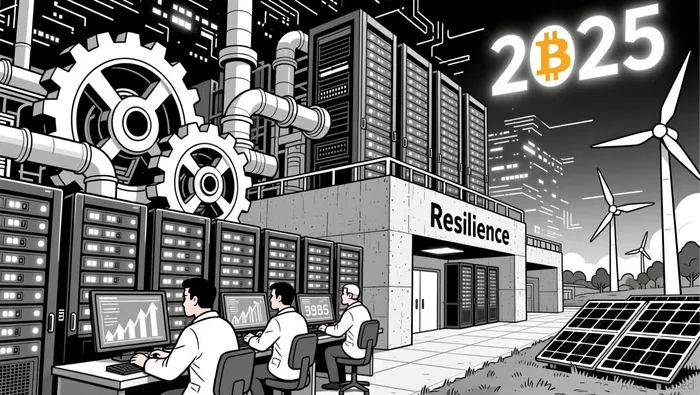
The BitcoinBTC-- mining industry has entered a new phase of industrialization, marked by relentless competition, technological innovation, and institutional adoption. As the network's difficulty surged by 35% in 2025-reaching 148.2 trillion-miners have demonstrated a commitment to maintaining security and scalability, even as operational costs and market volatility persist. This analysis explores how rising difficulty, hardware advancements, and institutional strategies are reshaping the sector's investment viability, with a focus on the long-term strategic value of infrastructure investments in 2026 and beyond.
Rising Difficulty and Network Security: A Barometer of Industry Maturity
Bitcoin's mining difficulty, a self-adjusting mechanism designed to maintain a 10-minute block time, closed 2025 at 148.2 trillion, up from 109.8 trillion in January. This growth reflects not only the network's expanding hashpower but also the industrial-scale competition driving the sector. While Bitcoin's price fluctuated between $89,000 and $126,000 during the year, miners remained active, betting on future price appreciation and the long-term value of securing the blockchain.
The next difficulty adjustment, scheduled for January 8, 2026, is projected to push the metric to 149.3 trillion. This trajectory underscores the industry's shift from individual miners to global operations, where efficiency and scale are paramount. Rising difficulty is not a threat but a signal of the network's resilience-a critical factor for investors evaluating the sustainability of mining infrastructure.
Hardware Innovation and Operational Efficiency: The New Competitive Edge
The 2025 hardware landscape is defined by breakthroughs in ASIC efficiency and system integration. Bitmain's Antminer S23 Hydro, with 580 TH/s at 9.5 J/TH, and Bitdeer's SEAL03 chip, achieving 9.7 J/TH, exemplify the industry's push toward sub-10 J/TH benchmarks. These advancements reduce power consumption, a major cost driver, and improve ROI for operators. For instance, the S23 Hydro 3U model generates $43.75 in daily gross income at $89,000 Bitcoin and $0.05/kWh electricity.
Operational efficiency now extends beyond hardware. Liquid cooling solutions, including immersion and hydro cooling, are becoming standard, reducing noise, equipment wear, and power usage effectiveness (PUE). Modular, rack-mounted designs enable repurposing of mining facilities for high-performance computing (HPC) and AI workloads, diversifying revenue streams. Meanwhile, AI-driven optimization tools are streamlining predictive maintenance, with 60% of innovation centers expected to integrate these technologies by 2025.
Institutional Investment and Strategic Allocation: A New Era of Legitimacy
Institutional adoption of Bitcoin has accelerated in 2025, driven by regulatory clarity and macroeconomic uncertainty. The approval of spot Bitcoin ETFs in the U.S. and the establishment of the Strategic Bitcoin Reserve (SBR) have signaled a paradigm shift, with firms like MicroStrategy and Tesla adopting Bitcoin as a treasury asset. By year-end, the global crypto ETP market had reached $191 billion in assets under management.
For mining infrastructure, institutional players are prioritizing projects with diversified revenue models. Early entrants like Riot Platforms and CoreWeave have repurposed mining facilities into AI and cloud computing hubs, capitalizing on the $12 trillion HPC market. Treasury strategies are also evolving: while some firms retain Bitcoin reserves for long-term value, others balance sales with ESG-aligned operations to meet regulatory expectations.
2026 Outlook: Navigating Difficulty, Diversification, and Institutional Momentum
The 2026 outlook hinges on three key factors: difficulty adjustments, Bitcoin's price trajectory, and institutional adoption. With difficulty projected to rise incrementally, operators must prioritize hardware with optimized hashrate-per-dollar ratios and robust thermal management. Simultaneously, Bitcoin's potential to break its 2021 all-time high-driven by liquidity returns and devaluation pressures-could catalyze further institutional inflows.
For investors, the strategic value of mining infrastructure lies in its adaptability. Facilities equipped with modular designs and AI-driven optimization are well-positioned to pivot between mining, HPC, and AI workloads, ensuring resilience against market cycles. Additionally, the integration of renewable energy and blockchain-based traceability for responsible sourcing is becoming a competitive differentiator.
Conclusion: A Sector Built for the Long Game
The Bitcoin mining industry's resilience in 2025-marked by rising difficulty, hardware innovation, and institutional adoption-highlights its transition from speculative niche to industrialized asset class. For investors, the key to long-term value lies in infrastructure that balances efficiency, diversification, and sustainability. As 2026 approaches, those who align with these principles will be best positioned to capitalize on the sector's next phase of growth.







Comentarios
Aún no hay comentarios