
Bitcoin Mining Hardware and Hashrate Economics in a Downturn: The Strategic Value of Integrated Hosting and AI Diversification
The BitcoinBTC-- mining industry is undergoing a seismic shift. As the 2024 halving event slashed block rewards by 50%, operational costs surged, and Bitcoin's price volatility intensified, miners faced a stark reality: survival hinges on adaptability. According to a report by Bloomberg, the average cost to mine one Bitcoin rose to $130,000 by 2025, while revenue per Bitcoin often failed to cover these expenses. This profitability crisis has forced firms to rethink their business models, with a growing number pivoting to integrated hosting solutions and AI diversification as a lifeline.
The Halving's Impact and the Cost of Survival
The 2024 halving marked a structural inflection point. With block rewards halved, miners' revenue streams contracted, and transaction fees-now less than 1% of block rewards-failed to compensate. Simultaneously, energy costs, hardware depreciation, and rising mining difficulty eroded margins. Data from Aminagroup reveals that Bitcoin mining's cash cost per BTC among public miners reached $74,600 in 2025, while all-in costs hit $137,800. This created a perfect storm, pushing smaller players out of the market and accelerating consolidation among larger firms.
The AI Arbitrage: Repurposing Infrastructure for Higher Margins
Bitcoin miners are uniquely positioned to capitalize on the AI boom. Their existing infrastructure-power-rich facilities, advanced cooling systems, and GPU fleets-is a natural fit for high-performance computing (HPC) and AI workloads. As stated by a report from Insights4.vc, AI compute generates $10–20 million per megawatt compared to Bitcoin mining's $1 million per megawatt. This arbitrage has driven firms like Core ScientificCORZ--, BitfarmsBITF--, and Riot PlatformsRIOT-- to repurpose their operations. For instance, Core Scientific secured a $9.7 billion deal with Microsoft, while IREN Ltd. inked a $5.5 billion agreement with Amazon Web Services.
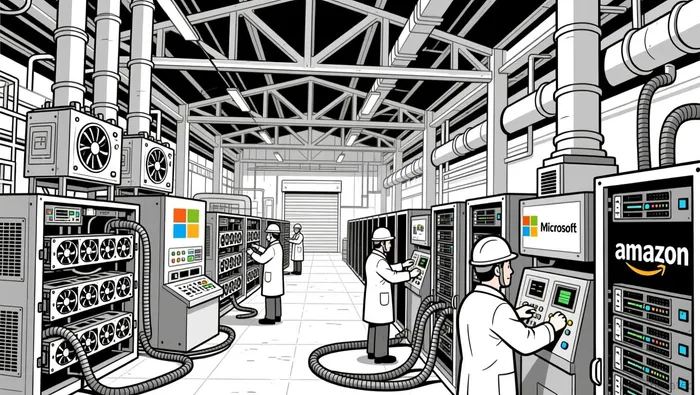
The financial rewards are staggering. CoreWeave, which fully transitioned to AI infrastructure, saw revenue surge from $30 million in 2022 to $1.92 billion in 2024. Similarly, TeraWulf's AI hosting contracts generate $1.85 million per MW annually. These figures underscore the profitability of AI diversification, which offers stable, high-margin revenue compared to Bitcoin's volatility.
Operational Synergies and Economic Models
The pivot to AI is not just about revenue-it's about operational resilience. Bitcoin miners leverage their expertise in power procurement, thermal management, and automation to meet AI's demanding requirements. As noted by Pantheon Mining, AI data centers require 33% annual growth in capacity through 2030, a demand that repurposed mining facilities can fulfill faster than traditional construction. For example, Core Scientific expanded from 200 MW to 500 MW of AI-ready capacity by reusing its mining infrastructure.
Economic models further validate this shift. Aminagroup's analysis shows that AI/HPC operations yield $9.11 million per MW of capacity, far outpacing Bitcoin mining's returns. Moreover, strategic partnerships with energy providers and hyperscalers reduce capital expenditures. CleanSparkCLSK-- and Cipher MiningCIFR--, for instance, raised billions via convertible bonds to fund AI expansions, securing long-term contracts with Google and Microsoft for steady cash flows.
Investor Priorities and Risk Mitigation
Investor sentiment has evolved alongside these shifts. Where once hash rate growth dominated, today's focus is on operational resilience, treasury strategy, and risk management. Firms like MARA have adopted a "HODL" approach, retaining Bitcoin reserves as strategic assets, while others, such as CleanSpark, balance Bitcoin sales with AI revenue. This diversification mitigates volatility risks, as AI contracts provide predictable income.
Hash rate derivatives and structured financing are also gaining traction. By hedging against Bitcoin's price swings and securing long-term power contracts, miners stabilize their financial outlooks. This aligns with broader industry maturation, as unprofitable miners exit and the market consolidates into resilient, multi-revenue models.
Challenges and the Road Ahead
Despite the promise, challenges persist. Transitioning to AI requires upfront capital for GPU upgrades, networking, and talent acquisition. Debt financing has surged in Q4 2025, with firms like IREN and Bitfarms raising billions to fund AI expansions. Additionally, meeting AI clients' stringent uptime requirements demands operational rigor.
However, the long-term outlook remains bullish. As AI demand accelerates, Bitcoin miners' repurposed infrastructure will play a pivotal role in the data economy. The industry's shift from speculative mining to infrastructure-as-a-service reflects a broader realignment of computing power.
Conclusion
The strategic integration of hosting solutions and AI diversification is no longer optional-it's existential for Bitcoin miners. By leveraging their power-rich, GPU-equipped facilities, firms can offset declining mining profitability with high-margin AI workloads. This pivot not only stabilizes cash flows but also positions miners as critical players in the AI infrastructure boom. For investors, the lesson is clear: the future of Bitcoin mining lies in adaptability, not just hash rate.





Comentarios
Aún no hay comentarios