
Bitcoin Mining Firms as Ethereum Exposure Play: BitMine's $11.4B Holdings Signal Institutional Adoption
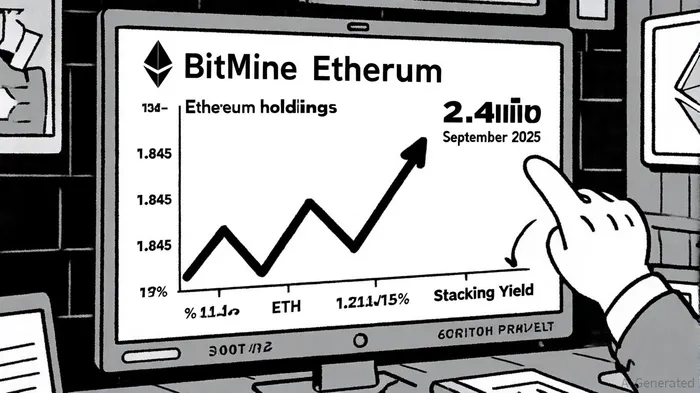
In the post-Ethereum Merge era, the cryptocurrency market has witnessed a paradigm shift in institutional strategies. The transition from proof-of-work (PoW) to proof-of-stake (PoS) has redefined the role of mining firms, with Bitcoin-focused entities like BitMine ImmersionBMNR-- Technologies (BMNR) pivoting to EthereumETH-- exposure as a strategic asset allocation play. BitMine's $11.4 billion in Ethereum and cash holdings—comprising 2.4 million ETHETH-- (2% of total supply) and $345 million in unencumbered cash—has positioned it as the largest public Ethereum holder and a bellwether for institutional adoption[2].
Strategic Asset Allocation in a Post-Merge World
The Ethereum Merge, completed in September 2022, eliminated energy-intensive mining rewards, redirecting capital toward staking and treasury accumulation. BitMine's chairman, Tom Lee, has capitalized on this shift by pursuing the “alchemy of 5%” strategy: acquiring 5% of Ethereum's circulating supply to anchor long-term value. As of September 2025, the firm's Ethereum holdings have grown from 1.845 million ETH in August to 2.4 million ETH, driven by a $365 million stock sale and $913 million in warrants[1]. This aggressive accumulation mirrors MicroStrategy's BitcoinBTC-- playbook, betting on Ethereum's potential to outperform traditional assets in a macroeconomic environment marked by inflation and central bank tightening[3].
BitMine's dual strategy of staking and treasury expansion further enhances its appeal. By staking a portion of its 2.4 million ETH holdings, the firm generates 3-4% annualized yields, while reinvesting mining revenues into additional ETH purchases[1]. This flywheel effect—where staking rewards and operational efficiency fund further accumulation—creates a compounding mechanism that aligns with institutional-grade risk management. According to a report by The Block, BitMine's staking activities alone could bolster Ethereum's network security, reinforcing its PoS model[3].
Institutional Confidence and Market Dynamics
The firm's institutional backing underscores its credibility. Founders Fund, ARK Invest's Cathie Wood, and Pantera Capital have all invested in BitMineBMNR--, signaling confidence in its Ethereum-centric thesis[5]. These investors view Ethereum notNOT-- merely as a speculative asset but as a foundational layer for decentralized finance (DeFi) and AI-driven blockchain applications. As stated by Tom Lee in a Coindesk interview, Ethereum is “at the intersection of Wall Street and AI,” with its smart contract capabilities enabling programmable finance and tokenized assets[1].
BitMine's market influence is already evident. A single acquisition of 276,800 ETH in August 2025 pushed Ethereum's price up by 1.6%, demonstrating the firm's ability to drive liquidity in a fragmented market[2]. However, this power raises concerns about centralization. Critics argue that a single entity controlling 5% of Ethereum's supply could distort governance dynamics or validator consensus, challenging the protocol's decentralized ethos[4]. BitMine counters that its staking activities enhance network security, with 4-5% annualized returns incentivizing long-term commitment[4].
Risks and Rewards
While BitMine's strategy is compelling, it is not without risks. The firm's stock has experienced an 18% decline in a week due to dilution fears from its $1.28 billion funding round and Ethereum's price volatility[1]. Additionally, regulatory scrutiny of corporate crypto holdings—particularly in the U.S.—could introduce compliance costs. Yet, institutional investors remain bullish. A Morningstar analysis notes that BitMine's $11.4 billion in crypto and cash holdings provide a buffer against short-term price swings, making it a “hedge against fiat devaluation”[2].
Long-Term Implications
BitMine's trajectory reflects a broader trend: institutional adoption of Ethereum as a strategic reserve asset. By treating Ethereum as a “digital gold” equivalent to Bitcoin, the firm is reshaping market dynamics. If successful, its 5% target could catalyze a new era of corporate treasury management, where Ethereum's utility in DeFi and tokenized assets drives demand. As Lee predicts, Ethereum's long-term price target of $80,000—while ambitious—could materialize if institutional adoption accelerates[1].
For investors, BitMine's story is a case study in strategic asset allocation. In a post-Merge world, Ethereum's role as a programmable reserve asset is being validated by corporate treasuries and staking yields. BitMine's $11.4 billion bet is not just a play on price appreciation but a wager on Ethereum's evolving infrastructure and its capacity to redefine global finance.





Comentarios
Aún no hay comentarios