
Bitcoin Mining as a Dual-Purpose Energy Solution: A New Frontier for Green Tech and Agricultural Efficiency
The BitcoinBTC-- mining industry, long criticized for its energy consumption, is undergoing a transformative shift. By repurposing the waste heat generated during mining operations, industrial applications are emerging as a dual-purpose energy solution-simultaneously advancing green technology and agricultural efficiency. This analysis evaluates the commercial viability and investment potential of heat recovery systems in Bitcoin mining, drawing on case studies, financial metrics, and market projections from 2025 to 2030.
Technical Feasibility: From Waste Heat to Productive Energy
Bitcoin mining's energy intensity- consuming approximately 211.58 terawatt-hours annually in 2025-has traditionally been viewed as a liability. However, liquid-cooling and immersion cooling technologies are redefining this narrative. Canaan's 3 MW pilot project in Manitoba, Canada, exemplifies this shift. By capturing 90% of server electricity as heat (reaching temperatures above 75°C), the system preheats water for a tomato greenhouse, reducing heating costs by up to 55%. Similarly, Western University's energy model demonstrates that integrating mining heat with greenhouses can optimize climate control, even in cold climates.
Advanced systems, such as those described in an IntechOpen study, leverage liquid-cooling to achieve higher-grade energy inputs, redefining efficiency metrics like Power Usage Effectiveness (PUE) and enabling heat reuse in district heating systems. 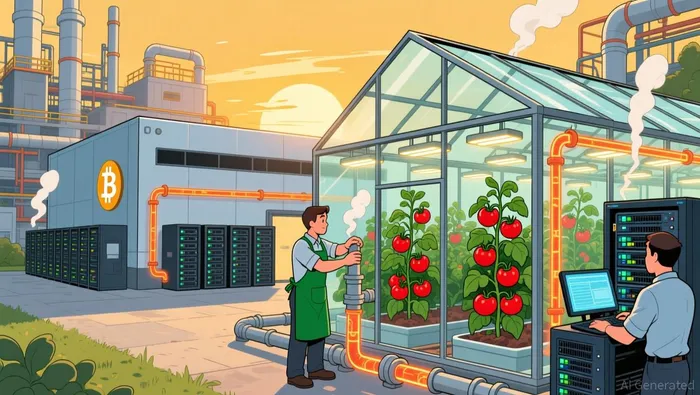 Meanwhile, model predictive control (MPC) strategies, researchers, further enhance agricultural productivity by dynamically regulating greenhouse conditions. These innovations position Bitcoin mining as a scalable solution for decarbonizing agriculture while addressing energy waste.
Financial Viability: ROI and Payback Periods
The economic case for heat recovery systems hinges on reducing operational costs and generating secondary revenue streams. In 2025, Bitcoin mining remains profitable for industrial operations using modern hardware and electricity rates below $0.06/kWh. However, payback periods for mining rigs have extended beyond 1,000 days due to rising network difficulty and hardware costs. Heat recovery systems mitigate this by repurposing thermal energy.
For instance, residential and commercial applications like Softwarm's Idaho project and Wisemining's immersion cooling systems demonstrate cost reductions of 35-55% in heating expenses. Greenhouse operations, in particular, show strong economics: a 10-rig setup can generate $12,000–$28,000 annually, with payback periods as short as 18 months. These figures are bolstered by the industry's shift toward renewable energy, with 52.4% of mining electricity now sourced from non-fossil fuels. Hybrid systems combining solar, wind, and mining operations further enhance ROI, as seen in a 3.5-year payback model for solar-powered mining.
Market Growth and Projections
The market for heat recovery systems in Bitcoin mining is poised for exponential growth. By 2028, residential mining-heat installations are projected to reach 45,000–65,000 units, assuming Bitcoin prices remain between $35,000–$65,000. Commercial applications, particularly in agriculture, are expected to drive even stronger adoption. The "heatpunk" initiative, which aims to convert mining heat into usable energy for homes and businesses, could double the network's computational power if 1% of global heating energy is repurposed.
Technological advancements in ASIC hardware-now achieving efficiencies below 30 J/TH- alongside innovations in immersion cooling, are accelerating integration into energy infrastructures. Policy developments, including the BITCOIN Act of 2025 and federal Strategic Bitcoin Reserves, further underscore the industry's growing legitimacy.
Challenges and Considerations
Despite these opportunities, challenges persist. Skeptics like academic Derek Mohr argue that small-scale mining for home heating is inefficient, citing the specialized hardware required for profitability. Additionally, payback periods for industrial systems remain unquantified in many cases, necessitating further real-world testing. However, the economic advantages of large-scale operations-such as Canaan's greenhouse project-suggest that institutional players will lead adoption.
Conclusion: A Dual-Purpose Investment Opportunity
Bitcoin mining's transformation into a dual-purpose energy solution represents a compelling investment opportunity. By repurposing waste heat, the industry not only reduces its environmental footprint but also creates value for agriculture, residential heating, and district energy systems. With market growth projections indicating a 350% increase in residential installations by 2028 and strong ROI in commercial applications, heat recovery systems are redefining Bitcoin's role in the energy transition. For investors, the key lies in supporting projects that combine cutting-edge cooling technologies, renewable energy integration, and scalable industrial applications.







Comentarios
Aún no hay comentarios