
Bitcoin Mining in 2025: Strategic Reallocation Opportunities for Institutional Investors
The BitcoinBTC-- mining landscape in 2025 is undergoing a seismic shift, driven by the compounding effects of the 2024 halving, hardware innovation, and institutional capital inflows. For institutional investors seeking strategic reallocation opportunities, the sector now presents a unique intersection of technological discipline, energy arbitrage, and macroeconomic positioning.
Post-Halving Profitability: Efficiency as the New Currency
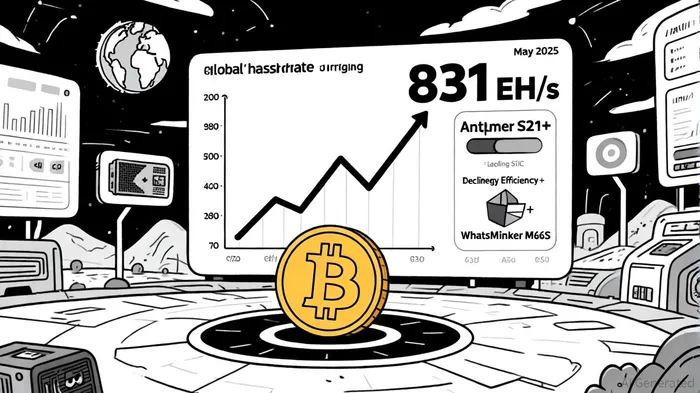
The 2024 halving reduced block rewards by 50%, forcing miners to prioritize operational efficiency to maintain margins. According to a report by Coin Telegraph, the global hashrate surged to 831 EH/s by May 2025, reflecting a race among larger firms to absorb costs through scale and technological upgrades [1]. This has accelerated the adoption of next-generation ASICs, such as Bitmain's Antminer S21+ and MicroBT's WhatsMiner M66S+, which deliver energy efficiencies as low as 16.5–17 joules per terahash [1]. However, profitability remains inextricably tied to energy costs. Miners in regions like Oman and the UAE, where subsidized electricity rates range from $0.035–$0.07 per kWh, now hold a significant edge over U.S. operations, where industrial power often exceeds $0.10 per kWh [3]. This geographic arbitrage is reshaping capital deployment strategies, with mining firms increasingly prioritizing low-cost energy corridors over traditional hubs.
Institutional Inflows: Beyond the ASIC Arms Race
Bitcoin mining's appeal to institutional investors extends beyond its role in Bitcoin's security layer. As highlighted in a Crypto News analysis, the sector's programmable load capabilities—its ability to dynamically consume surplus energy—position it as a strategic asset in energy infrastructure [2]. For example, mining operations can stabilize grids by absorbing excess renewable energy during off-peak hours, transforming what would otherwise be curtailed power into revenue. This dual utility—digital asset generation and energy optimization—has attracted capital from energy firms, infrastructure funds, and even AI-driven tech conglomerates.
Moreover, the sector's diversification into high-performance computing (HPC) and AI workloads is creating new revenue streams. Firms like Bitmain and MicroBT are repurposing their hardware to compete in the $50 billion HPC market, offering institutional investors a hedge against Bitcoin price volatility [2]. This convergence of industries underscores mining's evolution from a speculative niche to a disciplined, multi-utility asset class.
Strategic Reallocation: Key Considerations for Institutional Investors
For investors evaluating reallocation into Bitcoin mining, three factors dominate the calculus:
1. Energy Infrastructure Access: Projects with long-term contracts for low-cost, renewable energy (e.g., hydroelectric in Scandinavia, solar in the Middle East) offer the most defensible margins.
2. Hardware Flexibility: Firms deploying modular ASICs or dual-use hardware (e.g., for AI/HPC) can pivot revenue models in response to market shifts.
3. Geopolitical Resilience: Regulatory clarity and grid stability are critical. Jurisdictions like Canada and Kazakhstan, with favorable policies and underutilized energy assets, are emerging as top destinations [3].
A data query for a visualization might look like this:
Risks and Mitigations
While the sector's fundamentals are compelling, risks persist. Regulatory uncertainty in key markets and Bitcoin's price volatility remain headwinds. However, institutional-grade operators with diversified revenue streams (e.g., energy arbitrage, HPC contracts) are better positioned to weather these challenges. For example, firms leveraging Bitcoin mining as a “loss leader” to secure grid access or industrial partnerships can decouple profitability from Bitcoin's price action [2].
Conclusion
Bitcoin mining in 2025 is no longer a speculative bet but a strategic asset class demanding rigorous analysis. For institutional investors, the sector offers a rare combination of technological innovation, energy infrastructure leverage, and macroeconomic positioning. As the industry consolidates and efficiency becomes the primary differentiator, early movers with access to low-cost energy and diversified hardware capabilities will define the next phase of growth.






Comentarios
Aún no hay comentarios