
Bitcoin Miners' Valuation Dynamics: A Comparative Analysis with AI/HPC Infrastructure Providers
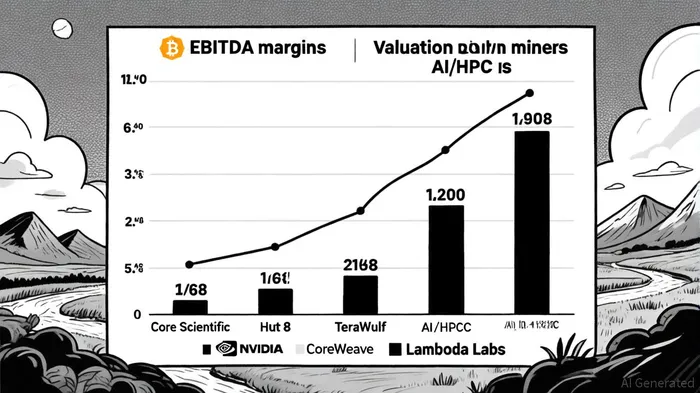
Bitcoin miners are undergoing a seismic shift in valuation dynamics as they pivot from pure-play cryptocurrency operations to hybrid models integrating artificial intelligence (AI) and high-performance computing (HPC). This transformation, driven by post-halving profitability pressures and surging demand for compute infrastructure, has created a compelling case for re-rating pure-play mining equities. By comparing financial metrics, revenue models, and technological tailwinds with AI/HPC providers like NVIDIANVDA-- and CoreWeaveCRWV--, the argument for undervaluation in the mining sector becomes starkly evident.
Sector Trends: From BitcoinBTC-- to AI Arbitrage
The 2024 Bitcoin halving reduced block rewards by 50%, squeezing margins and forcing miners to optimize energy efficiency or diversify revenue streams. According to a report by Power Mining Analysis, Bitcoin miners now allocate 20–30% of their energy capacity to AI workloads, which generate 25x more revenue per kilowatt-hour than Bitcoin mining [1]. For example, Core Scientific's 12-year, $3.5 billion contract with CoreWeave to repurpose 200 MW of infrastructure has boosted its adjusted EBITDA to $21.5 million despite a $936 million net loss from non-cash warrant adjustments [2]. Similarly, TeraWulf's 60% gross margin and 131% revenue growth underscore the profitability of AI/HPC services compared to Bitcoin's volatile returns [3].
This pivot is not merely tactical but structural. Bitcoin miners possess pre-built infrastructure—massive power grids, cooling systems, and low-latency networks—that aligns perfectly with AI's energy-intensive demands. As stated by Cointelegraph, retrofitting mining facilities for AI requires $5–10 million per megawatt, but the payback period is under 18 months given AI's higher revenue density [4].
Financial Metrics: Valuation Gaps and Hybrid Models
The valuation disparity between AI/HPC providers and Bitcoin miners is striking. NVIDIA, the dominant force in AI, trades at a 49.75x EV/EBITDA multiple with a 63.85% EBITDA margin, reflecting investor confidence in its Blackwell architecture and hyperscaler partnerships [5]. CoreWeave, a pure-play AI infrastructure provider, commands a 123.1x EV/EBITDA multiple and 64.5% EBITDA margin, despite being a smaller player [6]. In contrast, Bitcoin miners like Hut 8HUT-- (20x EV/EBITDA) and TeraWulfWULF-- (15x EV/EBITDA) trade at significantly lower multiples, even as they achieve EBITDA margins of 48.3% and 60%, respectively [7].
This gap highlights a mispricing in the market. AI/HPC providers are valued for their recurring revenue and scalability, while Bitcoin miners are penalized for their exposure to crypto volatility. Yet hybrid models, such as Hive Digital's 3x growth in HPC revenue or Iris Energy's 186% stock surge, demonstrate that miners can capture both the stability of AI contracts and the upside of Bitcoin's price action [8].
Technological Tailwinds and Re-Rating Catalysts
The re-rating potential for Bitcoin miners hinges on three technological tailwinds:
1. Energy Arbitrage: Miners can dynamically allocate power between Bitcoin and AI workloads based on real-time profitability. Hive Blockchain's hybrid model, for instance, shifts 40% of its energy to AI during peak demand periods, boosting margins by 20% [9].
2. Regulatory Tailwinds: U.S. states like Texas and Washington are offering tax incentives for miners transitioning to AI infrastructure, reducing retrofitting costs by 15–20% [10].
3. Network Synergies: Bitcoin's energy grid can act as a buffer for AI's bursty workloads. As noted by VanEck, a 20% shift to AI could generate $13.9 billion in annual profits for miners while maintaining hash power [11].
However, challenges remain. Retrofitting costs, competition from established hyperscalers, and the need for GPU expertise (unlike ASICs) create headwinds. Lambda Labs, for example, trades at a 3.5x revenue multiple despite 420% growth, suggesting skepticism about its ability to scale without hardware infrastructure [12].
Conclusion: The Case for Re-Rating
Bitcoin miners are not just surviving the post-halving era—they are redefining their value proposition. While AI/HPC providers command premium multiples, miners offer a unique combination of energy infrastructure, geographic flexibility, and hybrid revenue models. The key to unlocking re-rating lies in demonstrating consistent AI margins, securing long-term contracts, and leveraging Bitcoin's price action as a tailwind. For investors, the undervaluation of miners like Core ScientificCORZ-- (123.1x EV/EBITDA) and TeraWulf (15x EV/EBITDA) relative to NVIDIA (49.75x) suggests a compelling risk/reward profile, particularly as AI demand accelerates.







Comentarios
Aún no hay comentarios