
Bitcoin Miners' Strategic AI Pivot: A High-Conviction Play in a Crypto Winter
The crypto winter of 2025 has forced BitcoinBTC-- miners to confront a harsh reality: the economics of pure-play mining are no longer sustainable. With break-even prices for Bitcoin mining now hovering above $90,000 per coin according to Bloomberg, and the post-halving bear market squeezing margins, a seismic shift is underway. Miners are repurposing their energy-intensive infrastructure into AI data centers, leveraging their existing power grids, 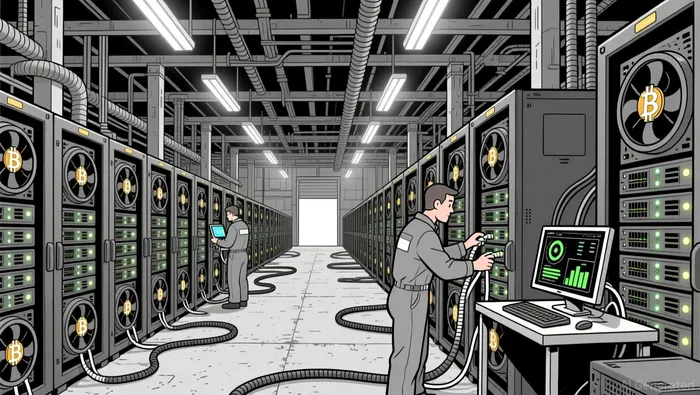 cooling systems, and land holdings to meet the insatiable demand for high-performance computing (HPC). This pivot isn't just a survival tactic-it's a strategic repositioning into a global AI infrastructure market valued at $1.3 trillion. For investors, the question isn't whether this transition will succeed, but which undervalued firms are best positioned to capitalize on it.
The Strategic Rationale: Why AI Hosting Outperforms Bitcoin Mining
Bitcoin mining's volatility is legendary, but AI hosting offers a stark contrast. According to Bloomberg, AI data centers generate margins up to 50% higher than traditional mining operations. This is because AI workloads, particularly those for large language models and machine learning, require sustained, high-density computing power-exactly what Bitcoin miners have already invested in. CleanSparkCLSK--, for instance, secured a 100-megawatt AI data center in Wyoming over Microsoft due to its ability to deploy infrastructure rapidly, leveraging its existing power infrastructure and flexibility in energy management.
The economics are compelling. Miners with active AI contracts now trade at $6 million per megawatt of capacity, compared to $3 million for pure-play miners. IREN's $9.7 billion, five-year contract with Microsoft alone led to a 135% re-rating in its market value. These figures underscore a critical insight: the value of Bitcoin miners' infrastructure is no longer tied to Bitcoin's price but to their ability to monetize energy assets in the AI era.
Undervalued Firms: CleanSpark and IREN as Case Studies
While the sector is crowded, two firms stand out for their financial discipline and strategic execution: CleanSpark and IREN.
CleanSpark (CLSK) has emerged as a poster child for the AI pivot. With a P/E ratio of 13 according to Yahoo Finance, it trades at a discount to peers like TerraWulf (P/E of 25) and Core Scientific (P/E of 18). CleanSpark's balance sheet is also a strength: its debt-to-equity ratio of 0.29 is among the healthiest in the sector, allowing it to fund AI expansions without overleveraging. The company has secured 285 megawatts of long-term power supply agreements and is acquiring land in Texas for an AI data center. Analysts project its AI contracts could generate $9.3 billion in revenue by late 2026, yet its market cap remains below $3 billion-a clear mispricing.
IREN (IREN), meanwhile, has leveraged its AI pivot to achieve a 393% year-to-date share price surge. Its $9.7 billion Microsoft deal is a testament to its ability to secure long-term, high-margin contracts. While IREN's debt-to-equity ratio is higher (1.2), its revenue from AI hosting is expected to grow from 3% of total revenue in Q3 2025 to over 40% by 2027 according to Bloomberg. The company's existing infrastructure-spanning 1.2 gigawatts of power capacity-positions it to scale rapidly without the capital expenditures required by traditional data center builders.
Risks and Mitigants: Debt, Execution, and Market Dynamics
No investment is without risk. The AI pivot has been funded by a surge in debt, with Bitcoin miners raising over $12.7 billion in total debt from Q2 2024 to Q2 2025. TerraWulf's $3.2 billion private placement, for example, carries a 7.75% coupon, translating to $250 million in annual interest expenses-far exceeding its 2024 revenue of $140 million according to Yahoo Finance. This highlights the sector's vulnerability to rising interest rates and execution risks.
However, the market appears to reward miners that balance debt with disciplined execution. CleanSpark's conservative leverage and IREN's focus on contracted revenue mitigate these risks. Additionally, the dual-use nature of mining infrastructure-switching between Bitcoin and AI workloads-creates a natural hedge. As noted by CNBC, miners can curtail energy use during peak demand and redirect power to the grid, a capability AI data centers lack. This flexibility enhances their value proposition to hyperscalers like Microsoft and Amazon.
Conclusion: A High-Conviction Play for the Long Term
The Bitcoin miners' AI pivot is not a temporary fix but a strategic repositioning into a secular growth industry. For investors, the key is to identify firms that combine strong balance sheets, contracted revenue, and executional discipline. CleanSpark and IREN exemplify this model, trading at significant discounts to their intrinsic value while securing multi-billion-dollar AI contracts.
As the CoinShares Bitcoin Mining ETF has surged 160% year-to-date, it's clear that the market is beginning to recognize the long-term value of these infrastructure plays. For those with a high-conviction, long-term mindset, the AI pivot offers a rare opportunity to invest in the next phase of the digital revolution-without relying on Bitcoin's price action.





Comentarios
Aún no hay comentarios