
Bitcoin Miners' Shift to AI Infrastructure and Its Implications for BTC
The BitcoinBTC-- mining industry is undergoing a seismic transformation as miners pivot toward artificial intelligence (AI) infrastructure, driven by deteriorating profitability in crypto mining and surging demand for high-performance computing (HPC). This shift, while unlocking new revenue streams and operational leverage for mining firms, raises critical questions about Bitcoin's network security, decentralization, and the investment thesis for mining stocks versus direct BTC exposure.
The AI Transition: A Strategic Pivot for Mining Firms
Bitcoin miners are leveraging their existing infrastructure-cheap power, cooling systems, and data-center expertise-to enter the AI/HPC market, where margins are significantly higher. CoreWeaveCRWV--, a former EthereumETH-- miner, has emerged as a leader in this space, operating GPU supercomputers with liquid cooling and achieving over 50% Model FLOPS Utilization on Hopper-class GPUs. 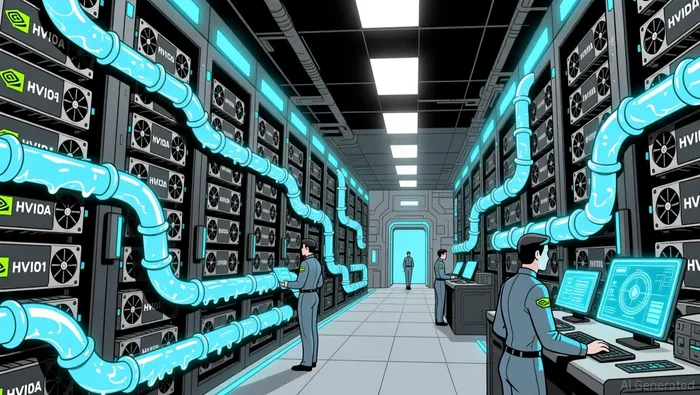 . The company's Q3 2025 results underscore its success: $1.36 billion in revenue, $51.9 million in operating income, and a $55.6 billion revenue backlog. CoreWeave's $6.3 billion NVIDIA collaboration and $4.35 billion in debt financing highlight the scale of capital deployment in this sector.
Similarly, BitdeerBTDR-- is expanding AI capacity beyond 200 MW by 2026, leveraging renewable energy partnerships in Bhutan. This dual-use model-switching between Bitcoin mining and AI workloads-provides operational flexibility, reducing exposure to Bitcoin's price volatility. For mining firms, AI infrastructure offers a path to diversification, with GPU workloads generating 2–5 times more revenue per kilowatt-hour compared to Bitcoin mining.
Investment Thesis: Mining Stocks vs. BTC Exposure
Bitcoin mining stocks have outperformed direct BTC exposure in 2025, driven by operational leverage and strategic AI diversification. Riot Platforms (RIOT) surged 231%, HiveHIVE-- Digital (HIVE) soared 369%, and Marathon Digital (MARA) rose 61% over six months, far outpacing Bitcoin's 38% gain. This outperformance reflects the sector's ability to monetize fixed infrastructure and low-cost energy, amplifying returns during Bitcoin price rallies. The sector's ability to monetize fixed infrastructure and low-cost energy amplifies returns during Bitcoin price rallies.
However, mining stocks carry higher risks. Energy costs, regulatory shifts, and capital expenditures for AI/HPC transitions expose these firms to operational volatility. For instance, retrofitting facilities for water cooling and urban proximity demands significant investment. In contrast, direct BTC exposure offers simplicity and a hedge against macroeconomic uncertainty, though it lacks the diversification and leverage inherent in mining equities.
Institutional adoption of Bitcoin as a strategic asset has also reshaped the landscape. Over 290 companies now hold $163 billion in BTC, with spot ETFs driving $1 billion in flows into mining equities by late 2025. This trend suggests a maturing market where Bitcoin is increasingly viewed as a store of value, while mining stocks are valued for their infrastructure adaptability.
Network Security Risks: Centralization and Resilience
The migration of miners to AI infrastructure poses structural risks to Bitcoin's network security. As hashprice (revenue per petahash) plummeted to $34.49 in November 2025, many miners redirected computing power to AI, reducing Bitcoin's hashrate growth. While the network's hashrate hit 1,041 EH/s in May 2025, top 10 mining pools now control 85% of hashpower, raising centralization concerns. If large-scale miners continue exiting Bitcoin, the network could face slower difficulty adjustments and increased vulnerability to hostile actors.
Yet, Bitcoin's resilience persists. Post-halving consolidation has strengthened the dominance of efficient, large-scale operations, with institutional entities controlling 13.4% of Bitcoin supply. The network's security remains robust, with a hashrate of 1 ZH/s, making 51% attacks economically infeasible. However, the long-term decentralization of mining could erode if AI migration accelerates.
Conclusion: Balancing Opportunity and Risk
The shift to AI infrastructure presents a dual-edged sword for Bitcoin. For mining firms, it unlocks higher-margin revenue and operational resilience, but for the network, it introduces centralization risks. Investors must weigh the outperformance of mining stocks-driven by AI diversification and operational leverage-against the inherent volatility of these firms. Direct BTC exposure, while simpler, lacks the strategic upside of mining equities but offers a clearer hedge against macroeconomic shocks.
As the industry evolves, the key will be monitoring how miners balance Bitcoin's security needs with AI's profitability. Those that successfully navigate this transition-without compromising network decentralization-may redefine the value proposition of mining stocks in the years ahead.





Comentarios
Aún no hay comentarios