
Bitcoin Miners as Key Drivers of Corporate Adoption in a Cooling Market
The BitcoinBTC-- market in late 2025 is undergoing a structural recalibration. As corporate treasuries retreat from aggressive accumulation, Bitcoin miners are emerging as the most consistent and cost-efficient accumulators of the asset. With 65% of public companies holding Bitcoin at prices below their cost basis and institutional buying slowing to its lowest levels since Q3 2024, the role of miners as long-term holders and strategic suppliers has become critical. This shift is not merely a function of market conditions but a reflection of miners' unique operational advantages and their growing alignment with institutional demand.
The Miner-Corporate Dynamic: A New Equilibrium
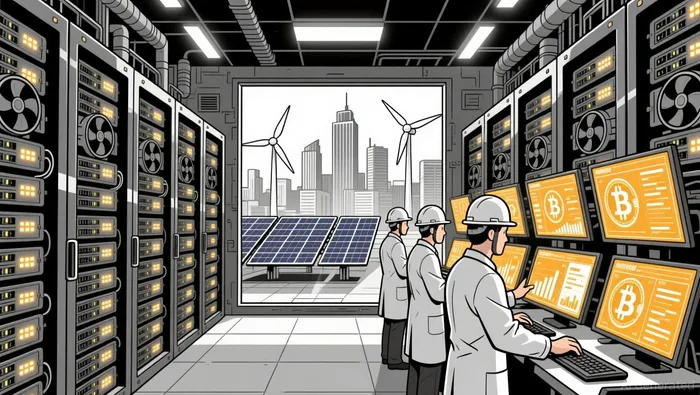
Bitcoin miners are uniquely positioned to acquire Bitcoin at a discount to spot prices through block production. Unlike corporations that purchase BTCBTC-- on the open market, miners generate the asset via energy-efficient operations, often leveraging stranded or renewable energy sources. This cost advantage allows them to maintain Bitcoin on their balance sheets without the same liquidity pressures faced by corporate buyers. For instance, Strategy and Strive, two of the largest institutional accumulators in November 2025, added 9,062 BTC collectively, while mining firms like CangoCANG-- and American BitcoinABTC-- contributed 508 and 139 BTC, respectively, from their production streams.
The structural imbalance between institutional demand and mining supply is stark. Over 290 public companies now hold $163 billion in Bitcoin, yet mining output during the same period has only added ~5% of the total circulating supply according to data. This gap is being filled by miners who, despite rising operational costs and the 2024 halving, continue to produce Bitcoin at an effective discount. For example, MARA HoldingsMARA-- and Riot PlatformsRIOT-- have maintained aggressive accumulation strategies, with the latter adding 9,062 BTC in November alone. These miners are not just surviving the market downturn-they are capitalizing on it.
Regulatory developments, such as the GENIUS Act, have further solidified Bitcoin's institutional legitimacy. This framework has reduced legal uncertainties, encouraging firms to treat Bitcoin as a blue-chip asset rather than a speculative play. As a result, 94% of institutional investors now express belief in blockchain technology, and 86% are either exposed to digital assets or planning allocations in 2025. Miners, with their stable production models and lower acquisition costs, are uniquely positioned to supply this growing demand.
The inverse correlation between Bitcoin and the U.S. dollar, coupled with its concurrent movement with gold, has also reinforced its role as a liquidity signal. In a cooling market, where corporate treasuries are retrenching, miners' ability to provide Bitcoin at a discount becomes a stabilizing force. For example, Bitcoin miners accounted for 12% of total public company Bitcoin holdings by mid-2025 according to reports, a figure that is likely to rise as institutional buyers prioritize cost efficiency over speculative timing.
Strategic Partnerships and Diversification
Miners are also diversifying their revenue streams to sustain profitability during the current crypto winter. Companies like Iris Energy and Cipher MiningCIFR-- have secured AI infrastructure contracts with tech giants such as Microsoft and Amazon, leveraging their existing power infrastructure to pivot into high-performance computing (HPC) hosting. This dual-use model not only stabilizes cash flows but also positions miners as enablers of the AI revolution, a sector projected to grow at 33% annually through 2030.
In Europe, miners are integrating with renewable energy grids, using surplus power to mine Bitcoin and contribute to district heating solutions according to analysis. These projects highlight the adaptability of mining operations in a post-halving environment, where energy efficiency and grid flexibility are paramount. For instance, Texas-based miners participating in ERCOT demand-response programs have generated millions in curtailment credits by reducing energy consumption during peak demand. Such innovations underscore the broader economic value of mining infrastructure beyond Bitcoin production.
Implications for Investors
The current market environment presents a unique opportunity for investors to assess miners as both asset accumulators and infrastructure providers. While Bitcoin's price has dipped below $90,000, miners like Hut 8 and Hive Digital Technologies are repurposing their operations to include AI data centers and cloud computing services. This pivot reflects a strategic shift from mining-centric models to diversified, power-asset-driven enterprises.
For corporate treasuries, the discounted supply from miners offers a cost-effective alternative to open-market purchases. As institutional demand outpaces mining production by a factor of ~6.7x according to data, miners with access to low-cost energy and next-generation hardware will likely dominate the supply chain. This dynamic is already evident in the performance of mining stocks, with Riot Platforms and Hive Digital seeing gains of 231% and 369%, respectively, over six months according to market analysis.
Conclusion
Bitcoin miners are no longer just operators in the background of the crypto ecosystem. They are now central to the institutional adoption narrative, acting as both stabilizers and suppliers in a cooling market. As corporate treasuries adopt a slower, more selective accumulation cadence, miners' ability to produce Bitcoin at a discount and diversify into adjacent markets will define their long-term value. For investors, the key takeaway is clear: miners are not just surviving the downturn-they are building the infrastructure for the next phase of Bitcoin's institutionalization.





Comentarios
Aún no hay comentarios