
Bitcoin Miners and Institutional Adoption: Strategic Positioning in a Post-Halving Market
Debt-Fueled Transformation: From Bitcoin to AI
Bitcoin miners have raised over $12.7 billion in debt and convertible notes since late 2023, a 500% surge from just $2.1 billion in 2023, according to a Coincodex article. This capital influx has enabled firms like TerraWulf and BitfarmsBITF-- to pivot into AI and HPC, sectors that offer stable, long-term contracts compared to Bitcoin's price volatility. For instance, TerraWulf's $3.2 billion private placement, featuring a 7.75% coupon, translates to an annual interest expense of $250 million-nearly double the company's 2024 revenue, according to a Coindesk report. While this debt-driven expansion has attracted a new investor base, it also raises concerns about solvency, particularly if energy costs or Bitcoin prices fluctuate sharply.
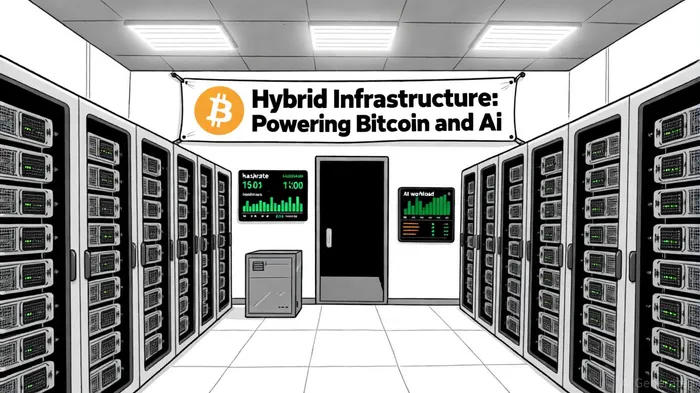
The dual-use of mining infrastructure-switching between Bitcoin mining and AI workloads-has emerged as a key resilience strategy. Analysts argue this approach does not compromise network security but instead leverages existing power and cooling infrastructure to maximize asset utilization, according to a Coinpaper piece. The CoinShares Bitcoin Mining ETF (WGMI), a proxy for the sector, has surged 160% year-to-date, reflecting investor optimism about this transition, as noted in the Coindesk report.
Institutional Adoption: From Skepticism to Strategic Alignment
The post-halving era has also accelerated institutional adoption of Bitcoin miners, driven by the approval of U.S. spot Bitcoin ETFs and the halving's impact on Bitcoin's supply dynamics. By early September 2025, these ETFs managed nearly $219 billion in assets, with BlackRock's iShares Bitcoin Trust and Fidelity's Wise Origin Bitcoin Trust leading the charge, according to a Financial Content article. This influx of capital not only bolstered Bitcoin's price-surpassing $124,000 in August 2025-but also reduced its volatility, positioning it as a strategic macro-asset, as the Financial Content article noted.
Institutional partnerships have further solidified this trend. U.S. Bank, for example, resumed Bitcoin custody services in 2025, partnering with NYDIG to offer secure solutions for institutional investors, per a U.S. Bank press release. Similarly, Coinbase Institutional expanded its custody capabilities to include BNBBNB-- and other tokens, while Swiss bank Sygnum launched a Bitcoin loan platform with multi-signature escrow wallets, as reported in a Coinbase Prime announcement and a Coinfomania report. These developments signal a maturing ecosystem where traditional financial institutions are integrating crypto infrastructure into their offerings.
Strategic Infrastructure and Regional Shifts
Direct institutional investments in mining infrastructure have reshaped the industry's geography, with operations increasingly concentrated in regions offering energy costs below $0.04/kWh. The Middle East, parts of Latin America, and certain Asian economies have become hubs for energy-efficient mining, driven by tax incentives and strategic energy agreements, according to a GlobeNewswire release. This centralization has pushed smaller, independent miners to the sidelines, accelerating consolidation.
Advanced mining facilities are also evolving into hybrid infrastructure providers, leveraging their power and cooling capabilities for AI and cloud computing. The deployment of Q4 2024's next-generation ASICs-offering higher efficiency thresholds-has further enabled this diversification, though payback periods remain sensitive to electricity price fluctuations, as the GlobeNewswire release noted.
Risks and Opportunities for Investors
While the pivot to AI and institutional adoption presents compelling opportunities, investors must weigh the risks. The sector's reliance on debt-now totaling $12.7 billion-exposes miners to interest rate volatility and liquidity crunches. For example, TerraWulf's interest expenses alone exceed its 2024 revenue, highlighting the precarious balance between growth and solvency, as the Coindesk report observed. Additionally, regulatory scrutiny of crypto operations and energy consumption remains a wildcard.
However, the long-term potential is undeniable. If Bitcoin breaches $90,000-a level analysts suggest could retest its all-time high-institutional demand and ETF inflows may further accelerate the market cycle, according to a Cointelegraph piece. For investors, the key lies in identifying miners with robust energy strategies, diversified revenue streams, and strong institutional partnerships.
Conclusion
Bitcoin miners are navigating a post-halving landscape defined by financial innovation, technological adaptation, and institutional alignment. While the road ahead is fraught with risks, the sector's strategic pivot to AI and HPC, coupled with the growing influence of institutional capital, positions it as a critical player in the evolving digital economy. For investors, the challenge is to balance the promise of high-growth opportunities with the realities of a debt-laden and volatile market.





Comentarios
Aún no hay comentarios