
Bitcoin Miners' Exodus: A Market Correction or a Buying Opportunity?
The BitcoinBTC-- mining industry is undergoing a seismic shift in 2025, driven by the aftermath of the 2024 halving and the relentless pursuit of efficiency. As block rewards halved from 6.25 BTC to 3.125 BTC, miners faced a stark reality: survival hinges on energy optimization, hardware upgrades, and geographic relocation. This exodus of capital and operations has sparked debate—is this a market correction signaling overcorrection, or a buying opportunity for those who understand the long-term dynamics of network resilience?
![]https://cdn.ainvest.com/aigc/hxcmp/images/compress-qwen_generated_1760734241893.jpg.png
Capital Reallocation: From Costly Hubs to Energy-Optimized Frontiers
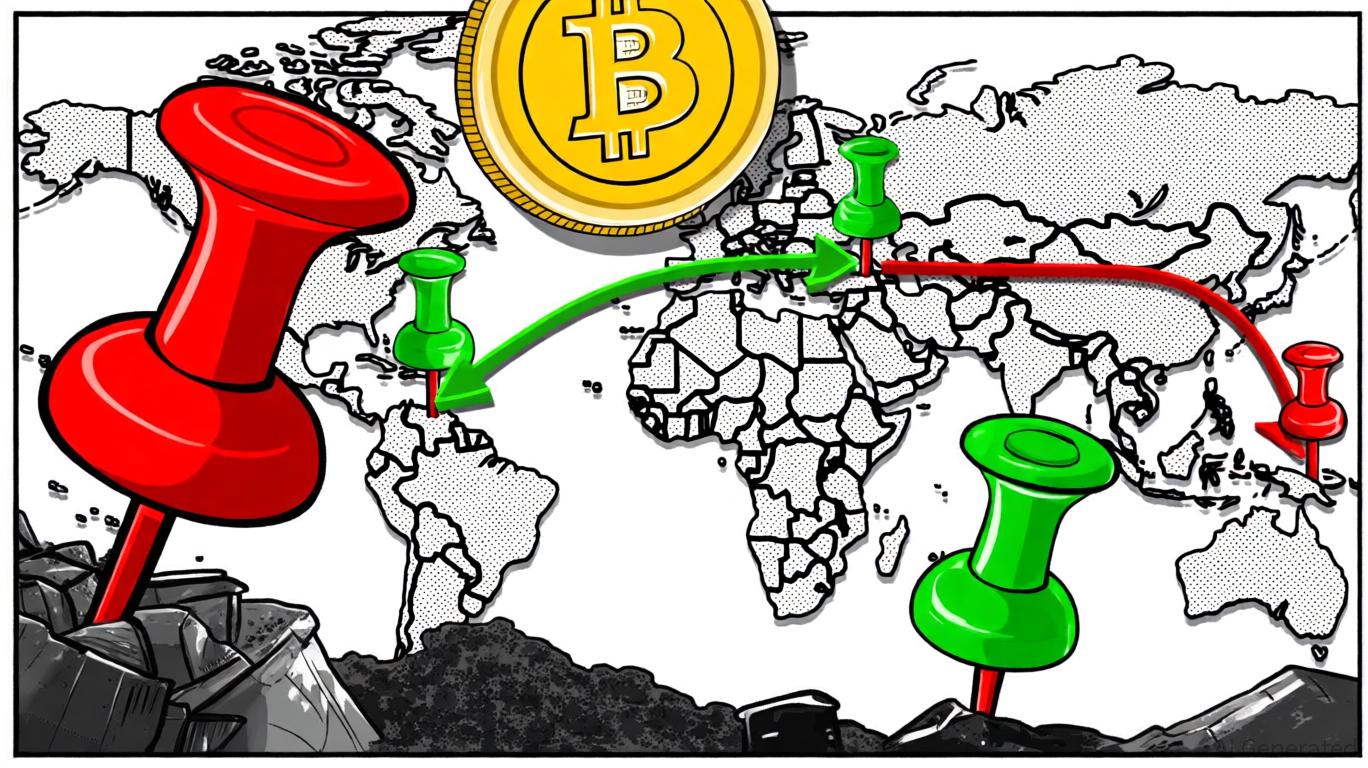
The most immediate consequence of the halving is the massive reallocation of capital toward low-cost energy regions. By May 2025, the network hashrate surged to 831 EH/s, a 77% increase from the 2024 low of 519 EH/s, as miners migrated to locales like Oman and the UAE, where electricity costs range from $0.035 to $0.07 per kWh, according to a Cointelegraph analysis. This shift is not merely operational but strategic: institutional-scale mining is now expanding into Africa, the Middle East, and Central Asia, where renewable energy and geopolitical stability create a fertile ground for capital deployment, as shown in a BitcoinsGuide analysis.
The U.S. ETF boom has further accelerated this reallocation. In the first 48 hours of U.S. Bitcoin ETF trading, over $1 billion in Bitcoin flowed from miner wallets to exchanges, marking a six-year high in miner outflows, a trend Cointelegraph reported. This liquidity demand reflects miners' need to cover operational costs amid shrinking margins. Meanwhile, non-U.S. investors are increasingly viewing Bitcoin as a "supra-sovereign" reserve asset, driving capital inflows from Asia, the Middle East, and Latin America, as noted by Cointelegraph.
Network Resilience: Efficiency, AI, and the Race for Profitability
Despite these challenges, Bitcoin's network resilience has been reaffirmed. The post-halving era has seen a paradigm shift in mining efficiency, with next-gen ASICs like Bitmain's Antminer S21+ and MicroBT's WhatsMiner M66S+ achieving 216 TH/s and 17 J/TH efficiency, respectively, per Cointelegraph research. Larger firms are also leveraging AI for predictive maintenance, dynamic energy arbitrage, and custom firmware tuning, giving them a 20–30% edge over less-optimized competitors, according to a Coin Metrics analysis.
Transaction fees, though still low (1.33% of miner revenue in Q1 2025), have seen a temporary boost from the Runes protocol launch, which generated 518,000 OP_RETURN transactions in its first day, based on a Crypto-Economy analysis. This underscores the potential for Layer-2 solutions to diversify miner revenue streams. However, the industry's reliance on Bitmain-manufactured ASICs (59%–76% of the hashrate) raises supply chain risks, particularly amid geopolitical tensions affecting shipments, as noted in a CryptoNews report.
Market Correction or Buying Opportunity?
The exodus of miners from high-cost regions like the U.S. to energy-optimized hubs is often framed as a "correction." Critics argue that the 31% post-halving price increase (compared to the 436% surge in 2017) signals underperformance. Yet this perspective overlooks the structural changes reshaping the industry.
1. Consolidation and Efficiency: Smaller, inefficient operations have shut down, while larger firms integrate AI and renewable energy. This consolidation is not a collapse but a natural evolution toward a more capital-efficient industry.
2. Geographic Diversification: The shift to regions like the UAE and Africa reduces exposure to U.S. regulatory and energy volatility, enhancing long-term stability.
3. Institutional Adoption: Bitcoin ETF inflows and sovereign demand are creating a new equilibrium, where mining profitability is decoupled from speculative price swings.
For investors, the exodus represents a buying opportunity for those who can navigate the risks. The network's resilience—evidenced by its ability to maintain a 123T difficulty level and 831 EH/s hashrate—suggests that Bitcoin's security model remains robust. Meanwhile, the impending October 2025 market peak, driven by Fed rate cuts and ETF inflows, could unlock further value for well-positioned miners, according to a TronWeekly analysis.
Conclusion: A New Equilibrium
The Bitcoin mining exodus is neither a correction nor a bubble—it is a reconfiguration of capital toward efficiency and resilience. While short-term volatility and outflows persist, the industry's adaptation to post-halving realities suggests a maturing market. For investors, the key lies in distinguishing between transient noise and structural tailwinds. Those who bet on miners with access to low-cost energy, AI-driven operations, and diversified revenue streams may find themselves positioned for the next phase of Bitcoin's growth.






Comentarios
Aún no hay comentarios