
Bitcoin Miners' Capitulation as a Contrarian Bullish Signal for 2026
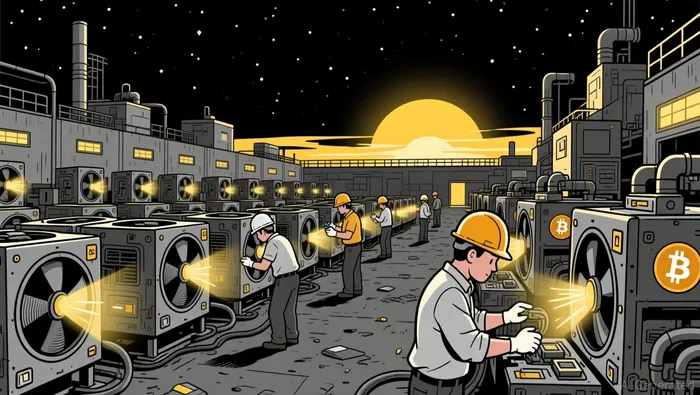
The BitcoinBTC-- mining industry in late 2025 is in the throes of a painful correction. Hash rates have declined to 1,045 EH/s in December from a peak of 1,160 EH/s in October, driven by a 30% drop in Bitcoin's price to $86,000 and rising energy costs. JPMorgan reports that mining profitability fell for the fourth consecutive month in November, with daily block reward gross profit declining 26%. This environment has forced miners to curtail operations, pivot to alternative revenue streams, or face insolvency. Yet, for contrarian investors, this capitulation may signal a critical inflection point: a buying opportunity for Bitcoin as institutional demand surges and network fundamentals begin to reposition for a 2026 rebound.
The Mechanics of Miner Capitulation
Bitcoin's price decline has compressed hashprice to $37 per PH/s/Day, rendering older hardware unprofitable. Winter energy spikes in North America have further strained operations, with grids like ERCOT reaching near-peak demand levels and forcing miners to shut down during cold snaps. Regulatory pressures in China and Russia have compounded these challenges, accelerating the exit of marginal hashrate. By early 2026, an estimated 40 EH/s of capacity could drop offline if prices remain stagnant.
This collapse in profitability has triggered a strategic shift among miners. Companies like Core ScientificCORZ-- and IRENIREN-- have pivoted to high-performance computing (HPC) and AI infrastructure, with IREN securing a $9.7 billion cloud computing deal with Microsoft. Others, including Riot PlatformsRIOT-- and BitfarmsBITF--, are evaluating facility conversions to accommodate AI workloads. These moves reflect a pragmatic response to Bitcoin's volatility but also highlight the industry's growing reliance on non-Bitcoin revenue streams for survival.
Institutional Accumulation: A Contrarian Tailwind
While miners struggle, institutional investors have doubled down on Bitcoin. VanEck's mid-December ChainCheck revealed that Digital Asset Treasuries (DATs) added 42,000 BTC (+4% m/m), with MicroStrategy (MSTR) leading the charge by leveraging stock issuance to fund acquisitions. Capriole Investments notes that institutional buying has exceeded daily mining output by 13%, absorbing supply and stabilizing prices. This trend mirrors 2020, when institutional adoption catalyzed a bull market despite weak on-chain activity.
Firms like CleanSparkCLSK-- and MARA Holdings exemplify this strategy. CleanSpark has adopted a balanced approach, selling portions of its Bitcoin production to fund operations while maintaining substantial reserves. MARA Holdings, meanwhile, has resumed a HODL strategy, acquiring additional Bitcoin to reinforce long-term confidence. These actions suggest that institutions view Bitcoin's current weakness as a buying opportunity, not a death knell.
Network Health: Weakness as a Precondition for Strength
Bitcoin's on-chain metrics paint a mixed picture. Active addresses have plummeted to a 12-month low of 660,000, and daily fees have fallen 14% m/m. Miner revenues have also declined from $50 million in Q3 to $40 million, with transaction fees accounting for just 1.33% of total revenue. These figures reflect a cooling market, but they also indicate that the network is being purged of speculative noise-a necessary precondition for a new cycle.
Historically, such lulls have preceded bull markets. The current active address count mirrors levels seen in late 2019 and early 2020, periods that eventually led to multi-year rallies. Moreover, the block reward halving in 2024 has already reduced supply, creating a structural scarcity that could amplify price resilience in 2026.
The Path to 2026: Miner Adaptation and Institutional Resilience
Miners' pivot to AI and HPC introduces a new dynamic. By monetizing excess electricity and infrastructure, these firms can generate stable cash flows while maintaining Bitcoin exposure. This duality-earning revenue from both crypto and non-crypto workloads-could stabilize the network by reducing the number of miners forced to sell Bitcoin at a discount during downturns.
Meanwhile, institutional accumulation continues to act as a counterweight to short-term volatility. VanEck reports that Bitcoin miners' total debt surged to $12.7B in Q2 2025, but this debt is increasingly being offset by institutional demand. As miners deleverage and institutions accumulate, the balance of power in the Bitcoin ecosystem is shifting-toward a model where demand, not supply, drives price discovery.
Conclusion: Capitulation as a Catalyst
Bitcoin's mining industry is undeniably in crisis. Yet, this crisis is a feature, not a bug, for a market that thrives on cycles of destruction and rebirth. The capitulation of weak miners, the strategic adaptation of survivors, and the relentless accumulation by institutions all point to a 2026 where Bitcoin's fundamentals are stronger and its network more resilient. For investors, the lesson is clear: capitulation is not the end-it is the prelude to a new beginning.





Comentarios
Aún no hay comentarios