
Bitcoin Miners' Access to Capital: A New Era of Institutional Validation
The BitcoinBTC-- mining industry in 2025 is no longer a niche corner of the cryptocurrency ecosystem but a cornerstone of institutional finance. As corporate treasuries and exchange-traded products (ETPs) absorb more Bitcoin supply than miners produce, the sector's access to capital has entered a transformative phase[1]. This shift is driven by strategic financing innovations and operational scalability solutions that align with institutional priorities: long-term stability, environmental sustainability, and predictable returns.
Strategic Financing: From Debt to Equity and Beyond
The 2022 crypto winter exposed the fragility of debt-heavy mining models, with companies like Compute North and Core ScientificCORZ-- collapsing under liquidity pressures[4]. In response, Bitcoin miners have pivoted to equity financing, raising over $4.9 billion between Q3 2023 and Q2 2024 alone[4]. This capital has funded hardware upgrades to offset post-halving reward reductions and diversified into high-performance computing (HPC) and artificial intelligence (AI), sectors where miners leverage their existing infrastructure and U.S. grid connections[4].
Innovative financing tools are further reshaping the landscape. Uminers, for instance, offers zero-interest Bitcoin mining loans collateralized by Bitcoin holdings, enabling clients to scale operations without upfront fiat costs[3]. These loans, secured via custodial partnerships like Ledger's enterprise solutions, reflect a broader trend of institutional-grade risk management[3]. Meanwhile, private equity and tech investors—ranging from TetherUSDT-- to Silicon Valley luminaries—are deploying capital into mining operations and critical minerals projects, signaling a maturation of the sector's capital markets[2].
Operational Scalability: Modular Mining and Renewable Energy
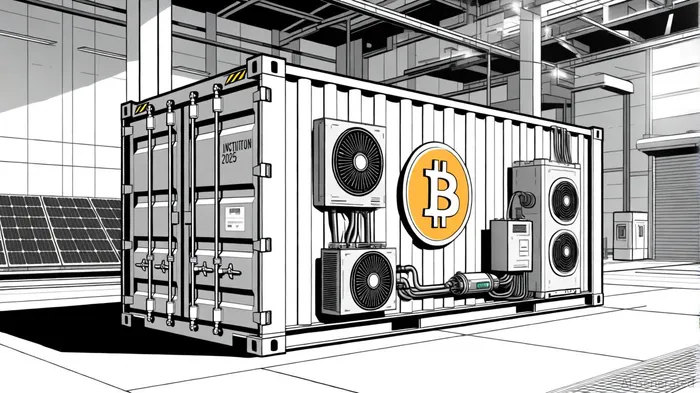
Operational scalability has become a competitive imperative. Modular mining containers, such as Cormint's climate-optimized units and Auradine's 1MW solutions, offer rapid deployment, adaptability to diverse climates, and enhanced security[1]. These containers, often equipped with immersion cooling and AI-driven resource optimization, enable miners to scale efficiently while reducing energy costs[6]. For example, American Bitcoin's expansion from 10 EH/s to 24 EH/s by September 2025 was powered by liquid-cooled ASIC infrastructure, underscoring the link between advanced hardware and institutional-grade operations[3].
Renewable energy integration is equally critical. Over 50% of Bitcoin mining now runs on renewables, with companies like HIVEHIVE-- Blockchain leveraging hydroelectric power from the Itaipu Dam in Paraguay to target 3% of global Bitcoin production by late 2025[1]. This shift aligns with ESG standards demanded by institutional investors, who prioritize clean energy sourcing and grid stabilization benefits[5]. Innovations such as methane-to-electricity conversions and heat reclamation further enhance Bitcoin mining's sustainability profile, turning it into an ESG-positive asset class[5].
The Institutional Imperative: Stability and Transparency
Institutions are not merely financing Bitcoin mining—they are redefining its operational and financial architecture. Multi-year hashrate offtake contracts, now a standard practice, provide miners with predictable revenue streams, reducing exposure to Bitcoin's price volatility[2]. These contracts also incentivize infrastructure investments, such as turnkey data center hosting and modular mining solutions, which cater to institutional demands for transparency and efficiency[2].
The rise of Bitcoin ETPs, with $114 billion in assets under management by 2024, has further professionalized the ecosystem[2]. These products allow institutions to gain Bitcoin exposure without custody complexities, accelerating adoption while reinforcing demand for clean, institutional-grade mining operations[2].
Conclusion: A Sustained Paradigm Shift
Bitcoin miners' access to capital in 2025 is no longer speculative but strategic. By aligning with institutional priorities through equity financing, modular infrastructure, and renewable energy, the sector is transitioning from a volatile frontier to a core component of global finance. As ESG standards and technological innovation converge, Bitcoin mining is poised to deliver both financial returns and environmental impact—a duality that institutions are increasingly willing to validate.







Comentarios
Aún no hay comentarios