
Bitcoin Miners' 2026 Strategic Pivots: AI Diversification as a Survival Play
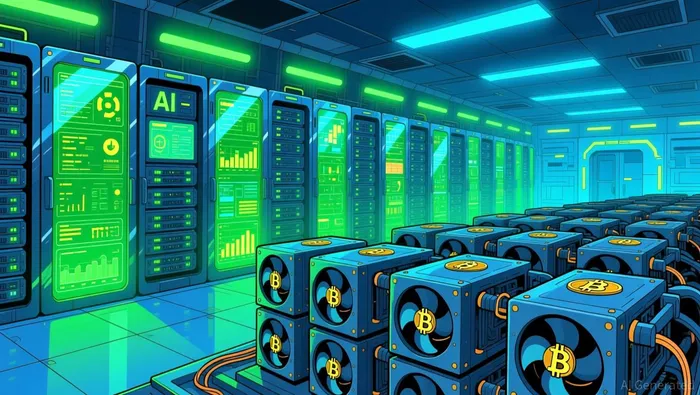
The BitcoinBTC-- mining sector in 2026 faces a stark reality: declining profitability, a post-halving environment, and a hashprice that has plummeted to below $35/PH/s. With Bitcoin's price hovering near $87,000-below the break-even threshold for many top miners-the industry's survival hinges on strategic reinvention. Enter artificial intelligence (AI) infrastructure. By repurposing their high-capacity power grids, cooling systems, and data centers, Bitcoin miners are pivoting to AI workloads, transforming from speculative crypto operators into stable, contract-driven digital infrastructure providers. This shift is not merely a tactical response to short-term losses but a calculated move to secure long-term investment resilience.
The Strategic Rationale: From Volatility to Stability
Bitcoin miners possess a unique advantage in the AI arms race: pre-existing infrastructure. Companies like Hut 8 Corp.HUT-- and CleanSparkCLSK-- are leveraging their 1 GW+ power capacities to serve dual purposes-Bitcoin mining and AI computing-while firms like BitfarmsBITF-- and Galaxy DigitalGLXY-- are fully repurposing facilities into GPU-as-a-service models or cloud AI partnerships. For instance, Hut 8's $7 billion, 15-year lease agreement with Fluidstack to convert its Louisiana campus into an AI data center exemplifies the sector's shift toward multi-year, high-margin contracts. Similarly, Galaxy Digital's $1.7 billion Helios project aims to deliver 133 MW of capacity to CoreWeaveCRWV-- by mid-2026, aligning with the surging demand for AI-ready infrastructure, which is projected to grow at a 33% annual rate through 2030.
This pivot is driven by stark financial realities. Bitcoin mining's payback periods for new hardware now exceed 1,200 days, while AI contracts offer predictable revenue streams with uptime requirements of 99.999%. As Nick Hansen, CEO of Luxor mining pool, notes, miners must balance the speculative nature of crypto mining with the stable, contract-driven returns of AI computing. The result? A sector rebranding itself as "digital infrastructure" firms, with companies like TeraWulf and Core Scientific deriving 14–21% of Q3 2026 revenue from AI/HPC services.
Financial Performance: A Mixed Landscape
 While AI diversification is gaining traction, 2026's financial metrics for miners remain mixed. Publicly traded miners now face a collective break-even price of $90,000 per Bitcoin, a level most cannot meet as operational costs rise. However, AI infrastructure is cushioning the blow. Cipher Mining secured a 15-year AWS contract to deliver 300 MW of capacity starting in 2026, while CoreWeave landed an $11.9 billion deal with OpenAI. These contracts highlight the sector's potential to generate durable cash flows, less correlated with Bitcoin's volatility.
Yet challenges persist. AI/HPC facilities demand higher water availability for liquid cooling and stricter uptime standards compared to Bitcoin mining. Moreover, many miners rely on debt financing to fund their AI transitions, exposing them to interest rate risks. Despite these hurdles, the broader market is bullish: McKinsey estimates $6.7 trillion will be invested in global data centers by 2030 to meet AI demand, a trend Bitcoin miners are uniquely positioned to capitalize on.
Regulatory Tailwinds and Institutional Adoption
Regulatory clarity in 2026 has further accelerated this transition. The U.S. GENIUS Act, enacted in 2025, stabilized the stablecoin market and boosted institutional confidence, while bipartisan crypto market structure legislation in 2026 provided a framework for blockchain integration with traditional finance. These developments have normalized digital assets as infrastructure, not speculation. For miners, this means institutional investors now view them as critical nodes in the AI value chain.
Institutional adoption is also reshaping the sector. Spot crypto ETPs have incorporated Bitcoin into mainstream portfolios, while tokenized real-world assets-worth $18.6 billion onchain by late 2025 signal a shift toward scalable, production-ready solutions. Miners pivoting to AI infrastructure are thus not only diversifying revenue but aligning with institutional-grade risk management and governance standards.
Long-Term Investment Resilience: A Calculated Bet
The long-term resilience of Bitcoin miners now depends on their agility in balancing dual operations. Hybrid models, such as Hive Digital Technologies' and MARA's strategies to split resources between Bitcoin and AI, offer a middle path but require hardware flexibility. Meanwhile, full transitions-like CoreWeave's-prioritize AI's predictable margins at the cost of crypto exposure.
For investors, the key metrics will be:
1. Contract Durability: Multi-year AI leases (e.g., Hut 8's 15-year Fluidstack deal) provide visibility.
2. Power Cost Arbitrage: Miners with low-cost energy (e.g., hydroelectric or renewable sources) will outcompete peers in AI hosting.
3. Regulatory Adaptability: Firms navigating evolving data center and crypto regulations-such as water usage mandates for cooling-will gain first-mover advantages.
Conclusion
Bitcoin miners' 2026 strategic pivots to AI infrastructure are not just survival plays-they are foundational shifts in a sector maturing from speculative mining to essential digital infrastructure. While Bitcoin's price volatility and operational costs remain headwinds, the AI transition offers a path to stable, scalable revenue. For long-term investors, the winners will be those miners that master the dual art of crypto-native agility and institutional-grade infrastructure reliability.





Comentarios
Aún no hay comentarios