
Bitcoin Miner Selling Pressure: Navigating Risks and Opportunities in a Shifting Market Cycle
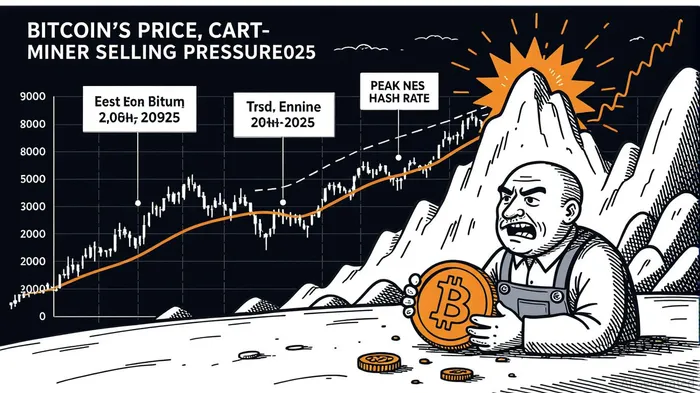
Bitcoin’s market dynamics in 2025 are increasingly shaped by a tug-of-war between miner distress and broader macroeconomic forces. While short-term holders face acute financial pressure—realizing $7 billion in losses over 30 days and nearing a +2 standard deviation capitulation threshold—long-term holders have solidified their dominance, controlling 63% of the supply and signaling Bitcoin’s evolution into a store of value [1]. This duality creates a complex landscape for investors, where miner behavior intersects with institutional adoption, regulatory shifts, and global monetary policy.
Current Miner Distress and Market Dynamics
Bitcoin miners are navigating a fragile equilibrium. Q3 2025 saw a reduction in selling pressure compared to earlier in the year, driven by the 2024 halving, which cut blockXYZ-- rewards to 3.125 BTC (~$373,000 at current prices) and tightened supply [4]. However, daily miner revenue remains 30% below 2024 levels, and sustained ETF outflows have exacerbated bearish momentum [1].
The financial health of mining firms further underscores this tension. CleanSpark’s record $198.6 million Q3 revenue and $257.4 million net income highlight operational efficiency and treasury growth, with 12,703 BTC held in reserves [5]. Conversely, BIT Mining’s $0.87 per share loss for H1 2025 reflects the sector’s volatility, while DMG Blockchain’s breakeven performance and 1.82% post-earnings stock dip illustrate the sector’s mixed fortunes [1][2].
For investors, these divergent outcomes underscore the importance of distinguishing between resilient operators and struggling entities. Miners with low debt (e.g., BIT Mining’s 0% debt-to-equity ratio) and scalable infrastructure (e.g., CleanSpark’s 50 EH/s hash rate) are better positioned to weather short-term volatility [2][5].
Historical Correlations: Miner Behavior and Price Trends
Historical data reveals a nuanced relationship between miner selling pressure and Bitcoin’s price. The Hash RibbonRBBN-- signal in February 2025—a 30-day moving average crossing below the 60-day—coincided with a 15% hash rate drop and a 4.2% BTC price decline to $43,110 [3]. Yet, miners’ subsequent push to record hash rates (129.7 trillion units as of August 2025) suggests confidence in Bitcoin’s long-term value [4].
The 2024 halving also reshaped miner economics. Reduced block issuance tightened supply, while rising difficulty (up 30% YoY) forced weaker operations to exit, consolidating the network [4]. This mirrors 2016 and 2020 cycles, where halving events initially increased selling pressure but ultimately strengthened Bitcoin’s scarcity narrative [1].
However, miner-driven price correlations are not absolute. From 2020–2025, Bitcoin’s price became increasingly tied to macroeconomic indicators like inflation expectations and Fed policy rather than miner behavior alone [2]. For instance, the 2022 Russia-Ukraine conflict initially drove BTC up 20% as a sanctions workaround, but aggressive rate hikes later erased 65% of gains [4]. Similarly, institutional ETF inflows during the 2024 Iran-Israel conflict limited BTC’s volatility to ±3%, demonstrating how macro forces can overshadow miner-specific dynamics [4].
Investor Strategy: Balancing Risks and Opportunities
For investors, the key lies in leveraging miner distress as a contrarian signal while hedging against macroeconomic headwinds. Here’s how:
HODL Through Miner Capitulation: Historically, miner capitulation events (e.g., the February 2025 Hash Ribbon signal) have preceded price recoveries. Short-term selling by distressed miners often creates buying opportunities for long-term holders [3].
Tactical Exposure to Resilient Miners: CleanSpark’s operational scale and BIT Mining’s debt-free balance sheet offer asymmetric risk-reward profiles. Investors should prioritize miners with low energy costs and diversified revenue streams [5][2].
Hedge with Derivatives: Regulated BitcoinBTC-- futures and options (e.g., CME Group’s products) allow miners and investors to lock in prices, reducing forced selling during downturns [1].
Monitor On-Chain Metrics: Track the Bull Score Index (currently at a two-year low) and the NVT ratio (up 12% to 56) to gauge speculative fervor and network valuation trends [1][3].
Conclusion
Bitcoin’s market cycle in 2025 is defined by a transition from miner-driven volatility to macroeconomic dominance. While short-term holders face existential risks, long-term accumulation trends and institutional adoption are cementing Bitcoin’s role as a reserve asset. Investors who recognize miner distress as a catalyst for capitulation—and not just a risk—can position themselves to capitalize on the next leg of Bitcoin’s journey.
**Source:[1] Bitcoin short-term holders face increasing financial pressure [https://www.mitrade.com/insights/news/live-news/article-3-722813-20250327][2] BIT MiningBTCM-- (BTCM) Balance Sheet & Financial Health Metrics [https://simplywall.st/stocks/us/software/nyse-btcm/bit-mining/health][3] Bitcoin Miner Capitulation and Hash Ribbon Signal [https://blockchain.news/flashnews/bitcoin-miner-capitulation-and-hash-ribbon-signal][4] How Hard Is It to Mine Bitcoin? Solo Mining Odds & Reality [https://www.coingecko.com/learn/can-you-mine-bitcoin-solo][5] CleanSparkCLSK-- Reports Third Quarter Fiscal 2025 Results [https://www.prnewswire.com/news-releases/cleanspark-reports-third-quarter-fiscal-2025-results-302524771.html]





Comentarios
Aún no hay comentarios