
Bitcoin's Miner-Driven Supply Surge: Navigating Short-Term Bearish Pressures and Long-Term Opportunities
The BitcoinBTC-- market in late 2025 is a study in contrasts. On one hand, miners grapple with collapsing profitability, surging network difficulty, and aggressive selling pressure. On the other, institutional adoption and whale accumulation hint at a resilient long-term narrative. This duality creates a fragmented market where short-term bearish forces clash with enduring bullish fundamentals.
Short-Term Bearish Pressures: A Perfect Storm for Miners
Bitcoin miners are under unprecedented strain. The hashprice-a metric reflecting the cost of mining one unit of hashpower-has plummeted to $43.1 per petahash/second (PH/s), its lowest level since April 2025, according to a FinanceFeeds report. This decline mirrors Bitcoin's 20% price correction from its October peak of $104,000. Compounding the issue, the network's difficulty recently hit an all-time high of 156 trillion (T), up 6.3% year-over-year, the same report noted. This means miners must expend more energy to validate blocks, squeezing margins further.
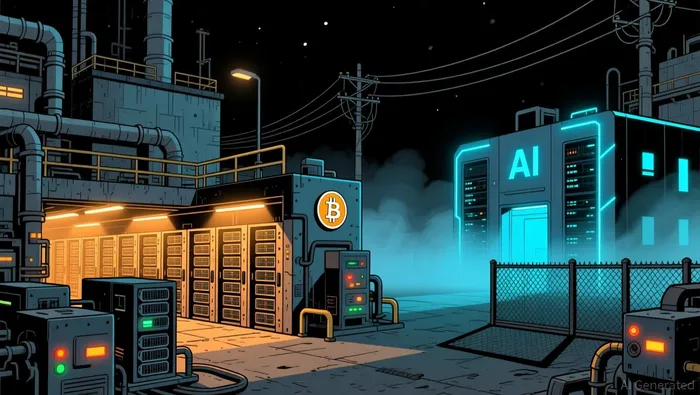
To adapt, firms like Riot PlatformsRIOT-- have diversified into AI and high-performance computing (HPC) to offset Bitcoin's volatility, though FinanceFeeds also covered these moves. Yet even with these efforts, mining costs have surged to $46,324 per bitcoin due to the 52% global hash rate increase, according to The Block. The result? A sector struggling to balance operational costs with dwindling returns.
The most visible sign of distress is the aggressive selling by miners. Marathon Digital (MARA), for instance, transferred $236 million in Bitcoin to institutional platforms like Coinbase Prime and Galaxy Digital over 12 hours, FinanceFeeds reported. This move, coinciding with Bitcoin's dip below $104,000, has sparked speculation about a potential sell-off. Analysts note that such transfers often signal liquidity needs or risk mitigation in bearish cycles, per the same coverage. Marathon's shift from holding mined Bitcoin for 16 months to selling half of its September output underscores the sector's financial fragility.
Long-Term Opportunities: Institutional Adoption and Whale Accumulation
Despite the short-term chaos, Bitcoin's long-term narrative remains intact. Institutional adoption is surging, with Tokyo-listed MetaPlanet securing a $100 million loan backed by its Bitcoin reserves, according to a Yahoo Finance article. The firm plans to use the funds for share buybacks, operational expansion, and further Bitcoin accumulation-a move that signals confidence in Bitcoin's value proposition as a store of value.
Meanwhile, on-chain data reveals a divergence in investor behavior. Long-term holders reduced their Bitcoin supply by 2.2% in October 2025, but this outflow-worth $7 billion-primarily came from smaller wallets (0.1–10 BTC), a CryptoTimes analysis found. Whale wallets, in contrast, have been accumulating, suggesting a strategic rebalancing by large players. This dynamic mirrors historical patterns where bear markets act as "bloodletting" phases, weeding out weak hands while institutional and sophisticated investors build positions, as noted in a Coinotag analysis.
Macroeconomic headwinds, including Federal Reserve uncertainty and geopolitical tensions, have dampened institutional demand temporarily, a trend Coinotag also examined. Yet Bitcoin's role as a hedge against inflation and currency devaluation remains intact. As global economic conditions stabilize, the asset's appeal to long-term investors is likely to resurge.
The Path Forward: A Market in Transition
Bitcoin's current phase is a classic example of market fragmentation. Short-term traders and cash-strapped miners are selling, while institutions and whales are buying. This divergence creates volatility but also opportunities for those with a long-term horizon.
For investors, the key lies in distinguishing between transient pain and enduring value. Miners' selling pressure may keep Bitcoin in bear territory for now, but the underlying fundamentals-network security, institutional adoption, and macroeconomic tailwinds-suggest a resilient asset. As one analyst put it, "Bitcoin's bear markets are not endings; they're setups for the next bull cycle."





Comentarios
Aún no hay comentarios