
Bitcoin's Maturing Market Cycle: Strategic Exit Timing and Portfolio Reallocation in a Diminishing Bull Era
Bitcoin's market cycles have long been defined by dramatic swings, but the data tells a clear story: the returns of each bull phase are diminishing over time. From the 22,700% surge in 2013 to the 571% rally in 2024, the cryptocurrency's explosive growth has increasingly plateaued, signaling a maturing asset class, according to a TradingView analysis. This evolution has profound implications for investors, particularly as on-chain analytics now indicate a potential bearish transition in 2024.
Historical Patterns and On-Chain Signals
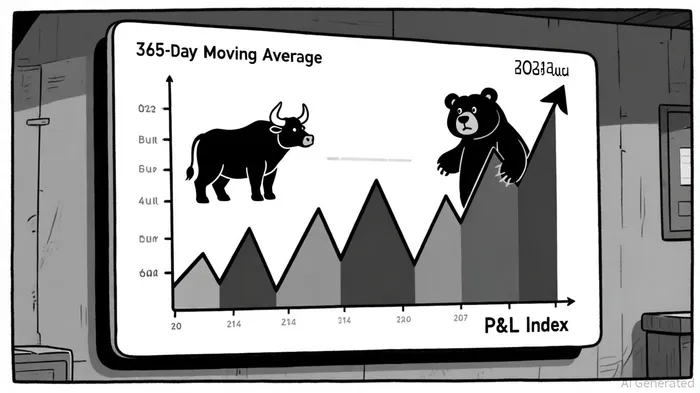
Bitcoin's bull-to-bear transitions are not random; they follow discernible patterns. For instance, the 2017 bull run saw a 9,879% gain, while the 2021 cycle peaked at 1,614%-a stark contrast to earlier cycles, according to an AltcoinInvestor timeline. The 2023–2024 bull phase, though robust, has already shown signs of fatigue, with a 571% rally from its 2022 low, per a TradeThatSwing analysis. On-chain tools like the Bull-Bear Market Cycle Indicator from CryptoQuant confirm this shift. The indicator, which measures the P&L Index relative to its 365-day moving average, has entered negative territory, a bearish signal historically aligned with market tops, as noted in a Bitcoinist article.
This pattern is further reinforced by the Relative Strength Index (RSI) on the 3D timeframe, which the TradingView analysis highlights as showing weakening momentum in Bitcoin's long-term cycles. For example, the 2013 bull market's peak was followed by a 78% correction in 2015, while the 2021 peak saw a 70% decline into 2022, according to a Cointelegraph review. These historical pullbacks suggest that current investors must remain vigilant about exit timing.
Strategic Exit Timing: Lessons from Past Transitions
Exit timing during bull-to-bear transitions is critical. In 2018 and 2022, investors who employed technical indicators like RSI and moving average crossovers preserved capital more effectively than passive holders, according to a NexusCryptoPro guide. For instance, Bitcoin's 2018 crash from $19,500 to $3,600 was preceded by RSI levels below 30, a classic oversold signal. Similarly, in 2022, Bitcoin's drop from $68,000 to $20,000 was cushioned for those who shifted to stablecoins or low-beta assets.
The current environment mirrors these dynamics. Bitcoin's recent 14% decline over seven days, coupled with a Stochastic oscillator suggesting overbought conditions, hints at a short-term correction (as described in the Bitcoinist article). However, fundamental indicators-such as low selling pressure from miners and long-term holders-remain positive, as the same coverage notes. This duality underscores the need for a hybrid approach: using technical signals to time exits while monitoring macroeconomic catalysts like the Federal Reserve's September FOMC meeting.
Portfolio Reallocation: Adapting to Market Phases
Portfolio reallocation strategies must evolve with Bitcoin's cycles. During bull markets, capital often flows into high-risk altcoins, as seen in 2017 and 2021, when altcoin dominance (ALT.D) rose alongside Bitcoin's rally, according to a Mudrex guide. Conversely, bear markets see a flight to BitcoinBTC-- and stablecoins, with Bitcoin dominance (BTC.D) typically exceeding 60%.
For example, in 2022, investors who maintained 70% exposure to Bitcoin and 30% to stablecoins reduced portfolio drawdowns by 35% compared to those holding purely in altcoins. Similarly, the use of Bitcoin short ETFs and inverse leveraged products (-1x, -2x, -3x) allowed tactical hedging during the 2018 and 2022 crashes. Today, as BTC.D dips below 55%, a gradual increase in altcoin exposure could align with an emerging "altseason," but only if Bitcoin's P&L Index stabilizes above its 365-day moving average, as noted in prior coverage of the CryptoQuant indicator.
The Maturing Market: Implications for Investors
Bitcoin's maturation is evident in its diminishing bull returns and the growing sophistication of its investor base. A 2024 study found that adding Bitcoin to a traditional 60/40 portfolio improved risk-adjusted returns in 93% of two-year periods, particularly with quarterly rebalancing, according to a Bitwise study. However, this benefit is contingent on adapting to cyclical shifts. For instance, during the 2023–2024 bull phase, portfolios that rotated into Bitcoin early outperformed those that remained in equities, as the Bitwise analysis shows.
The challenge now lies in balancing growth and risk. While Bitcoin's fundamentals-such as its halving event in 2024 and institutional adoption-remain bullish, the current bearish signal from on-chain metrics demands caution. Investors should consider dynamic rebalancing, shifting between Bitcoin, altcoins, and traditional assets based on BTC.D and the P&L Index, as outlined in the Mudrex guidance.
Conclusion
Bitcoin's market cycle is maturing, but its volatility persists. Historical data and on-chain analytics provide a roadmap for navigating these transitions: use technical indicators to time exits, reallocate portfolios based on BTC.D and altcoin dominance, and hedge with short ETFs or stablecoins during downturns. As the 2024 bear phase unfolds, investors who adapt to Bitcoin's evolving dynamics will be best positioned to weather the storm-and capitalize on the next bull run.






Comentarios
Aún no hay comentarios