
Bitcoin's Maturing Bull Cycle and Imminent Macro Inflection Point
Bitcoin's bull cycle, now entering its maturation phase in Q3 2025, is being shaped by a confluence of on-chain metrics and capital flow dynamics that signal an impending macroeconomic inflection pointIPCX--. From the NVT (Network Value to Transactions) ratio to ETF inflows and wallet distribution patterns, the data paints a picture of structural momentum and institutional-driven adoption. These indicators suggest that BitcoinBTC-- is not merely consolidating but preparing for a phase shift that could redefine its role in global financial markets.
The NVT Ratio: A Leading Indicator of Market Inflection
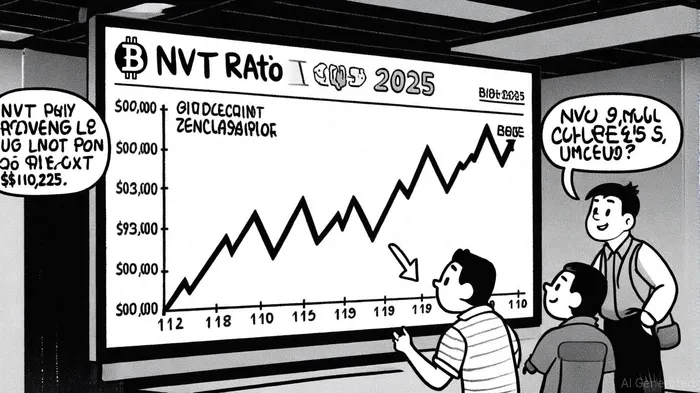
The NVT ratio, a critical on-chain metric that compares Bitcoin's market value to its daily transaction volume, has entered oversold territory in Q3 2025. According to a report by MEXC, this development is often associated with early recovery phases or potential market reversals, particularly when paired with strong on-chain sentiment[1]. The NVT golden cross—a technical signal where the short-term NVT line crosses above the long-term average—has further reinforced this narrative.
Currently, Bitcoin's price is consolidating between $93,000 and $110,000, a range where significant supply has accumulated since late 2024. This consolidation, coupled with the NVT ratio's oversold condition, suggests that long-term holders (LTHs) are maintaining control, potentially setting a floor for further price action[1]. Analysts are closely monitoring whether this range will act as a catalyst for a new rally or remain a battleground for short-term volatility.
ETF Inflows: Institutional Capital as a Catalyst
The role of institutional capital in Bitcoin's bull cycle cannot be overstated. ETF inflows for 2025 have surged to $400 billion, a figure that underscores growing institutional interest and liquidity provision[2]. This influx of capital has not only bolstered Bitcoin's price but also altered its liquidity profile, making it more akin to traditional asset classes.
Data from Glassnode highlights that these inflows are synchronized with broader macroeconomic trends, such as central bank policy shifts and global risk-on sentiment[2]. The correlation between ETF inflows and Bitcoin's price movements suggests that institutional investors are increasingly viewing Bitcoin as a strategic asset rather than a speculative one. This shift is critical for understanding the maturation of the bull cycle, as it reflects a transition from retail-driven momentum to institutional-grade adoption.
Wallet Distribution: A Barometer of Decentralization
While wallet distribution data is less frequently discussed, it is a vital metric for assessing the health of Bitcoin's bull cycle. On-chain analysis from Q3 2025 indicates a broadening base of Bitcoin holders, with capital dispersing across a more diverse set of wallets[2]. This trend is a hallmark of a maturing bull market, as it signals increased adoption and reduced concentration of ownership.
A decentralized wallet distribution mitigates the risk of market manipulation and enhances Bitcoin's utility as a store of value. It also aligns with the broader narrative of Bitcoin's transition from a niche asset to a mainstream financial instrument. As wallet distribution continues to diversify, it reinforces the argument that Bitcoin's bull cycle is gaining structural resilience.
The Interplay of Metrics and the Path Forward
The convergence of these metrics—NVT ratio, ETF inflows, and wallet distribution—points to an imminent macroeconomic inflection point. The NVT ratio's oversold condition suggests a potential reversal, while ETF inflows provide the liquidity to sustain upward momentum. Meanwhile, wallet distribution dynamics indicate a healthy, decentralized ecosystem capable of supporting long-term growth.
However, the path forward is not without risks. Traders and investors remain cautious about short-term volatility, particularly as Bitcoin consolidates in a key price range. The coming weeks will be critical in determining whether this consolidation resolves into a breakout or a breakdown. For now, the data suggests that Bitcoin's bull cycle is not only maturing but also positioning itself for a new phase of institutional-driven growth.
Conclusion
Bitcoin's Q3 2025 bull cycle is being defined by a unique interplay of on-chain metrics and capital flow dynamics. The NVT ratio's oversold condition, record ETF inflows, and broadening wallet distribution collectively signal a maturing market structure. As these indicators align with macroeconomic trends, they underscore the likelihood of a significant inflection point in the near term. For investors, the challenge lies in distinguishing between consolidation and catalyst—two forces that will shape Bitcoin's trajectory in the months ahead.






Comentarios
Aún no hay comentarios