
Bitcoin's Maturation: How Institutional Adoption is Reshaping Risk and Retail Dynamics
The Quiet Revolution in Bitcoin's Risk Profile
Bitcoin's journey from a speculative asset to a cornerstone of global finance is accelerating, driven by a seismic shift in its risk profile. Michael Saylor, CEO of MicroStrategy, has long argued that Bitcoin's volatility is notNOT-- a bug but a feature of its early-stage adoption. However, as institutional capital floods the market, this volatility is rapidly diminishing—a transformation Saylor likens to the maturation of the petroleum industry in the 1870s [1].
Corporate BitcoinBTC-- treasuries now hold 1.011 million BTC, valued at over $118 billion, or 5% of the circulating supply [1]. Yet, accumulation patterns have shifted: firms are purchasing smaller amounts due to macroeconomic uncertainty, reflecting a more measured approach to risk management [1]. This contrasts sharply with the frenetic retail-driven cycles of the past, where price swings were often amplified by speculative trading.
Institutional Adoption: A New Equilibrium
Institutional adoption has become the primary driver of Bitcoin's price action in 2025. Over 75% of institutional investors plan to increase their digital asset activities, with publicly traded companies acquiring 415,000 BTC in 2025 alone [2]. The launch of spot Bitcoin ETFs, such as BlackRock's iShares Bitcoin Trust (IBIT), has provided a compliant on-ramp for large investors, with IBITIBIT-- alone amassing $18 billion in assets under management by Q1 2025 [2].
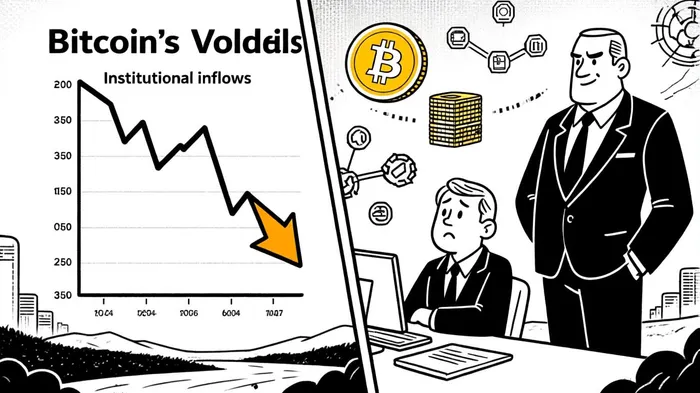
This institutional influx has fundamentally altered Bitcoin's volatility. Realized volatility has dropped by as much as 75% from historical levels by mid-2025, attributed to deeper liquidity and the “strong hands” effect from long-term institutional holders [2]. Saylor emphasizes that this stabilization is not merely a technical shift but a structural one: Bitcoin is evolving into a digital capital and settlement layer for global finance [1].
Retail Participation: A Cooling Trend
While institutions have embraced Bitcoin, retail investor behavior tells a different story. Exchange data reveals a net loss of 16% in Bitcoin supply across platforms in 2025, signaling reduced retail participation [2]. Social media sentiment and forum activity further underscore this trend, with Bitcoin mentions declining by over 20% since February 2025 despite rising prices [2].
This cooling of retail interest is not a sign of waning enthusiasm but a natural consequence of Bitcoin's maturation. As Saylor notes, the “thrill” of volatility—once a hallmark of retail trading—is being replaced by a more institutionalized, long-term mindset [1]. Retail investors, meanwhile, are increasingly adopting a wait-and-see approach amid macroeconomic uncertainty and the proliferation of Bitcoin-backed financial instruments.
Market Dynamics: Liquidity, Derivatives, and On-Chain Confidence
Q2 2025 saw Bitcoin reach an all-time high of $111,900 amid global macroeconomic uncertainty, yet average daily spot trading volume declined by 10% to $40 billion [3]. This paradox—higher prices with lower liquidity—reflects the growing dominance of institutional investors, who prefer derivatives markets for hedging and leverage. Derivatives volume in Q2 2025 hit $20.2 trillion, a slight dip from Q1 but still dwarfing spot trading activity [3].
On-chain data reveals strong accumulation by long-term holders, with over 70% of Bitcoin now held in wallets for more than 12 months [2]. This “strong hands” dynamic reinforces Bitcoin's role as a store of value, while fiscal expansion in the U.S. and China has injected liquidity into private sector balance sheets, creating favorable conditions for further appreciation [2].
The Road Ahead: A Digital Gold Rush
Saylor predicts a “digital gold rush” from 2025 to 2035, with new business models and fortunes emerging alongside inevitable missteps [1]. The launch of Bitcoin-backed preferred stock instruments—Strike, Strife, StrideLRN--, and Stretch—by MicroStrategy aims to bridge traditional finance and Bitcoin, offering yields up to 12.7% to attract cautious investors [1].
Analysts project Bitcoin could reach $180,000–$220,000 by year-end 2025, driven by institutional inflows and favorable macroeconomic conditions [2]. However, the U.S. government's establishment of a Strategic Bitcoin Reserve in March 2025—funded by seized Bitcoin—has further legitimized the asset, signaling its acceptance as a strategic reserve asset [2].
Conclusion
Bitcoin's evolving risk profile reflects a broader transformation in its role within the global financial system. Institutional adoption has tamed its volatility, while retail participation has shifted toward a more passive, long-term orientation. As Saylor aptly puts it, Bitcoin is becoming “boring”—not in its potential, but in its stability. For investors, this signals a new era where Bitcoin's value is measured not by daily price swings but by its growing integration into the bedrock of global capital markets.





Comentarios
Aún no hay comentarios