
Bitcoin Market Sentiment Shifts: A Whale's $340M Short and What It Means for Investors
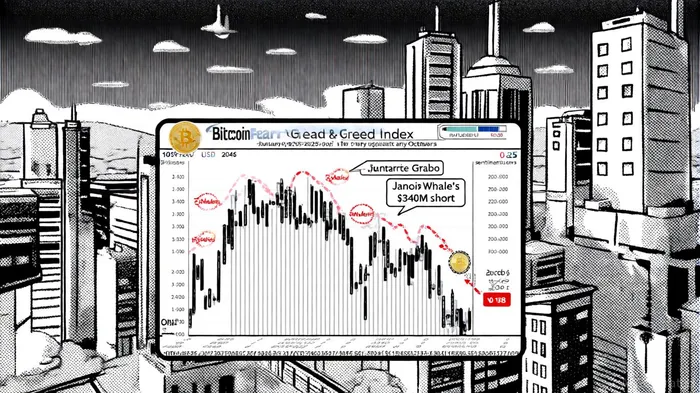
The BitcoinBTC-- market in late 2025 is a theater of contradictions. On one hand, institutional adoption and regulatory clarity have driven a bullish rally, with prices surging past $126,000 in October 2025, according to an Aurpay analysis. On the other, a single whale-dubbed the "Trump Insider Whale"-has amplified bearish sentiment by increasing its short position to $340 million, leveraging 10x leverage and risking liquidation if Bitcoin breaches $130,460, according to an EdgarIndex report. This move, coupled with a Fear & Greed Index reading of 28 (indicating "extreme fear"), reported by a BTCC article, underscores a fragile psychological equilibrium in the market. For investors, understanding the interplay of market psychology and leveraged risk dynamics is critical to navigating this volatile landscape.
Market Psychology: Fear, Greed, and the Role of Whales
Bitcoin's Fear & Greed Index has historically served as a barometer for investor sentiment. In late October 2025, the index plummeted to 28, its lowest point since April 2025, following a sharp price decline below key support levels and the Federal Reserve's hawkish pause, as reported by BTCC. This "extreme fear" reading aligns with historical patterns where fear often precedes market bottoms. For example, in September 2023 and March 2025, similar fear readings were followed by price reversals, according to a CryptoSlate analysis.
However, the current environment reveals a divergence between retail and institutional behavior. While retail investors are net selling, data from Glassnode shows that whales (holders with >1,000 BTC) are accumulating, a trend noted in BTCC's coverage. This dynamic mirrors the 2022–2025 bull run, where long-term investors capitalized on fear-driven pullbacks. The "Trump Insider Whale's" $340M short, meanwhile, reflects a bearish bet rooted in macroeconomic uncertainty. Despite Trump's backtracking on tariffs, the whale's position suggests skepticism about Bitcoin's ability to sustain its rally above $117,000-a critical support level identified by analysts, as discussed in a Coingape piece.
Historical precedents further contextualize this tension. During the 2022 bear market, Bitcoin plummeted from $47,300 to below $20,000, with bear traps luring short-sellers into false breakouts, a pattern highlighted in the EdgarIndex report. Similarly, the 2018 crash from $19,500 to $3,600 was exacerbated by large short positions, as also noted by EdgarIndex. These cycles highlight a recurring theme: fear often precedes capitulation, but institutional confidence can drive recovery.
Risk Dynamics: Leverage, Liquidations, and Systemic Vulnerabilities
The "Trump Insider Whale's" 10x leverage amplifies both its potential gains and risks. If Bitcoin surges past $130,460, the whale's position will be liquidated, wiping out its $700,000 unrealized profit, according to the EdgarIndex analysis. This scenario mirrors the early 2025 liquidation event, where a $1.29 billion short wipeout triggered a $453 million loss for traders, as reported in a BTCC report. Such events underscore the fragility of leveraged positions in crypto, where forced liquidations can exacerbate volatility.
Leverage Position Openings and Closures (LPOC) metrics reveal deeper risks. By analyzing open interest (OI) and price correlations, LPOC data shows that leveraged shorts often cluster near key resistance levels. In Q3 2025, $2 billion in short positions hovered near $121,600, creating a precarious environment where a failed breakout could trigger cascading liquidations, a concentration discussed in the EdgarIndex piece. This dynamic is compounded by fragmented liquidity and manipulative tactics like spoofing, which distort price signals, as EdgarIndex also notes.
Retail traders, meanwhile, are increasingly aware of these risks. First-party telemetry from platforms like Leverage.Trading shows that liquidation safety checks spike before major market events. During the October 6 crash, such checks surged 5× above baseline, reflecting heightened anxiety, per CryptoSlate's reporting. For investors, this data serves as an early warning system: elevated retail stress often precedes sharp corrections.
Implications for Investors: Navigating the Crossroads
The current market environment demands a nuanced approach. For long-term investors, the whale's short position and fear-driven pullbacks present opportunities to accumulate at discounted prices, particularly if Bitcoin stabilizes above $117,000, as the Coingape piece suggests. However, leveraged traders must exercise caution. The $130,460 liquidation threshold for the whale's position could trigger a short squeeze, pushing prices higher and forcing other short-sellers to cover their bets.
Regulatory developments also play a critical role. The U.S. government's clarity on crypto regulations has reduced institutional hesitancy, but future tightening (e.g., leverage caps) could disrupt leveraged positions, a dynamic explored in the Aurpay analysis. Investors should monitor macroeconomic signals-such as inflation trends and Fed policy-as well as on-chain metrics like whale accumulation and short position concentrations, topics Aurpay also highlights.
Conclusion
Bitcoin's market in late 2025 is a battleground of psychology and leverage. The "Trump Insider Whale's" $340M short, while bearish, exists within a broader context of historical cycles and institutional confidence. For investors, the key lies in balancing risk management with strategic opportunism. As the Fear & Greed Index suggests, fear may yet give way to a new bull phase-but only if Bitcoin can overcome its psychological and structural hurdles.






Comentarios
Aún no hay comentarios