
Bitcoin Market Sentiment and Risk Management: Decoding Short-Term Trader Behavior as a Canary in the Coal Mine
The BitcoinBTC-- market is a theater of extremes-where euphoria and panic often collide in a volatile dance. As we approach the tail end of 2025, the cryptocurrency's price action has become increasingly influenced by short-term trader behavior, a phenomenon that acts as both a catalyst and a canary in the coal mine for broader market corrections. With retail sentiment hitting record highs and leverage levels reaching dangerous thresholds, the interplay between speculative fervor and structural resilience is shaping a narrative that every investor must understand.
The Sentiment Overload: A Precursor to Correction
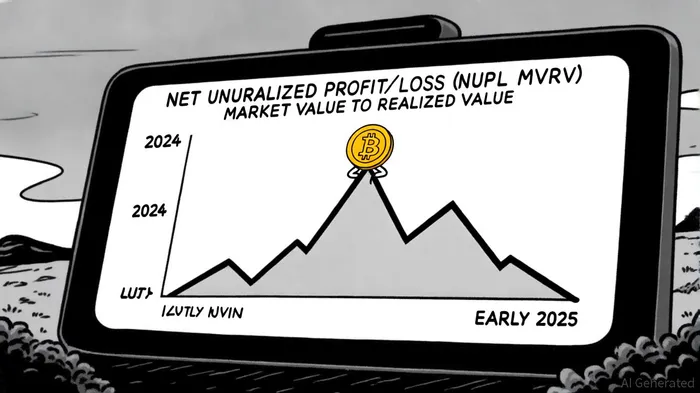
Bitcoin's sentiment index currently sits at the 95th percentile, a level historically associated with market tops and impending corrections [1]. This extreme optimism is mirrored in the Net Unrealized Profit/Loss (NUPL) and Market Value to Realized Value (MVRV) metrics, both of which have surged to unsustainable levels [1]. These indicators suggest that the majority of Bitcoin holders are sitting on paper profits, a condition that often precedes profit-taking and subsequent price consolidation.
Retail investor demand, meanwhile, has plummeted to levels reminiscent of the 2021 correction, signaling a shift from speculative frenzy to cautious disengagement [1]. This divergence between institutional confidence and retail exodus is a classic warning sign. As stated by Bitfinex's Head of Derivatives, Jag Kooner, "The market is primed for a correction above $44,000 due to profit-taking and illiquidity, especially during the holiday season" [3].
Short-Term Traders: The Double-Edged Sword
Short-term holders (STHs) are the most volatile segment of Bitcoin's ecosystem. Their behavior-driven by algorithms, FOMO, and fear of missing out-can amplify price swings. When STHs deposit Bitcoin on exchanges in anticipation of corrections, they increase the available supply, creating a self-fulfilling prophecy of downward pressure [1]. This dynamic was evident in October 2025, when $132 million in short positions were liquidated during a sharp price drop, triggering a mechanical deleveraging event [3].
The current price structure also reveals critical levels: resistance at $91,000–$92,000 and support at $83,000 [2]. A break below $83,000 could signal a deeper correction, while a sustained rally above $92,000 might indicate a continuation of the bull phase. However, historical backtesting from 2022 to the present suggests that relying solely on these levels may not offer a significant advantage. A study of 1,376 qualifying events found that the average return of +3.49% was nearly identical to the benchmark, with no statistically significant edge at the 5% level. This implies that while these levels are important, they should be used in conjunction with other indicators rather than as standalone signals.
The broader market is entering Phase 3 of its cycle, characterized by reduced Bitcoin dominance and a shift toward altcoins [3]. This phase often prolongs the upward trajectory but increases the risk of sideways consolidation.
Leverage as a Time Bomb
Leverage usage has surged to unprecedented levels, with Bitcoin's open interest hitting $96.2 billion in June 2025 [4]. The Realized Cap Leverage Ratio stands at 10.2%, a metric that historically correlates with sharp price swings [4]. While stablecoin-margined positions have matured the derivatives market post-FTX, the sheer volume of leveraged bets-$1.7 trillion in futures trading on Binance alone-remains a systemic risk [4].
Crypto trader Joe McCann has warned of a potential 20–40% correction before Bitcoin can rally to $150,000 by Q1 2025 [4]. This prediction hinges on the unwinding of overleveraged positions, a process that could trigger cascading liquidations. The MVRV Z-Score of 2.15, however, suggests the market is not in extreme euphoria or oversold territory, offering a buffer against panic-driven capitulation [3].
Risk Management in a Volatile Regime
For investors, the key lies in balancing exposure to Bitcoin's long-term potential with short-term risk mitigation. Here are three actionable strategies:
1. Position Sizing: Allocate only a fraction of capital to leveraged positions, especially during overbought conditions.
2. Stop-Loss Orders: Use trailing stops to lock in gains while allowing room for volatility.
3. Diversification: Hedge against Bitcoin's beta by allocating to altcoins or traditional assets during consolidation phases.
Historically, Bitcoin's cycles have followed a four-year rhythm, with halvings acting as catalysts for price surges. The April 2024 halving has set the stage for renewed momentum in late 2025, but the path will likely involve corrections [5]. Long-term holders, who control over 90% of the circulating supply, remain in profit, indicating structural strength [3].
The Road Ahead: Corrections as Opportunities
While the immediate outlook is fraught with risks, corrections often create buying opportunities for patient investors. Institutional adoption and macroeconomic tailwinds-such as low-interest rates-continue to bolster Bitcoin's case as a store of value [4]. The challenge lies in navigating the short-term noise without losing sight of the long-term vision.






Comentarios
Aún no hay comentarios