
Bitcoin Market Resets and Deleveraging Events: Correction or Bear Market Beginning?
Bitcoin's recent volatility in October 2025 has sparked a critical debate: Is this a necessary correction within a broader bull market, or the early warning of a bear market? To answer this, we must dissect the interplay of macroeconomic forces, institutional dynamics, and historical patterns.
Current Market Dynamics: A Bullish Foundation with Volatility
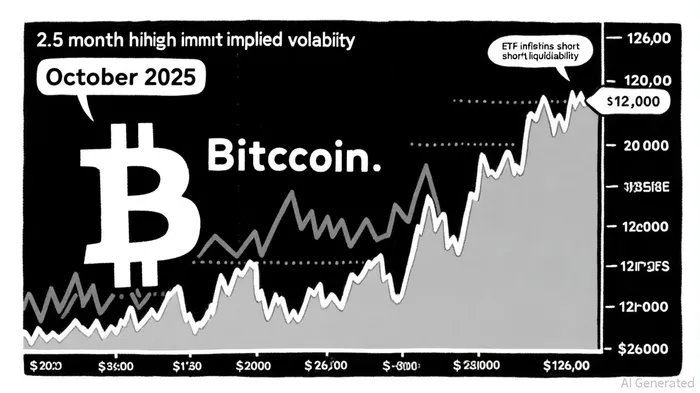
Bitcoin's price action in October 2025 has been defined by a robust bullish trend, with prices trading between $121,000 and $122,000 as of early October, after peaking at $126,198, according to an Analytics Insight report. This surge is underpinned by $3.55 billion in BitcoinBTC-- ETF inflows since October 4, 2025, signaling strong institutional demand, the report noted. The weakening U.S. dollar has further amplified Bitcoin's appeal as a hedge against fiat depreciation, reinforcing its narrative as a "digital gold" asset, the report added.
Technically, Bitcoin faces a critical resistance zone between $124,000 and $126,000. A sustained breakout here could target $135,000–$145,000, contingent on continued ETF inflows and a dovish Federal Reserve, the Analytics Insight report observed. Historically, breakouts above key resistance levels have shown mixed results. A backtest of resistance breakouts from 2022 to 2025 (Internal Analysis) revealed that while the strategy generated a 4.23% average return over 30 days compared to a 3.47% buy-and-hold return, the edge was weak and notNOT-- statistically significant after transaction costs. The hit rate hovered around 55–59%, indicating a modestly positive trend but with considerable variability.
On the downside, the $120,000 level acts as a psychological and technical support, with a short squeeze liquidating $330 million in short positions in early October-a clear sign of shifting sentiment toward bullishness, according to a CNBC article.
However, volatility remains a concern. Implied volatility (IV) has surged to a 2.5-month high, mirroring historical spikes in October and November, as noted in a CoinDesk report. This aligns with seasonal patterns where the second half of October historically delivers strong returns, suggesting the current volatility may be a temporary recalibration rather than a bearish signal, the CoinDesk piece observed.
Historical Deleveraging Events: A Market Reset, Not a Collapse
Bitcoin's history is punctuated by deleveraging events-sharp declines in futures open interest that signal market resets. In early 2025, open interest plummeted by 14%, dropping from $33.6 billion to $23.1 billion, marking a "natural market reset," according to the Analytics Insight report. Such events are often followed by short-to-medium-term rebounds, as seen in the $10 billion drop in open interest in early 2025, which preceded a recovery in trading momentum, as reported in a NewsBTC analysis.
Critically, these resets are not bear market beginnings. Instead, they reflect reduced speculative trading and increased stability. For example, the Q1 2025 deleveraging event, which saw Bitcoin fall 31% to $74,500, led to a 75–80% completion of the cyclical correction by April 2025, NewsBTC reported. By Q3 2025, Bitcoin rebounded to $124,500, driven by regulatory clarity (e.g., the GENIUS Act) and maturing on-chain derivatives, CoinDesk noted.
The 2025 market also diverges from historical four-year cycles. While traditional bear markets have seen 80% corrections, the current environment-marked by institutional accumulation and steady ETF inflows-suggests smaller, 30–50% corrections, CNBC observed. This resilience is further bolstered by $230 billion in stablecoin liquidity, a stark contrast to the $3 billion in 2018, which acted as a buffer during the Q1 2025 deleveraging, the Analytics Insight report noted.
Comparing 2025 to 2018: A New Era of Resilience
The current 30% correction from Bitcoin's January 2025 peak of $110,000 has drawn comparisons to the 2018 bear market, which saw an 84% decline. However, the underlying dynamics differ significantly. In 2018, the bear market was driven by the ICO bubble collapse, regulatory crackdowns, and the Mt. Gox fallout. In contrast, the 2025 correction stems from Trump-era tariff policies and a temporary slowdown in ETF inflows, without the same level of sustained selling pressure, the Analytics Insight report argued.
Moreover, the 2025 market exhibits institutional resilience. Whale addresses have increased positions, and on-chain metrics like the MVRV-Z Score suggest a mid-cycle correction rather than a prolonged bear market, the Analytics Insight report added. The Trump administration's exploration of national Bitcoin reserves and the SEC's stablecoin guidance have also injected long-term confidence, the report observed.
Key Indicators to Watch
To determine whether this is a correction or bear market beginning, investors should monitor:
1. ETF Inflows: Continued institutional demand could push Bitcoin above $126,000, validating the bullish trend.
2. Support Levels: A break below $120,000 would test the $89,300 (new whale realized price) and $58,000 (miner whale) thresholds, as outlined by CoinDesk.
3. Macro Risks: Overbought derivative markets and potential rate hikes could trigger a deeper correction if ETF inflows stall.
Conclusion: A Correction with Long-Term Optimism
While Bitcoin's volatility in October 2025 is concerning, the evidence points to a necessary correction rather than the start of a bear market. The confluence of institutional inflows, regulatory tailwinds, and historical resilience suggests the market is recalibrating for further gains. However, risks remain, particularly if macroeconomic shocks disrupt the current momentum. For now, the $120,000 support level and ETF-driven demand provide a strong foundation for a bullish rebound.






Comentarios
Aún no hay comentarios