
Bitcoin’s Market Peak and Monetary Policy Dynamics: Navigating Macroeconomic Cycles and Liquidity-Driven Valuation
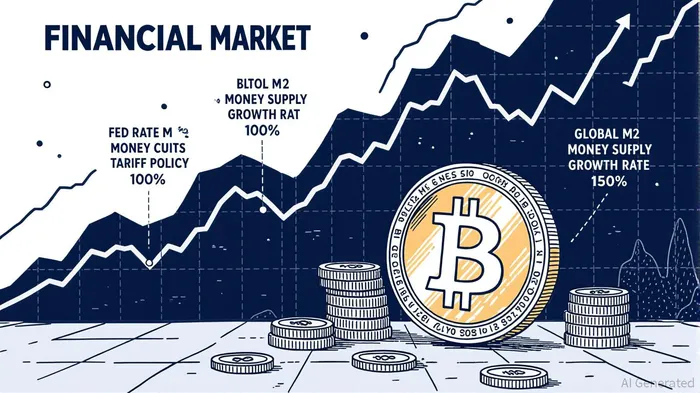
Bitcoin’s ascent as a macroeconomic asset has become increasingly evident in 2025, with its price dynamics tightly intertwined with central bank liquidity cycles and monetary policy shifts. The cryptocurrency’s historical role as a barometer for global liquidity—exemplified by its 0.94 long-term correlation with M2 money supply growth [1]—has only deepened in recent years, as institutional adoption and regulatory clarity amplify its sensitivity to macroeconomic forces.
The Fed’s Dovish Pivot and Bitcoin’s Macroeconomic Sensitivity
The U.S. Federal Reserve’s dovish signals at the Jackson Hole symposium in August 2025 marked a pivotal shift in monetary policy, with Chair Jerome Powell hinting at a potential rate cut as early as September [1]. This pivot reflects a broader recalibration from inflation-focused tightening to addressing slowing GDP growth, a move that has reshaped Bitcoin’s price correlations. Notably, Bitcoin’s response to macroeconomic data has evolved: while it historically reacted more strongly to inflation surprises, recent trends show a stronger link to employment figures. For instance, the July 2025 employment report—revealing weaker-than-expected job creation and downward revisions to prior months—triggered a volatile but ultimately bullish reaction in BitcoinBTC--, contrasting with the sell-off in traditional risk-on assets [1].
Central bank liquidity remains a cornerstone of Bitcoin’s valuation. Historical data from Alphractal reveals that increases in global liquidity typically precede Bitcoin price growth by 70–107 days [3], a lag that aligns with the cryptocurrency’s current rally in late 2025. The global M2 money supply, now at a record $108.4 trillion [3], underscores this liquidity-driven backdrop. Meanwhile, the U.S. dollar index’s decline from 110 to 96.37—a proxy for shifting liquidity from tight to loose—has further bolstered Bitcoin’s appeal as a hedge against dollar depreciation [5].
Historical Peaks and Liquidity Cycles: A 4-Year Pattern
Bitcoin’s market peaks have consistently aligned with periods of expansive monetary policy. The 2016–2017 and 2020 bull runs coincided with central bank interventions that inflated global liquidity, while bear markets in 2018–2019 and 2022 followed liquidity contractions [1]. This pattern reinforces Bitcoin’s role as a liquidity barometer, with its 4-year halving cycle often overlapping with these trends. For example, historical bull market peaks have emerged roughly 35 months after cycle lows [2], a rhythm that appears to be repeating in 2025 as liquidity injections and Fed easing converge.
On-chain metrics corroborate this narrative. The MVRV Z-Score and Value Days Destroyed (VDD) indicate that Bitcoin is in a healthy bull cycle phase, with long-term holders accumulating at lower prices [3]. These indicators mirror historical bull market recoveries, suggesting that the current correction may represent a local bottom rather than a sustained downturn.
Institutional Adoption and Regulatory Tailwinds
Institutional adoption has further solidified Bitcoin’s macroeconomic relevance. U.S. Bitcoin ETFs, which attracted significant inflows in 2025, have reduced volatility and enhanced liquidity [4]. Regulatory developments, such as the CLARITY Act and the inclusion of Bitcoin in 401(k) plans, have normalized its role as an institutional asset [4]. These factors, combined with rising M2 growth and accommodative monetary policies, create a compelling case for continued price appreciation.
Risks and Macro Headwinds
Despite these bullish drivers, risks persist. The expiration of Trump’s 90-day tariff freeze on July 9, 2025, reintroduced trade tensions, historically linked to sharp Bitcoin corrections [1]. Additionally, the U.S. faces growing financial fragility as debt levels outpace liquidity growth, a scenario that could trigger a crisis and drive demand for Bitcoin as a hedge [2]. However, ETF-driven liquidity and reduced volatility may mitigate these risks, enabling Bitcoin to weather macroeconomic turbulence more resiliently than in past cycles.
Conclusion: A Liquidity-Driven Future
Bitcoin’s 2025 rally reflects a confluence of factors: dovish monetary policy, expanding global liquidity, and institutional adoption. While historical patterns like the “Red September” curse warrant caution, the interplay of macroeconomic tailwinds and on-chain strength suggests a favorable environment for further gains. Investors must remain vigilant to geopolitical risks but should recognize that Bitcoin’s role as a liquidity barometer—and its alignment with central bank cycles—positions it uniquely to capitalize on the evolving macroeconomic landscape.
Source:[1] Bitcoin: A Global Liquidity Barometer [https://www.lynalden.com/bitcoin-a-global-liquidity-barometer/][2] Half Way Through The 4 Year Bitcoin Cycle [https://www.nasdaq.com/articles/half-way-through-4-year-bitcoin-cycle][3] M2 Money Supply and Bitcoin in 2025 [https://medium.com/@coolwavecapital/m2-money-supply-and-bitcoin-in-2025-5c639f446f80][4] Will Bitcoin 2025 Break the Red September Curse? A ... [https://www.bitget.com/news/detail/12560604943265][5] Macroeconomic Outlook for the Cryptocurrency Market in ... [https://www.chaincatcher.com/en/article/2193720]






Comentarios
Aún no hay comentarios