
Bitcoin Market Manipulation and Short-Squeeze Dynamics: Institutional Strategies and Risk-Reversal Opportunities in 2025
Institutional Strategies: The Whale's Playbook
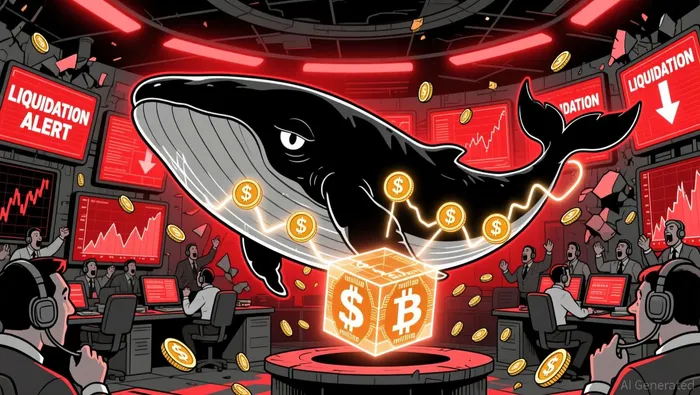
Institutional-grade Bitcoin short-squeeze strategies often rely on layered tactics to manipulate liquidity and trigger cascading liquidations. According to on-chain analytics, whales frequently employ Sell to Buy (STB) and Buy to Sell (BTS) mechanisms, where opposing positions are opened to activate stop-loss orders and absorb retail traders' capital, as noted in a Hashdex analysis. For instance, during a downtrend, a whale might briefly go long to push prices upward, triggering short-covering from retail traders, before reversing the trend to liquidate their own short positions at favorable levels, as Hashdex observed.
The October 2025 market turmoil, triggered by President Trump's 100% tariff announcement on Chinese imports, provided fertile ground for such strategies. Bitcoin plummeted 18% in nine hours, wiping out $19–20 billion in liquidations and 1.62 million traders, according to Lookonchain. While retail investors blamed "whale manipulation," institutional participants capitalized on the chaos. MicroStrategy, for example, acquired 11,000 BTC ($1.1 billion) in Q1 2025, while ETF inflows and outflows fluctuated wildly, reflecting macroeconomic sensitivity, as reported by Lookonchain.
Risk-Reversal Frameworks: Balancing Volatility and Resilience
Despite the October crash, structural factors suggest institutional risk-reversal frameworks are maturing. Bitcoin ETFs now hold 6.5% of the total supply, while Ethereum's staking ratio stands at 30.2%, creating a scenario where modest demand shifts can drive outsized price responses, as Lookonchain reported. These dynamics were evident in the October event: as Bitcoin dipped below $100,000, the Deribit put-call ratio hit 0.72, signaling heightened demand for downside protection, as noted in the Hashdex analysis.
Institutional adoption is also accelerating, with 59% of institutional investors allocating 10%+ of their portfolios to crypto, according to Lookonchain. JPMorgan's acceptance of BTC and ETHETH-- as collateral further underscores the sector's integration into traditional finance. However, the lack of unified safeguards-such as circuit breakers-leaves crypto markets vulnerable to manipulation. During the October crash, centralized exchanges like Hyperliquid and Bybit faced $10.3 billion and $4.65 billion in liquidations, respectively, as Auto-Deleveraging (ADL) mechanisms compounded volatility, as Lookonchain reported.
Investor Implications: Navigating the New Normal
For investors, the October 2025 event highlights the duality of crypto markets: volatility remains a double-edged sword. While whales and institutions exploit short-term dislocations, long-term fundamentals-such as ETF adoption and staking yields-suggest resilience. Mid-tier holders (100–1,000 BTC) expanded their share of total supply from 22.9% to 23.07% during the crisis, indicating sustained institutional confidence, as Lookonchain reported.
However, retail investors must remain cautious. The Crypto Fear & Greed Index's plunge to "Extreme Fear" levels during the crash underscores the emotional toll of market manipulation. Advanced surveillance tools and on-chain analytics are now critical for detecting whale activity, yet the industry still lacks a unified framework to mitigate systemic risks, as Lookonchain reported.
Conclusion
The $12.99 million whale event is a microcosm of broader institutional strategies in Bitcoin markets. While short-squeeze mechanics and risk-reversal frameworks offer lucrative opportunities, they also expose the fragility of a sector still grappling with regulatory and structural gaps. As macroeconomic pressures persist, investors must balance opportunism with vigilance, recognizing that the line between market efficiency and manipulation is increasingly blurred.






Comentarios
Aún no hay comentarios