
Bitcoin Market Dynamics and Short-Squeeze Risks: A Behavioral and Macroeconomic Analysis
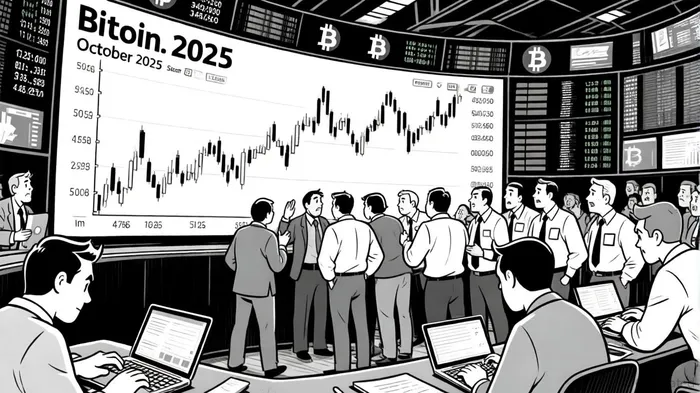
Bitcoin's 2025 price action has been a masterclass in the interplay between macroeconomic forces and behavioral economics. With the cryptocurrency trading near record highs in October 2025, the market is perched on a knife's edge, where institutional adoption, regulatory clarity, and speculative fervor collide with the risks of a short squeeze. This analysis unpacks the dynamics at play, emphasizing how investor psychology and macro signals are shaping Bitcoin's trajectory.
Macroeconomic Tailwinds and Structural Risks
Bitcoin's rally in 2025 has been fueled by a confluence of favorable macroeconomic conditions. The Federal Reserve's shift to an easing monetary policy, marked by rate cuts in late September, has reduced real yields and bolstered risk-on sentiment, according to an Invezz analysis. Simultaneously, a 10% year-to-date decline in the U.S. dollar has made BitcoinBTC-- an attractive alternative asset, while inflows into spot ETFs-bolstered by regulatory clarity under the CLARITY and GENIUS acts-have institutionalized demand, as highlighted in a Clometrix report. These factors have positioned Bitcoin as a high-beta asset, amplifying its sensitivity to liquidity trends and global macro shifts, as noted by Invezz.
However, structural risks loom. U.S.-China tariff tensions and potential yield curve control experiments by central banks could destabilize markets, pushing Bitcoin further into its role as a systemic hedge, according to a CryptoRobotics analysis. Meanwhile, the eurozone's fragility, particularly in France, and the specter of capital controls in advanced economies add layers of uncertainty, as argued in a Medium analysis.
Short-Squeeze Dynamics: A Behavioral and Technical Convergence
Bitcoin's derivatives market is a powder keg. By October 2025, short interest had ballooned to $19 billion, with a single whale's $438 million short position on Hyperliquid sitting perilously close to a $140,000 liquidation threshold, according to CryptoRobotics. This concentration of bearish bets creates a self-fulfilling risk: a sustained rally above key resistance levels ($123,000, $143,170) could trigger cascading liquidations, amplifying volatility, as the Clometrix report shows.
Historical data on similar price events offers nuance. A backtest of Bitcoin's price behavior near the $143,170 resistance and $115,000 support levels from 2022 to 2025 reveals that while these levels occasionally influenced short-term momentum, they did not consistently generate a robust trading edge. Specifically, over 1,319 events where Bitcoin touched these levels, the average excess return over a 30-day horizon was +0.20 ppts (3.67% vs. 3.47%), with no statistically significant advantage. The win rate for such events drifted from ~51% on day 1 to ~59% by day 30, still within random expectation. This suggests that while resistance and support levels may temporarily influence sentiment, they are not reliable predictors of long-term outcomes.
Behavioral economics explains why such scenarios unfold. The reflection effect-where investors become risk-seeking in losses and risk-averse in gains-has driven premature profit-taking during rallies and panic selling during dips, as noted by CryptoRobotics. For example, during Bitcoin's May 2025 short squeeze, institutional buyers provided structural support while retail traders accounted for 89% of liquidations during a $700 million adverse move, according to the Clometrix report. This asymmetry between institutional discipline and retail emotion underscores the fragility of short positions in a market prone to FOMO-driven buying.
AI Sentiment and Macro-Trading Signals: Navigating the Noise
The 2025 Bitcoin market is increasingly governed by AI-driven sentiment analysis and macro-trading signals. Advanced algorithms now parse social media, news, and blockchain data to predict volatility, with some models achieving 85% accuracy in forecasting price swings, according to Clometrix. For instance, during the July 2025 CPI release, sentiment models successfully anticipated Bitcoin's volatility by analyzing pre-event social media chatter, as the Clometrix report documents.
Yet these tools are not infallible. Biases in training data, social media noise (e.g., bot-driven sentiment inflation), and overfitting during volatile periods limit their reliability, per Clometrix. Retail investors, meanwhile, remain susceptible to meme-driven narratives-such as the "Crypto Go Brrr" phenomenon-which can trigger sudden volume spikes, a risk also highlighted in the Medium analysis.
Implications for Investors
For investors, the 2025 Bitcoin landscape demands a dual focus on macroeconomic fundamentals and behavioral guardrails. While ETF inflows and institutional adoption suggest long-term value, short-term volatility will likely persist due to concentrated short positions and psychological triggers. Strategies like dollar-cost averaging and algorithmic hedging can mitigate emotional biases, but they must be paired with a clear-eyed assessment of macro risks, such as geopolitical shocks or regulatory reversals, as CryptoRobotics warns.
The coming months will test Bitcoin's resilience. A break above $140,000 could ignite a short squeeze, but a drop below $115,000 might expose deeper vulnerabilities in the market's structure. As always, the line between opportunity and peril is razor-thin.






Comentarios
Aún no hay comentarios