
Bitcoin's Mainstream Breakthrough: How Block's Zero-Fee Lightning Integration Is Reshaping Global Commerce
The Lightning Network: A Catalyst for Mass Adoption
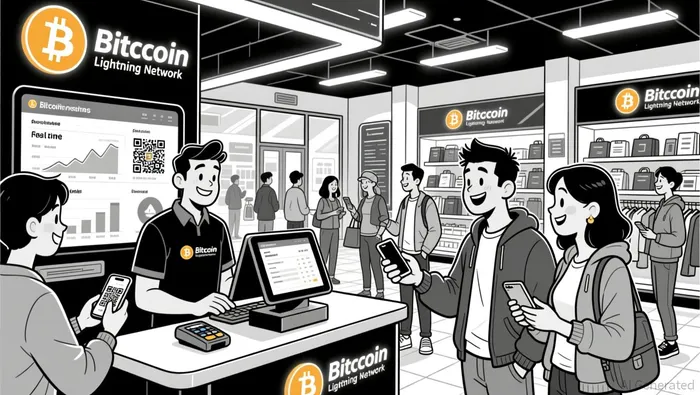
Block's integration of the Bitcoin Lightning Network for over 4 million merchants-primarily in the U.S.-represents a tectonic shift in payment infrastructure. By enabling near-instant settlements and eliminating chargebacks, the Lightning Network addresses Bitcoin's historical scalability issues while slashing transaction costs to zero until 2027, according to a Coinotag report. Merchants can now accept Bitcoin at checkout and convert it to fiat in real time, creating a seamless bridge between crypto and traditional commerce, as noted in a TechInAsia piece.
This strategy isn't just about convenience. It's a calculated move to democratize access to Bitcoin's network effects. For example, Block's $50 incentives for early adopters have accelerated onboarding, while its reinvestment of 10% of Bitcoin profits into its balance sheet signals long-term commitment to the ecosystem, according to a TechInAsia report. The result? Over $15 trillion in on-chain settlements in 2024 alone, a figure that underscores the Lightning Network's growing utility, as noted in a Coinotag report.
Financial Projections and Market Dynamics
Block's Bitcoin business is already a revenue engine. In Q3 2025, the company reported $2 billion in Bitcoin-related revenue, accounting for nearly a third of its total quarterly earnings, according to a TechInAsia report. This growth is part of a broader trend: the Bitcoin technology market is projected to expand at an 18.4% CAGR, reaching $20.15 billion in 2025 and $54.5 billion by 2027, as noted in a TechInAsia report.
The Lightning Network's role in this growth is critical. Coinbase, another major player, now processes 15% of its Bitcoin transaction volume via Lightning, a testament to institutional confidence in the protocol's scalability, according to a TheBlock report. Meanwhile, Block's dominance in Lightning node infrastructure-ranked among the top globally-positions it to capture a significant share of this expanding market, as noted in a TechInAsia report.
Regulatory Hurdles and Strategic Adaptation
Regulatory uncertainty remains a wildcard. Square's exclusion of New York merchants from its Bitcoin rollout highlights the challenges posed by state-level BitLicense requirements, according to a Coinotag report. However, the industry's pivot toward compliance-focused innovation-such as Telcoin's regulated custody services and Hercle's stablecoin infrastructure-suggests a broader strategy to align with evolving U.S. regulations, as noted in a TechInAsia report. For investors, this signals a maturing ecosystem where regulatory agility will determine long-term winners.
Investment Implications: Beyond the Hype
The zero-fee model is a Trojan horse for Bitcoin's mainstream adoption. By removing cost barriers, BlockXYZ-- is incentivizing merchants to experiment with crypto, creating a flywheel effect: increased usage drives network effects, which in turn attract institutional capital. This dynamic is already playing out. The Bitcoin market cap stabilized above $1.35 trillion in 2025, buoyed by infrastructure advancements like Lightning, as noted in a TechInAsia report.
For institutional investors, the key metric is transaction volume velocity. The Lightning Network's ability to process micropayments at scale-combined with Block's 7x growth in usage in 2024-points to a future where Bitcoin competes directly with legacy payment systems, as noted in a TechInAsia report. This isn't just speculative; it's a structural shift in how value is transferred globally.
Conclusion: A New Paradigm for Value Transfer
Block's zero-fee Lightning integration isn't a niche experiment-it's a blueprint for Bitcoin's role in global commerce. For investors, the implications are clear: the next phase of crypto adoption will be defined by infrastructure innovation, regulatory alignment, and the ability to scale utility. As the Bitcoin technology market surges toward $54.5 billion by 2027, companies like Block are not just participants-they're architects of a new financial paradigm.
The question isn't whether Bitcoin will become a mainstream payment method. It's how quickly investors can position themselves to profit from the transition.





Comentarios
Aún no hay comentarios