
Bitcoin's Macroeconomic Crossroads: PCE, Fed Policy, and Volatility in Late 2025
In late 2025, BitcoinBTC-- (BTC) finds itself at a pivotal juncture, where its price trajectory is increasingly shaped by macroeconomic forces such as U.S. inflation data and Federal Reserve (Fed) policy decisions. As the Fed navigates a delicate balance between disinflationary pressures and persistent inflation, Bitcoin's sensitivity to these dynamics has become a focal point for investors and analysts. This article examines how Bitcoin's price in late 2025 has been influenced by the Personal Consumption Expenditures (PCE) inflation report, expectations of rate cuts, and broader liquidity conditions, while also highlighting the asset's evolving role in a risk-on/risk-off environment.
PCE Inflation: A Steady but Uncertain Gauge
The latest U.S. core PCE price index for December 2025 came in at 0.2%, aligning with forecasts and reflecting a stable inflationary environment. This stability has bolstered expectations for a Fed rate cut, with the probability of a 25-basis-point reduction at the December 10 meeting standing at 87.6%. However, historical context complicates this narrative: core PCE inflation had averaged 2.9% year-on-year in September 2025, indicating that while disinflation is progressing, the Fed's 2% target remains elusive.
Bitcoin's price in late 2025 has oscillated between $92,000 and $94,000 as traders priced in these developments. A softer-than-expected PCE reading could further ease the 10-year Treasury yield and support risk assets, including Bitcoin. Yet, the asset's correlation with equities-evidenced by a rolling 20-day correlation coefficient of 0.96 with Nasdaq 100 futures and a high-beta, liquidity-sensitive profile-suggests that Bitcoin is increasingly behaving as a high-beta, liquidity-sensitive asset rather than a traditional safe-haven. This dynamic was underscored in October 2025, when a Fed rate cut led to a 10% drop in Bitcoin's price, defying historical patterns.
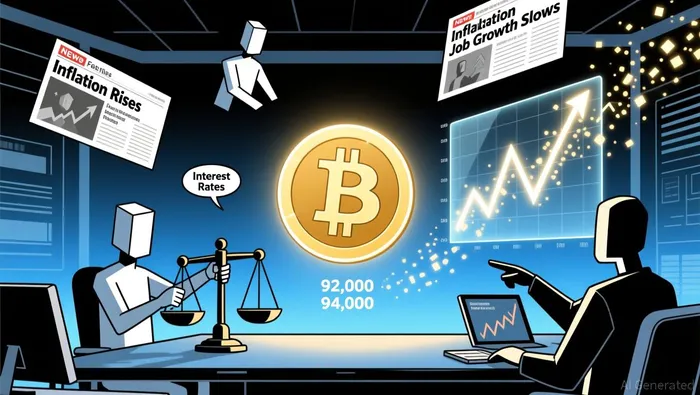
Fed Policy and Liquidity: A Double-Edged Sword
The Fed's decision to end its quantitative tightening (QT) program in December 2025 marked a pivotal shift toward accommodative monetary policy. This move injected liquidity into global markets, with Bitcoin rebounding above $93,000 as the U.S. Dollar Index (DXY) and bond yields fell to multi-month lows. Analysts argue that Bitcoin benefits from lower real yields and easier monetary conditions, as these factors reduce the cost of capital and incentivize flows into risk assets.
However, the market remains fragile. Despite the Fed's dovish pivot, liquidity has not fully recovered, leaving Bitcoin vulnerable to sharp swings triggered by macroeconomic surprises or derivatives activity. For instance, ETF outflows in November 2025 pressured Bitcoin's price, pushing it below $84,000 before stabilizing in late December. This volatility highlights the interplay between institutional demand and macroeconomic signals: while crypto ETF inflows resumed in late December, the asset's performance remains contingent on the Fed's policy path and the broader macroeconomic environment.
Volatility and the PCE-Fed Nexus
Bitcoin's price swings in late 2025 have been closely tied to the release of PCE data and Fed rate-cut expectations. For example, in early December, Bitcoin faced a 3–5% price swing ahead of the PCE report, with traders anticipating a 25-basis-point cut. A core PCE reading of 2.8% year-on-year in December 2025 reinforced the case for a rate cut, but stickier inflation or a stronger labor market could disrupt this narrative and the broader market sentiment.
Historically, Bitcoin has shown a complex relationship with inflation data. While lower real yields and accommodative policy typically support the asset, Bitcoin's response to PCE releases is not linear. For instance, a 25-basis-point rate cut in September 2025 had minimal impact on crypto markets, as the move was largely priced in. Conversely, unexpected geopolitical shocks-such as U.S.-China trade tensions-have amplified volatility, as seen in October 2025 when Trump-era tariff threats triggered a $19 billion flash crash in leveraged positions.
The Road Ahead: Policy, Liquidity, and Institutional Adoption
Looking forward, Bitcoin's trajectory in late 2025 will hinge on three key factors:
1. The December 10 FOMC meeting and Jerome Powell's press conference will validate or refute market expectations of a rate cut.
2. The Fed's pivot toward rate cuts and the end of QT have already improved liquidity, but further easing could push Bitcoin toward $100,000.
3. ETF inflows and regulatory developments-such as the SEC's proposed "innovation exemption"-have reinforced institutional confidence, though concerns about systemic risks from large holders like MicroStrategy (MSTR) persist.
Conclusion
Bitcoin's sensitivity to PCE inflation data and Fed policy in late 2025 underscores its role as a barometer for global liquidity and risk appetite. While the asset has historically benefited from accommodative monetary conditions, its price movements remain subject to macroeconomic surprises, regulatory shifts, and geopolitical tensions. As the Fed prepares for further rate cuts in 2025, investors must remain vigilant to the interplay between inflation data, liquidity dynamics, and institutional adoption-a trifecta that will define Bitcoin's next chapter.






Comentarios
Aún no hay comentarios