
Bitcoin as a Macro Hedge Against Fiat Currency Erosion
The Erosion of Dollar Credibility
The U.S. dollar's dominance is under pressure from multiple fronts. In Q3 2025, the Consumer Price Index (CPI) hit 2.9% year-over-year, with core CPI at 3.1%-well above the Federal Reserve's 2% target, as reported in Powell and the US Economy. These figures, while slightly lower than 2023's 4.1% annual inflation rate, per Dollar Tree's Q3 2025 report, remain stubbornly elevated, driven by cost-push pressures from tariffs and supply chain disruptions. For instance, Polaris, a major manufacturer, raised its estimated FY25 tariff costs to $130–140 million, forcing it to restructure supply chains and accept margin compression, according to Polaris' FY25 tariff update. Such corporate pain points underscore how trade policies are reshaping economic fundamentals, further straining the dollar's credibility.
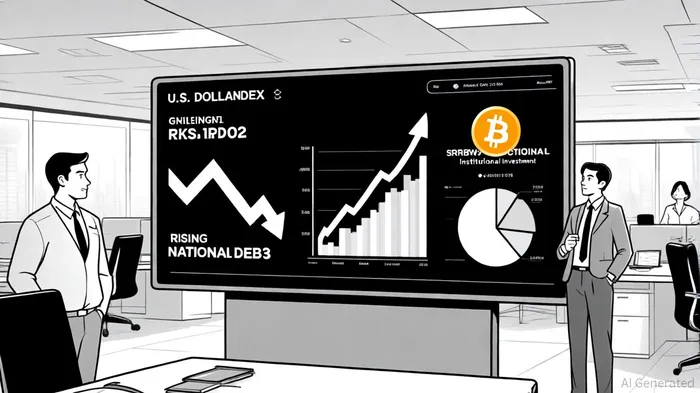
Compounding these issues, the U.S. national debt now exceeds $37.8 trillion, according to The CryptoBasic article, a figure that dwarfs annual tax revenues and raises questions about long-term fiscal sustainability. Morningstar analysts warn that the dollar is "overvalued" and that structural weaknesses-including rising debt and political pressures on the Federal Reserve-are eroding institutional confidence. This environment has created fertile ground for alternative assets like Bitcoin, which offer a fixed supply cap and decentralized value proposition.
Institutional Bitcoin ETF Demand: A New Era
Bitcoin ETFs have become the vehicle of choice for institutions seeking exposure to crypto's macro hedge. In late October 2025, spot Bitcoin ETFs saw a staggering $2.71 billion in net inflows between October 6–10 alone, according to a Coinotag report, with BlackRock's IBIT capturing $2.63 billion of that total. This surge coincided with Bitcoin trading above $122,000-a 7.55% weekly gain-highlighting renewed institutional confidence, as noted in a BlackRock iShares report.
The trend is not isolated to a single firm. Luxembourg's sovereign wealth fund, FSIL, became the first Eurozone institution to allocate $8 million (1% of its €702 million portfolio) to Bitcoin ETFs in July 2025, signaling a strategic diversification into alternative assets, per a Luxembourg sovereign fund report. Similarly, BlackRock added $136 million in Bitcoin and EthereumETH-- to its ETFs, with IBIT holding 781,900 BTC and ETHA acquiring 16,910 ETH, as detailed in a Coinotag report on BlackRock. These moves, executed through platforms like CoinbaseCOIN-- Prime, reflect a growing institutional consensus that Bitcoin's scarcity and censorship resistance make it an essential portfolio component.
The Macro Hedge: Why Bitcoin Wins
Bitcoin's appeal lies in its ability to hedge against the devaluation of fiat currencies. Unlike the U.S. dollar, which can be printed indefinitely, Bitcoin's 21 million supply cap enforces scarcity-a trait historically associated with hard assets like gold. As central banks struggle to balance inflation control with economic growth, Bitcoin offers a counterparty-free store of value.
This dynamic is already reshaping capital flows. The $3.5 billion inflow into BlackRock's iShares Bitcoin Trust in October 2025 mirrors broader trends in asset management, where Bitcoin ETFs are now treated as regulated, liquid alternatives to traditional holdings. Even speculative ideas-like using XRPXRP-- to offset the $37.8 trillion debt-highlight the market's search for solutions to fiat's limitations (see The CryptoBasic article). Yet, Bitcoin's institutional adoption remains grounded in its proven resilience, not hypothetical scenarios.
Conclusion: A Paradigm Shift
The U.S. dollar's credibility erosion and the rise of Bitcoin ETFs signal a paradigm shift in global finance. Institutions are no longer viewing Bitcoin as a speculative asset but as a necessary hedge against monetary debasement. As more capital flows into regulated crypto products, Bitcoin's role as a macro hedge will only solidify-forcing traditional markets to adapt or risk obsolescence.





Comentarios
Aún no hay comentarios