
Bitcoin's Macro-Driven Volatility: Decoding Binance Signals and PCE Inflation in 2025
Introduction
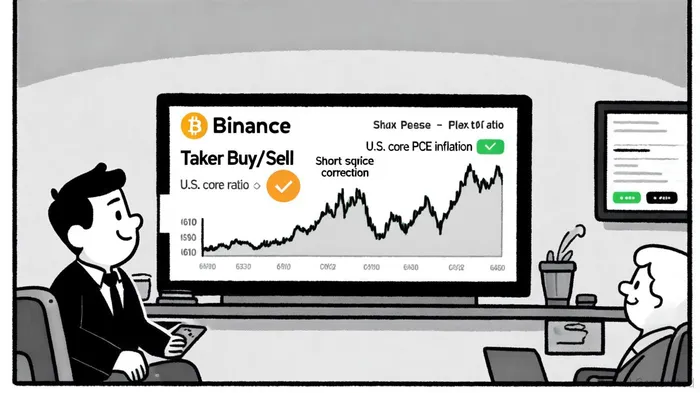
Bitcoin's price dynamics in 2025 have become increasingly intertwined with macroeconomic signals and exchange-level volatility metrics. As the U.S. Personal Consumption Expenditures (PCE) inflation data and Binance's on-chain indicators—such as the Taker Buy/Sell ratio and short squeeze pressure—gain prominence, investors are recalibrating their strategies to navigate a market where traditional and digital asset correlations are tightening. This analysis explores how these macroeconomic and exchange-specific signals interact to shape Bitcoin's price trajectory, offering actionable insights for 2025.
Binance Volatility Signals: A Microcosm of Market Sentiment
Binance's Taker Buy/Sell ratio has emerged as a critical barometer of short-term BitcoinBTC-- sentiment. As of late September 2025, the ratio fell below 1.0, indicating that selling pressure on the exchange outweighed buying activity [1]. This divergence from the broader market—where the aggregate Taker Buy/Sell ratio across other exchanges remained above 1.0—has historically preceded Bitcoin price corrections of 5–10% within days, as seen in February 2024 and August 2023 [2].
Short squeeze pressure on Binance further amplifies volatility. With 62% of traders short on the platform and $108 million in recent short liquidations, Bitcoin faces a high probability of sharp rallies if it breaks above $110,000 [3]. Historical patterns, such as the May 2025 surge from $88,000 to $104,000, underscore how short-covering cascades can drive rapid price surges [4].
U.S. PCE Inflation: A Macroeconomic Anchor for Bitcoin
The U.S. core PCE inflation data for 2025 has remained stubbornly elevated, averaging 2.5–2.8% year-over-year [5]. This “sticky inflation” has delayed Federal Reserve rate cuts, which are typically bullish for risk assets like Bitcoin. For instance, the January 2025 PCE report—showing a 2.5% headline rate and a 0.3% core increase—correlated with a 1.7% drop in Bitcoin's price as traders priced in prolonged high-interest-rate environments [6].
Conversely, unexpected PCE declines, such as the March 2025 reading of 2.3%, have reignited hopes for rate cuts and liquidity expansion, temporarily boosting Bitcoin [7]. However, the interplay between PCE data and Bitcoin's implied volatility remains complex. In September 2025, Bitcoin's implied volatility hit multi-year lows, diverging from its price action and signaling a potential consolidation phase ahead of a breakout [8].
Interplay of Signals: Macro and Micro in Sync
The convergence of Binance's bearish divergence and sticky PCE inflation has created a volatile environment. For example, in September 2025, Bitcoin's price dipped as Binance's Taker Buy/Sell ratio fell below 1.0, coinciding with a hotter-than-expected PCE report [9]. This dual pressure amplified selling, pushing Bitcoin below $104,000 after a 5% weekly decline [10].
Conversely, short squeeze events on Binance—such as the $66.3 million liquidation in May 2025—have temporarily offset macroeconomic headwinds, driving Bitcoin to $111,000 [11]. These episodes highlight how exchange-level dynamics can counteract or reinforce macro trends, depending on liquidity conditions and trader positioning.
Strategic Implications for Investors
- Short-Term Hedging: With Binance's short squeeze pressure at elevated levels, investors should consider hedging against sudden rallies above $110,000, particularly if PCE data signals Fed easing.
- Macro-Monitoring: Closely track PCE releases for clues on rate-cut timelines. A sustained drop below 2.3% could unlock liquidity-driven Bitcoin rallies.
- Divergence Alerts: Binance's Taker Buy/Sell ratio below 1.0, combined with elevated short positions, warrants caution. Historical precedents suggest corrections of 5–10% are likely if the ratio remains sub-1.0.
Conclusion
Bitcoin's price in 2025 is increasingly a function of both micro-level exchange signals and macroeconomic fundamentals. Binance's volatility metrics provide granular insights into trader behavior, while U.S. PCE inflation acts as a broader policy anchor. For investors, the key lies in synthesizing these signals to anticipate volatility, manage risk, and capitalize on dislocations in a market where digital and traditional asset dynamics are converging.






Comentarios
Aún no hay comentarios