
Bitcoin's Long-Term Viability Post-Crash: Debunking the Debasement Narrative
The narrative that BitcoinBTC-- is a debased asset-destined to lose value due to regulatory crackdowns, macroeconomic headwinds, or speculative overextension-has persisted since its 2022 crash. Yet, the data from 2023 to 2025 tells a different story. Bitcoin's post-crash recovery, institutional adoption, and alignment with macroeconomic trends collectively refute the notion of debasement, painting a picture of a maturing asset class with long-term resilience.
Market Behavior: A Resilient Recovery
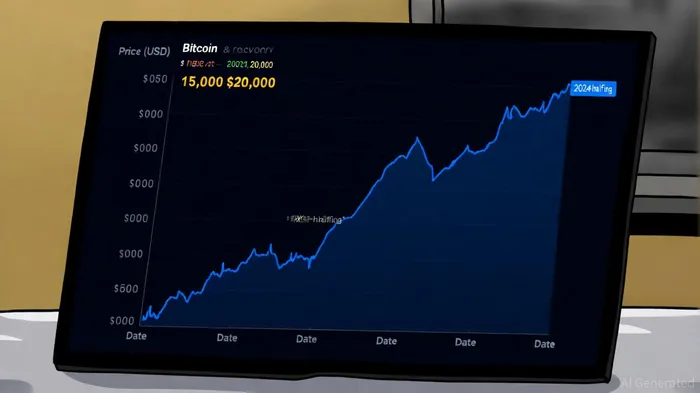
Bitcoin's price trajectory since 2023 defies the "debasement" narrative. After hitting a low of $25,000 in early 2023, the cryptocurrency stabilized and began a steady ascent, forming higher lows and higher highs-a hallmark of technical strength. By 2024, Bitcoin had rebounded to $50,000, and as of October 2025, it traded near $111,000, with projections suggesting a potential pullback to $100,000 as a bullish consolidation phase[1].
This recovery aligns with Bitcoin's historical 2–3-year cycle for post-crash rebounds[1]. The 2024 halving event, which reduced block rewards and tightened supply, acted as a catalyst, historically preceding price rallies. Moreover, volatility has normalized to historic lows, with seasonal trends pointing to a strong Q4 2025 breakout[4]. Critics who argue Bitcoin is "debased" ignore its ability to absorb shocks-such as the October 2025 U.S.-China trade shock, which caused a 10% dip but was swiftly reversed by institutional demand[1].
Prior to the 2023 recovery, Bitcoin's support level around $17,000–$18,000 played a critical role in stabilizing the price during late 2022. This level, tested repeatedly, acted as a psychological and technical barrier, preventing further declines amid volatile market conditions[1]. While it provided a floor for the asset, the narrow trading range also limited upward momentum, reflecting mixed investor sentiment. On one hand, the support level offered reassurance to long-term holders; on the other, the stagnant price trend frustrated investors seeking growth, potentially leading to capital outflows[1].
Technical analysis suggests that the resilience of this support level contributed to Bitcoin's eventual rebound. A breakout above $18,000 could have signaled renewed buyer confidence, while a sustained drop below $17,000 might have triggered further selling pressure[1]. The historical performance of this support level underscores Bitcoin's ability to absorb shocks and maintain structural strength, even during periods of uncertainty.
Institutional Adoption: A New Era of Legitimacy
The approval of U.S. spot Bitcoin ETFs in early 2024 marked a turning point. These products injected institutional capital and legitimacy into the market, with global crypto ETFs attracting $5.95 billion in inflows by October 2025 alone[1]. U.S. ETFs now hold 1.3 million BTC, while corporate treasuries added another 1.1 million BTC to their holdings, collectively controlling 12.2% of the total supply[1].
This institutional adoption has transformed Bitcoin from a speculative asset into a recognized store of value. For instance, ARK Invest notes that historical peaks in ETF balances have consistently preceded new price highs[1]. The growing participation of institutions-coupled with layer-2 scaling solutions and regulatory clarity-has reduced Bitcoin's perceived risk profile, making it a viable alternative to traditional assets like gold[3].
Macroeconomic Trends: Bitcoin as a Hedge
Bitcoin's appeal as a hedge against macroeconomic instability further undermines the debasement narrative. The Fed's dovish stance, including a 0.25% rate cut in September 2025 and expectations of further cuts, has historically correlated with strong Bitcoin performance[1]. In a world of quantitative easing and geopolitical tensions, Bitcoin's fixed supply of 21 million coins positions it as a natural counter to fiat devaluation.
Moreover, Bitcoin's role as "digital gold" has been reinforced by its performance during periods of traditional market instability. For example, during the October 2025 trade shock, Bitcoin's price stabilized faster than equities, underscoring its unique utility as a safe-haven asset[3]. Analysts argue that Bitcoin's ability to absorb macroeconomic shocks-while maintaining its value-demonstrates its long-term viability[1].
Addressing the Bear Case
Critics of Bitcoin's long-term prospects often cite potential corrections due to Fed policy missteps or geopolitical risks. Citigroup, for instance, warns of a possible $60,000–$80,000 pullback in 2026[1]. However, these bearish scenarios assume a static market environment, ignoring the compounding effects of institutional adoption and regulatory progress. The EU's MiCA framework and U.S. ETF rules have already reduced uncertainty, paving the way for broader participation[1].
Additionally, technical indicators like RSI and MACD suggest Bitcoin is in a strong uptrend, though overbought levels caution against short-term overextension[1]. A mid-cycle correction, if it occurs, would likely mirror historical patterns rather than signal debasement.
Conclusion
Bitcoin's post-crash recovery, institutional adoption, and macroeconomic alignment present a compelling case for its long-term viability. The "debasement" narrative, rooted in short-term volatility and outdated assumptions, fails to account for the structural changes reshaping the crypto ecosystem. As Bitcoin approaches its next halving cycle and institutional demand accelerates, its role as a hedge against traditional financial instability-and its potential to outperform fiat currencies-will only strengthen.
For investors, the key takeaway is clear: Bitcoin is not a debased asset but a maturing store of value, increasingly integrated into the global financial system.






Comentarios
Aún no hay comentarios