
Bitcoin's Long-Term Viability: Navigating Macroeconomic Realities and Fading Speculation
Bitcoin's journey from a niche speculative asset to a macroeconomic player has been marked by volatility, institutional adoption, and evolving correlations with traditional financial indicators. As the cryptocurrency faces price stagnation in late 2025, the debate over its long-term viability hinges on its integration into global macroeconomic systems versus its historical roots in speculative fervor.
Macroeconomic Integration: A New Paradigm
Bitcoin's price movements from 2020 to 2025 have increasingly mirrored macroeconomic fundamentals. A Bayesian structural VAR model revealed that cryptocurrency price shocks explain 18% of equity and 27% of commodity price fluctuations, while contributing 4% to unemployment and 6% to industrial production variance. This underscores Bitcoin's role as a systemic financial asset rather than an isolated speculative play.
Central bank policies, particularly the Federal Reserve's 75-basis-point rate hike in November 2025, further highlight this integration. Despite expectations that lower interest rates would bolster Bitcoin as an inflation hedge, the asset underperformed, dropping below $100,000 amid persistent inflation above 2%. Analysts now argue that BitcoinBTC-- behaves more like a high-beta technology stock than a stable store of value, reacting to liquidity shifts and geopolitical tensions rather than purely inflationary pressures.
Global GDP trends and inflationary pressures in Japan and the U.S. have also shaped Bitcoin's valuation. By the third quarter of 2025, its correlation with the S&P 500 reached 0.85, signaling alignment with traditional markets. 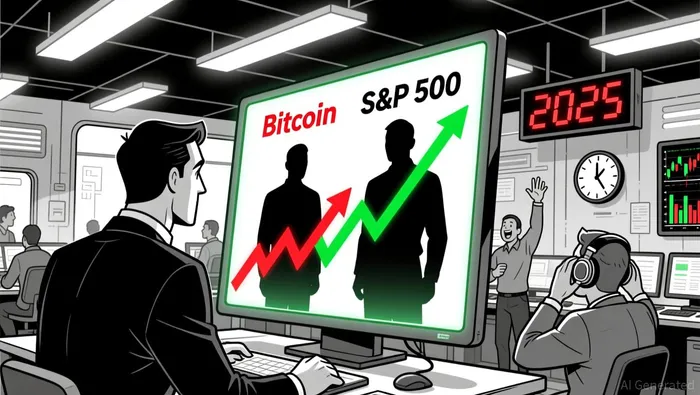 . This alignment reflects Bitcoin's growing acceptance as a macroeconomic asset, influenced by the same forces that drive equities and commodities.
From Speculation to Stability: Historical Cycles Revisited
Bitcoin's historical cycles-peaking in 2017, 2021, and now 2025-reveal a shift from retail-driven speculation to institutional-driven stability. The 2017 bull run, fueled by media hype and retail frenzy, saw prices surge from under $1,000 to $20,000, only to collapse in 2018. In contrast, the 2025 cycle, while marked by a rare October price dip (a historically bullish month), has seen institutional investors maintain positions, suggesting a more mature market.
The 2025 dip, which saw Bitcoin consolidate between $100,000 and $115,000, mirrors the 2017 correction but with key differences. Over 8% of Bitcoin's total supply is now held in corporate treasuries, and the launch of spot Bitcoin ETFs has attracted long-term institutional capital. These developments distinguish 2025 from 2017, where retail speculation dominated and liquidity was far less robust.
Institutional Adoption: A Game Changer
Institutional adoption has been a cornerstone of Bitcoin's macroeconomic evolution. The proliferation of spot ETFs and regulatory clarity-such as the U.S. Securities and Exchange Commission's (SEC) recent approvals-has normalized Bitcoin as a portfolio asset. This shift is evident in Bitcoin's reduced volatility compared to earlier cycles, as institutional investors prioritize long-term value over short-term speculation.
Moreover, Bitcoin's fixed supply and lack of traditional cash flows make it uniquely responsive to macroeconomic demand drivers. Falling interest rates, global dollar liquidity, and inflation expectations now play a more direct role in its valuation. For example, the Federal Reserve's December 2025 rate cut, despite dissenting votes, has created uncertainty that complicates Bitcoin's inflation-hedge narrative. Yet, institutional demand remains resilient, with corporate holdings acting as a stabilizing force.
The Road Ahead: Macroeconomic Cues and Technical Indicators
Looking forward, Bitcoin's trajectory depends on macroeconomic stability and technical resilience. If the asset sustains support above $100,000 and key resistance levels like $115,000 hold, it could retest prior highs or even break into new territory. However, challenges such as slower liquidity inflows and political uncertainty persist.
Technical indicators and historical cycle overlays suggest a potential parabolic move if macro conditions stabilize. Matt Hougan of Bitwise notes that Bitcoin's traditional four-year cycle is being reshaped by new macroeconomic forces, including regulatory clarity and institutional adoption. This evolution positions Bitcoin not just as a speculative play but as a legitimate macro asset reflecting broader economic trends.
Conclusion
Bitcoin's long-term viability is no longer solely a question of speculative demand but a function of its integration into macroeconomic systems. While price stagnation in 2025 has tested its inflation-hedge narrative, the asset's growing alignment with traditional markets, institutional adoption, and regulatory progress suggest a durable foundation. As macroeconomic forces and technical indicators converge, Bitcoin's role as a macro asset-rather than a speculative outlier-may yet define its next chapter.






Comentarios
Aún no hay comentarios