
Bitcoin as a Long-Term Store of Value: Why Stacking and Time Beat Timing
In the ever-evolving landscape of global finance, BitcoinBTC-- has emerged as a unique asset class, challenging traditional paradigms of value storage and wealth preservation. With its fixed supply of 21 million coins, Bitcoin's design inherently resists inflation and mimics the scarcity of precious metals like gold. This scarcity, combined with its decentralized nature, positions Bitcoin as a compelling alternative to fiat currencies, particularly in an era marked by rising national debts and monetary debasement. However, the true test of Bitcoin's value lies not just in its supply constraints but in how investors approach it: through disciplined accumulation and patience, rather than speculative timing.
The Scarcity Premium and Inflation Resistance
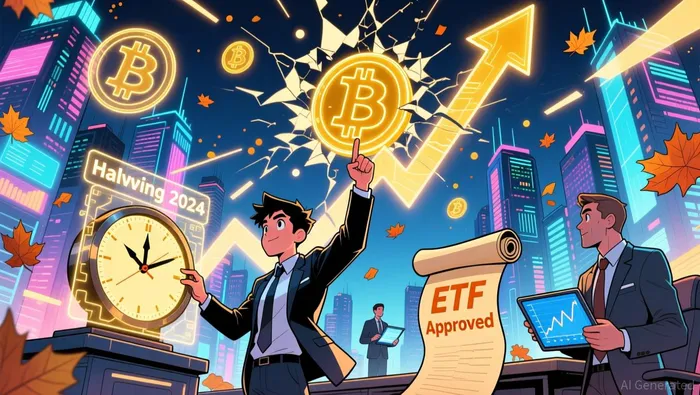
Bitcoin's capped supply ensures that no additional units can be created beyond 2140, a feature that distinguishes it from fiat currencies, which can be inflated at will by central banks according to Investopedia. This scarcity-driven model has been a cornerstone of its appeal as a store of value. As of 2025, over 19.7 million BTC have been mined, with the remaining coins expected to be released through halving events that reduce block rewards by 50% every four years. These halvings not only slow the rate of new supply but also create a deflationary pressure that, historically, has coincided with price surges. For instance, the 2024 halving event, coupled with the approval of Bitcoin spot ETFs, drove the price to over $72,000 by March 2024.
The economic implications of this scarcity are profound. Governments and institutions, including the United States and El Salvador, have explored Bitcoin as a strategic reserve asset to hedge against inflation and geopolitical risks. Unlike gold, which requires physical storage and is subject to logistical challenges, Bitcoin offers a censorship-resistant, borderless alternative that can be transferred instantly and securely.
Behavioral Finance: The Pitfalls of Market Timing
Despite Bitcoin's structural advantages, its volatility has made it a magnet for speculative behavior. Behavioral finance research underscores how cognitive biases-such as overconfidence, anchoring, and herding- distort rational decision-making in cryptocurrency markets. Investors often attempt to time the market, seeking to buy at perceived lows and sell at highs. However, studies show that even poorly executed market timing strategies typically underperform consistent, disciplined accumulation.
For example, during the 2018 crypto winter, Bitcoin lost 80% of its value but regained its losses within three years, surpassing previous all-time highs. Similarly, in 2025, Bitcoin reached a peak of $126,198.07 before a short-lived correction, demonstrating its asymmetric recovery potential. These patterns highlight a critical insight: attempting to predict Bitcoin's price movements is fraught with risk, as emotional biases often lead to premature exits or overexposure during downturns.
The Power of Disciplined Accumulation
Disciplined accumulation, such as dollar-cost averaging (DCA), mitigates the risks of volatility by spreading investments over time. This approach avoids the trap of anchoring to arbitrary price points and reduces the psychological burden of timing the market. Historical data reinforces this strategy's efficacy: from 2020 to 2025, Bitcoin's price surged despite macroeconomic uncertainties, including the pandemic and geopolitical tensions according to Investopedia. Investors who consistently added to their positions during dips, rather than waiting for a "perfect" entry point, capitalized on its long-term appreciation.
Moreover, Bitcoin's inverse relationship with the U.S. dollar has been a key driver of its resilience. Studies using wavelet coherence analysis reveal that Bitcoin's price dynamics are less correlated with the ICE U.S. dollar index (DXY) than traditional assets, reinforcing its role as a hedge against currency risk. This decoupling is particularly relevant in a world where central banks are increasingly expanding money supplies, eroding the purchasing power of fiat currencies.
Institutional Adoption and Macroeconomic Tailwinds
The institutionalization of Bitcoin has further solidified its legitimacy as a long-term store of value. By 2025, 59% of institutional investors allocated 1–5% of their portfolios to Bitcoin, recognizing its potential to diversify risk and preserve capital. The approval of spot Bitcoin ETFs in early 2024 marked a turning point, unlocking $43 trillion in addressable capital and normalizing Bitcoin as a mainstream asset. This shift has reduced its perceived volatility relative to traditional markets, with its correlation to the S&P 500 rising to 0.5–0.88 in 2025.
However, Bitcoin's role in a diversified portfolio remains nuanced. While its volatility is 3–4 times higher than the S&P 500, its scarcity-driven value proposition makes it a strategic tool for generational wealth planning. Experts emphasize that Bitcoin should not be viewed as a stable store of value but as a high-risk, high-reward asset that requires careful allocation based on individual risk tolerance.
Conclusion: Stacking and Time Beat Timing
Bitcoin's fixed supply and historical resilience underscore its potential as a long-term store of value. Yet, its true value is unlocked not through speculative timing but through disciplined accumulation and patience. Behavioral finance principles caution against the pitfalls of emotional decision-making, while historical data demonstrates that consistent, patient investors outperform those who chase short-term gains. As Bitcoin continues to mature as an asset class, its role in wealth preservation will depend on investors' ability to align their strategies with its structural advantages-scarcity, decentralization, and macroeconomic tailwinds.
In a world of fiat devaluation and geopolitical uncertainty, Bitcoin offers a unique combination of scarcity and adaptability. For those willing to embrace its volatility and commit to a long-term horizon, the rewards may well justify the risks.






Comentarios
Aún no hay comentarios