
Bitcoin's Long-Term Price Trajectory and Solana's Institutional Adoption Potential: A Macro-Driven Investment Outlook
The cryptocurrency market in 2025 is being reshaped by a confluence of macroeconomic tailwinds, institutional adoption, and regulatory clarity. Two assets—Bitcoin and Solana—stand at the forefront of this transformation, each driven by distinct yet complementary forces. This analysis delves into Bitcoin's long-term price trajectory and Solana's institutional adoption potential, framing their trajectories within the broader context of high-conviction macro trends.
Bitcoin's Long-Term Price Trajectory: A Confluence of Scarcity and Institutional Demand
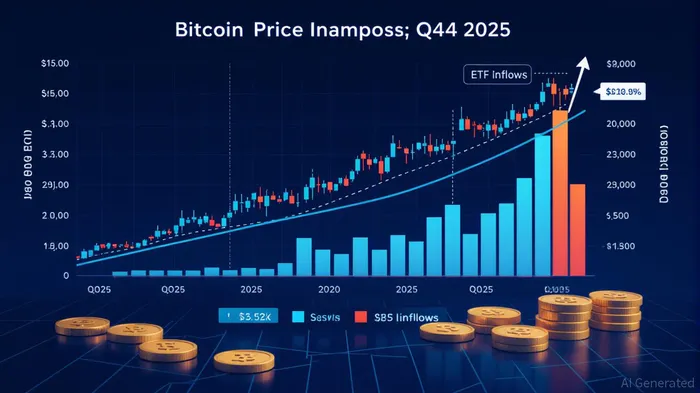
Bitcoin's price action in 2025 is increasingly influenced by structural factors that align with bullish macroeconomic narratives. Galaxy Research projects BitcoinBTC-- to cross $150,000 in H1 2025 and test $185,000 by Q4 2025, citing post-halving supply constraints and institutional adoption as key drivers[1]. Similarly, Gov Capital forecasts a base case range of $110,000–$150,000 for Q3 2025, expanding to $130,000–$180,000 by year-end, fueled by ETF inflows and regulatory progress[2].
The macroeconomic backdrop further strengthens Bitcoin's case. The U.S. national debt surpassing $36.2 trillion has prompted investors to seek alternatives to dollar-based assets, with Bitcoin increasingly viewed as a hedge against fiat devaluation[3]. Meanwhile, the Federal Reserve's anticipated rate cuts in a “low inflation + low growth” environment could redirect capital flows into Bitcoin, which historically exhibits an inverse correlation with the U.S. dollar[4].
Institutional adoption has also accelerated, with Bitcoin ETFs amassing $160 billion in assets under management (AUM), drawing parallels to gold ETFs[5]. The Genius Act's passage in July 2025 has further legitimized Bitcoin as a strategic reserve asset, with Standard Chartered and Bitwise projecting $200,000–$250,000 by year-end[6]. However, skeptics caution that achieving $200,000 requires sustained buying pressure and favorable geopolitical conditions[7].
Solana's Institutional Adoption Potential: Scalability, Partnerships, and Yield-Driven Strategies
While Bitcoin dominates headlines, SolanaSOL-- (SOL) is quietly capturing institutional interest through its technical superiority and strategic partnerships. The network's 18-month streak of perfect uptime, coupled with 162 million daily transactions and sub-400ms finality, positions it as a scalable infrastructure for institutional-grade applications[8]. Partnerships with PayPalPYPL--, ShopifySHOP--, and BlackRockBLK-- have further cemented Solana's role in tokenizing real-world assets (RWAs) and expanding decentralized finance (DeFi) ecosystems[9].
Institutional adoption is also driven by Solana's deflationary tokenomics and high staking yields (7–8%), which mirror traditional treasury strategies[10]. The Firedancer upgrade, enhancing validator efficiency, and the Alpenglow consensus update are critical upgrades that reduce downtime and improve network reliability[11]. Meanwhile, over $600 million in SOL held by public companies and pending spot ETF applications from VanEck and Bitwise signal a potential influx of billions in institutional capital[12].
On-chain metrics underscore Solana's growth: 90 million monthly active addresses and a DeFi TVL of $7.8 billion highlight its expanding utility[13]. Analysts project that a Solana ETF approval could push the price toward $4,000, with bullish technical patterns like the “cup and handle” suggesting further upside[14]. However, historical backtesting of the cup-and-handle pattern on SOL from 2022 to 2025 reveals mixed results. While 93 instances of the pattern were detected, the average return over a 30-day holding period was approximately -2%, matching the benchmark's performance. Short-term returns (1-10 days) also showed negative averages, with win rates around 35-40%.
Investor Sentiment and Technical Analysis: Navigating Volatility
Bitcoin's current consolidation around $115,000 reflects a tug-of-war between bullish fundamentals and historical September volatility[16]. A breakout above $117,000 could signal a path toward $125,000, while a drop below $110,000 risks a correction. For Solana, the 132% recovery from a mid-2025 low to $236 demonstrates resilience, with on-chain data and institutional inflows suggesting a potential retest of its 2025 high of $263[17].
Conclusion: A Macro-Driven Bull Case for Crypto
Bitcoin and Solana exemplify the macroeconomic and institutional forces reshaping the crypto landscape. Bitcoin's scarcity-driven narrative, bolstered by ETF inflows and regulatory clarity, supports a multi-year bull case. Meanwhile, Solana's technical innovation and strategic partnerships position it as a critical infrastructure layer for institutional adoption. Investors who align with these trends may find compelling opportunities in both assets, though vigilance toward regulatory and macroeconomic headwinds remains essential.





Comentarios
Aún no hay comentarios