
Bitcoin's Long-Term Price Trajectory: Macroeconomic and On-Chain Catalysts for 2028
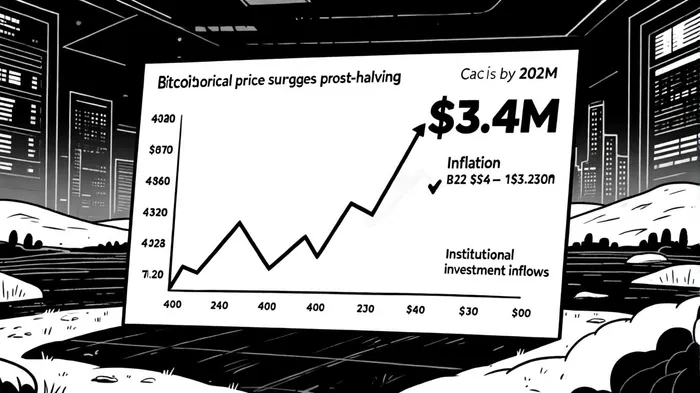
The cryptocurrency market has long been a theater of volatility, but Bitcoin's long-term trajectory is increasingly shaped by macroeconomic forces and on-chain fundamentals. Arthur Hayes, co-founder of BitMEX, has famously predicted BitcoinBTC-- could reach $3.4 million by 2028. While the specifics of his model remain opaque, the broader market dynamics he likely considers—such as halving events, institutional adoption, and macroeconomic shifts—provide a compelling framework for analysis.
Macroeconomic Catalysts: Inflation, Interest Rates, and Institutional Trust
Bitcoin's appeal as a hedge against inflation and central bank overreach remains a cornerstone of its value proposition. As global inflation rates climb, fiat currencies lose purchasing power, driving demand for scarce assets like Bitcoin. According to a report by the World Bank, macroeconomic instability often spurs investors to seek alternatives, with Bitcoin's fixed supply of 21 million coins making it a natural contender[1].
However, rising interest rates complicate this narrative. Higher rates incentivize capital to flow into yield-bearing assets, potentially cooling speculative demand for cryptocurrencies. Yet, as central banks normalize rates post-pandemic, the market is adapting. The recent approval of U.S. crypto ETFs—such as those for Ripple's XRPXRP-- and Dogecoin—signals growing institutional confidence[3]. These products act as bridges, funneling traditional capital into crypto markets while mitigating regulatory uncertainty.
On-Chain Dynamics: Scarcity, Halvings, and Market Cycles
Bitcoin's supply mechanics are arguably its most robust long-term catalyst. The 2024 halving event, which reduced block rewards from 6.25 to 3.125 BTC, is a textbook example of how scarcity drives value. Historical patterns show price surges following halvings, as reduced issuance tightens supply while demand grows[2]. By 2028, the next halving will further constrain Bitcoin's annual supply, potentially amplifying its store-of-value narrative.
On-chain metrics also suggest Bitcoin is entering a consolidation phase. Markus Thielen of 10x Research notes that recent market activity has faded, with traders unwinding leveraged positions after a $200 billion crypto sell-off[3]. This correction, while painful in the short term, may stabilize the price base for future growth.
Converging Forces: The Path to $3.4M by 2028
For Bitcoin to reach $3.4 million by 2028, several conditions must align:
1. Macroeconomic Stability: A return to low inflation and steady interest rates would reduce the cost of capital, encouraging long-term investment in Bitcoin.
2. Institutional Adoption: Continued ETF approvals and corporate treasury allocations (e.g., MicroStrategy's Bitcoin purchases) will normalize Bitcoin as a financial asset.
3. Supply Constraints: The 2028 halving will reduce issuance by 50%, reinforcing Bitcoin's scarcity premium.
4. Regulatory Clarity: A coherent global framework will mitigate risks, attracting institutional capital.
While short-term volatility persists—exacerbated by leverage and profit-taking—the long-term fundamentals remain intact. Arthur Hayes' $3.4M target, though ambitious, is plausible if these catalysts converge.
Conclusion
Bitcoin's journey to $3.4 million by 2028 hinges on its ability to outperform traditional assets in a macroeconomic environment defined by scarcity and institutional trust. While the path is fraught with volatility, the interplay of halvings, regulatory progress, and macroeconomic shifts creates a compelling case for long-term optimism. Investors who align with these structural trends may find themselves well-positioned for the next leg of Bitcoin's ascent.






Comentarios
Aún no hay comentarios