
Bitcoin's Long-Term Holder Dominance: A Structural Bull Case for 2025 and Beyond
Bitcoin's market fundamentals in 2025 are being reshaped by a seismic shift in holder behavior. Over 92% of newly mined BitcoinBTC-- is now absorbed by long-term holders (LTHs), while short-term holder (STH) supply has collapsed to historic lows[1]. This structural reallocation-from speculative to strategic ownership-is not just a market anomaly; it is a foundational signal of Bitcoin's maturation as an asset class.
The On-Chain Case for Structural Bullishness
On-chain data reveals a stark redistribution of Bitcoin's supply. Entities holding Bitcoin for over 155 days now control 15.9 million BTC, a 10.4% quarter-on-quarter increase[1]. The 1+ Year HODL Wave alone accounts for 64% of total supply[4], a level not seen since the 2021 bull market. This trend mirrors historical patterns preceding sustained bullish phases, where reduced active liquidity strengthens technical support levels[1].
Institutional actors are accelerating this shift. BlackRock's iShares Bitcoin Trust (IBIT) alone amassed $86 billion in AUM by mid-2025[1], while the U.S. Treasury manages a $23 billion strategic Bitcoin reserve[1]. These moves signal Bitcoin's transition from speculative token to strategic reserve asset-a narrative reinforced by the 3–5 year holder cohort, which controls 12% of circulating supply and shows signs of exhaustion[5].
Institutional Capital: The New Market Floor
The approval of U.S. spot Bitcoin ETFs in 2024 catalyzed a $118 billion institutional inflow in Q3 2025[2]. This capital influx has normalized Bitcoin's volatility, reducing annualized volatility by 75% compared to 2020 levels[1]. The ETF-driven demand-absorption dynamic is critical: for every 3.125 BTC mined (post-2024 halving), ETFs absorbed 10x that volume in Q3 2025[4]. This structural demand, combined with Bitcoin's fixed 21 million supply cap, creates a deflationary tailwind.
Historical correlations further validate this trend. From 2020 to 2025, a one standard deviation increase in ETF inflows ($3 billion) drove Bitcoin higher by $9,300[4]. The September 2025 ETF performance defied traditional seasonal outflows, with BlackRock's IBITIBIT-- growing from $200 million at launch to $80 billion in under a year-the fastest ETF growth in financial history[1].
Investor Sentiment and the Psychology of HODLing
Bitcoin's price resilience in 2025 is also tied to evolving investor sentiment. Studies show a 0.94 correlation between Bitcoin and global M2 money supply growth from 2013 to 2024[2], but 2025's institutional adoption has decoupled Bitcoin from traditional liquidity cycles. The Positive HODL Days indicator now shows 99% of past days in Bitcoin's history were profitable at current prices[3], reinforcing long-term holding strategies.
This sentiment is amplified by macroeconomic tailwinds. The Federal Reserve's rate cuts and a weaker U.S. dollar have positioned Bitcoin as a hedge against currency devaluation[4]. Meanwhile, corporate treasuries-led by MicroStrategy and 180+ businesses-now hold 6.2% of total Bitcoin supply[1], further reducing circulating liquidity.
Strategic Allocation: The 2025 Imperative
The convergence of on-chain strength, institutional adoption, and macroeconomic tailwinds creates a compelling case for strategic Bitcoin allocation. Historical cycles suggest the 2024 halving will drive prices to new highs by 2026, with price targets ranging from $102,600 to $136,400 in Q4 2025[3]. However, the current landscape offers a stronger foundation:
- Reduced Volatility: Institutional participation has stabilized Bitcoin's price action, with 59% of institutional investors now allocating 10%+ to digital assets[1].
- Regulatory Legitimacy: The SEC's approval of multiple ETFs and ongoing crypto ETF applications signal growing institutional confidence[2].
- Supply Dynamics: With STHs holding less than 10% of supply and ETFs outpacing miner issuance, Bitcoin's scarcity premium is accelerating[1].
For investors, this means Bitcoin is no longer a speculative bet but a strategic asset. The 2025 bull case is not built on hype-it is rooted in structural demand, institutional validation, and on-chain fundamentals that mirror historical inflection points. 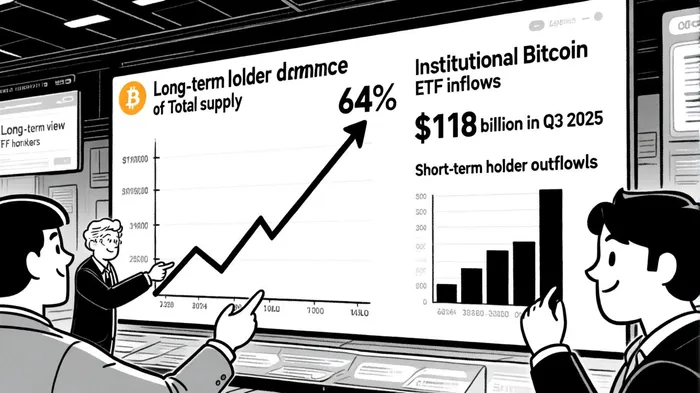





Comentarios
Aún no hay comentarios