
Bitcoin Liquidations and Market Imbalance: Decoding Positioning Dynamics for Near-Term Price Predictions
Bitcoin Liquidations and Market Imbalance: Decoding Positioning Dynamics for Near-Term Price Predictions
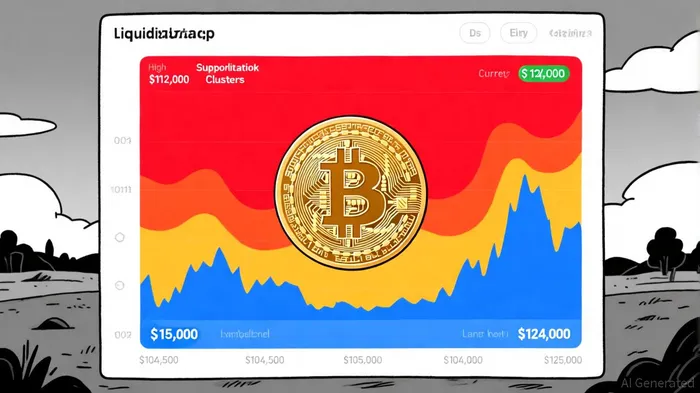
Bitcoin's derivatives market has become a battleground for positioning dynamics between longs and shorts, with liquidation trends and leverage ratios offering a predictive lens into near-term price action. As of September 2025, the market is teetering on the edge of a potential breakout or consolidation, with $115,000 serving as a critical fulcrum. The interplay of leveraged positions, open interest, and historical sentiment patterns suggests that Bitcoin's next move will hinge on whether bulls or bears can dominate these imbalances.
Market Positioning: A Delicate Balance
The BitcoinBTC-- long/short ratio, a derivative metric tracking the proportion of leveraged longs to shorts, currently sits in a neutral range, reflecting cautious optimism. Data from Bitcoin CounterFlow indicates that long liquidation leverage has been declining since June 2025, signaling growing bullish conviction as traders reduce riskier long positions. Conversely, short positions remain concentrated between $105,000 and $112,000, with approximately $11.5 billion in exposure at risk if Bitcoin breaks its all-time high of $111,900. This imbalance creates a self-fulfilling prophecy: a rally above $112,000 could trigger a short squeeze, while a dip below $104,500 risks cascading long liquidations.
The market's fragility is further amplified by record Open Interest (OI), which has surpassed $220 billion. This metric, a measure of leveraged bets on price movement, highlights the heightened risk of volatility. For instance, if Bitcoin falls to $104,500, long positions could face over $10 billion in losses, while a surge above $124,000 may wipe out $5.5 billion in short positions, according to BeInCrypto. The concentration of leverage around these levels means even minor price swings could trigger mechanical selling or buying, exacerbating trends.
Historical Correlation: A Contrarian Indicator
Historical data from 2020 to 2025 reveals a consistent pattern: divergences in the long/short ratio often precede price reversals. For example, during the 2021 bull run, a declining long/short ratio (as shorts increased) coincided with a 60% price surge, suggesting shorts were betting against the trend-only to be liquidated as the rally continued, per DemandSage's Bitcoin price history. Conversely, in 2022's bear market, a rising long/short ratio during downtrends indicated aggressive long entries, which were later liquidated as prices collapsed (DemandSage).
This dynamic is playing out again in 2025. The recent drop in long liquidation leverage (a sign of reduced risk-taking) contrasts with the stubborn short positions near $112,000. If Bitcoin breaks above this level, the short squeeze could propel prices toward $124,000, where another cluster of liquidations awaits (BeInCrypto). Conversely, a breakdown below $110,000-already a support level-could trigger a cascade of long liquidations, dragging the price toward $105,000–$90,000.
Macro Catalysts: The Fed's Role and ETF Flows
While positioning dynamics set the stage, macroeconomic factors will determine the outcome. The Federal Reserve's upcoming rate decisions loom large, with potential cuts in Q4 2025 expected to boost global liquidity and asset prices. A dovish pivot could amplify Bitcoin's appeal as a hedge against inflation and currency debasement, providing bulls with a tailwind, per the BeInCrypto Q3 outlook.
Meanwhile, ETF inflows remain a double-edged sword. While renewed institutional demand could offset leveraged selling pressure, slowing inflows-coupled with heavy liquidation zones-risk amplifying volatility. As an analyst at YassCrypto wrote, "The market's ability to absorb sell pressure is waning; every $10 billion in liquidations could force a 5–7% correction unless ETFs step in" (YassCrypto).
Strategic Implications for Traders
For traders, the key lies in identifying liquidation-prone zones and managing leverage. Liquidation heatmaps from platforms like Bybit and Binance reveal that the $113,300–$114,500 range is a "pressure cooker" for Bitcoin, with concentrated positions likely to push the price back toward $110,000 support (BeInCrypto Q3 outlook). Position sizes should be limited to avoid margin calls, and stop-loss orders placed just below key support/resistance levels.
Moreover, the long/short ratio should be used in conjunction with other metrics. For instance, rising funding rates in perpetual futures contracts (which incentivize short sellers to cover positions) could signal a bullish bias, while declining open interest during a rally may indicate a topping pattern (Bitcoin CounterFlow).
Conclusion: A Tipping Point
Bitcoin's derivatives market is at a tipping point, with positioning dynamics pointing to a high-stakes battle between longs and shorts. While the long/short ratio and liquidation trends suggest a potential breakout above $112,000, the path is fraught with risks. Traders must remain vigilant, using historical correlations and real-time data to navigate the volatility. As the Fed's decisions and ETF flows unfold, the market's next move could redefine Bitcoin's trajectory for the remainder of 2025.






Comentarios
Aún no hay comentarios