
Bitcoin Leverage Liquidation Crisis: Navigating Volatility with Prudent Risk Management
The Anatomy of the 2025 Liquidation Cascade
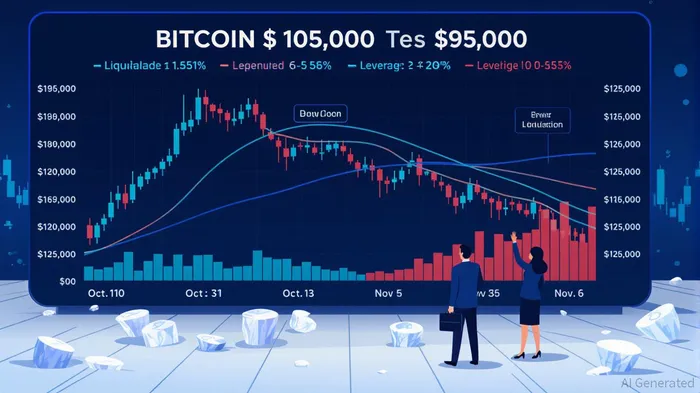
Bitcoin's descent below $100,000 in November 2025 marked a turning point. Over the preceding weeks, the cryptocurrency had experienced a 20% correction from its October 6 peak, erasing $1 trillion in market value and triggering an average of 300,000 daily liquidations, according to a Yahoo Finance report. The most dramatic event occurred on October 10, when $20 billion in leveraged positions collapsed within 48 hours, driven by algorithmic trading bots and margin calls, according to the Yahoo Finance report. By October 31, the carnage intensified: $105 million in positions were liquidated in just 12 hours, including a single $21.4 million BTC-USD trade on Hyperliquid, according to a Bitget news report.
These events were not isolated. During November 2025, Bitcoin's price drop below $100,000 triggered $1.3 billion in liquidations, with $1.08 billion attributed to long positions, according to a Bitzo analysis. The crisis was exacerbated by excessive leverage-platforms offering 1,001x exposure without adequate risk checks-and a lack of circuit breakers to stabilize cascading sell-offs, according to the Bitget news report.
Expert Warnings: Leverage as a Double-Edged Sword
Analysts have long cautioned against the perils of leveraged trading in crypto. A recent report by CoinGlass noted that over $217 million in positions were liquidated in 24 hours during October 2025, with Bitcoin and EthereumETH-- leading the selloff, according to an Economic Times article. The study emphasized that leveraged positions amplify losses during sharp price movements, creating a self-reinforcing cycle of panic selling and margin calls, according to the Economic Times article.
Willy Woo, a prominent crypto analyst, highlighted the precarious position of leveraged investors in November 2025. He argued that companies like MicroStrategy (MSTR), which hold significant Bitcoin reserves, are unlikely to face full liquidation as long as Bitcoin remains above $91,502 per coin, according to a ZyCrypto analysis. However, he warned that partial liquidations could occur if the asset fails to surge during the next bull market in 2028, according to a ZyCrypto analysis.
Hedging Strategies: Lessons from November 2025
Amid the chaos, successful hedging strategies emerged as a lifeline for institutional and retail investors. For example, Michael Burry's Scion Asset Management adopted a bearish stance on tech stocks by purchasing $1 billion in put options on Nvidia and Palantir, effectively hedging against a potential market downturn, according to a Fortune report. This approach, while sector-specific, underscores the value of derivatives in mitigating downside risk.
On-chain data also revealed effective tactics for individual traders. Position sizing-limiting exposure to 2–5% of a portfolio per trade-and dynamic margin allocation (shifting to lower-leverage positions like 5x instead of 100x) helped reduce losses during November's volatility, according to the Fortune report. Academic research further supported these strategies, advocating for machine learning-driven dynamic hedging to adapt to real-time market conditions, according to a ResearchGate paper.
JPMorgan's 64% increase in Bitcoin ETF holdings to $343 million in November 2025, according to a Coinotag article, reflects another hedging approach: long-term accumulation. By avoiding leveraged bets, institutions like JPMorgan positioned themselves to benefit from Bitcoin's potential recovery while sidestepping liquidation risks.
The Path Forward: Cautious Leverage and Adaptive Hedging
The 2025 liquidation crisis serves as a stark reminder of leverage's dangers in crypto. Traders must prioritize risk management by:
1. Avoiding excessive leverage (e.g., 100x or higher) unless prepared for rapid losses.
2. Implementing stop-loss orders to automate exits during sharp declines.
3. Monitoring open interest and funding rates to gauge market sentiment, according to the Economic Times article.
4. Diversifying hedging tools, including perpetual futures, options, and long-term accumulation.
As Bitcoin's MVRV ratio hit 1.8 in November-a level historically preceding price recoveries, according to a Cointelegraph analysis-the market may be nearing a stabilization point. However, until volatility subsides, prudence remains paramount.
Source
[1] Yahoo Finance report
[2] Bitget news report
[5] Economic Times article
[6] ResearchGate paper
[8] Cointelegraph analysis
[10] Bitzo analysis
[11] ZyCrypto analysis
[12] Fortune report
[14] Coinotag article






Comentarios
Aún no hay comentarios