
Bitcoin's Leverage-Driven Volatility: Navigating Derivatives Risks in a Fractured Market
The BitcoinBTC-- derivatives market has evolved into a double-edged sword for investors. On one hand, it reflects the maturation of crypto as an asset class, with institutional participation and regulatory clarity driving unprecedented notional volumes. On the other, the explosive growth of leveraged trading has created a fragile ecosystem prone to cascading liquidations and systemic risk. As Q4 2025's market turmoil demonstrates, the interplay between leverage and volatility is no longer a theoretical concern-it is a lived reality for traders and a looming threat to broader financial stability.
The Leverage Buildup: A House of Cards?
By mid-September 2025, Bitcoin derivatives open interest reached a record $39 billion, with the average daily open interest (ADOI) settling at $31.3 billion. This surge was fueled by a combination of macroeconomic tailwinds, such as the U.S. Federal Reserve's dovish pivot, and the influx of institutional capital into crypto derivatives. However, the average leverage ratios applied in these trades-some as high as 1,001:1- exposed a critical flaw: the market's reliance on fragile, algorithmically amplified positions.
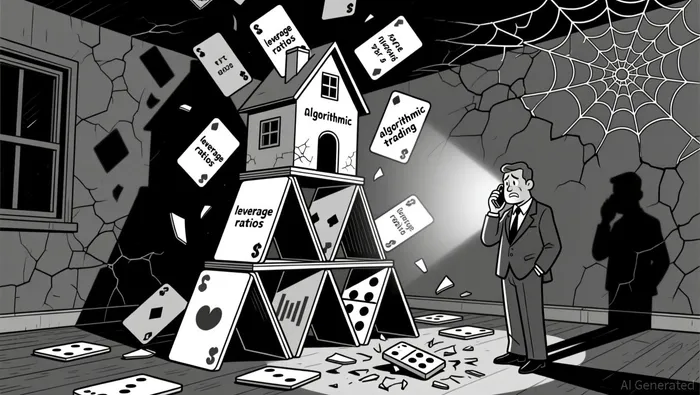
The dominance of perpetual futures contracts, which accounted for 78% of trading volume, further exacerbated this fragility. Unlike traditional futures, perpetuals lack a fixed expiration date, encouraging traders to hold leveraged positions indefinitely. This dynamic creates a feedback loop: rising prices attract more leverage, which in turn amplifies price swings when liquidations occur.
October 2025: The Perfect Storm of Liquidations
The tipping point came in October 2025, when a geopolitical shock-a 100% tariff on Chinese imports announced by President Donald Trump- triggered a $19 billion liquidation event in a single day. Bitcoin's price plummeted below $100,000, wiping out 85–90% of liquidated positions as long bets collapsed. Platforms like Hyperliquid reported $10.08 billion in losses, while the broader market saw $20 billion in forced liquidations over the week.
This cascade was not a random event but a systemic failure. The concentration of open interest in long positions, combined with thin liquidity and algorithmic interactions like auto-deleveraging (ADL), created a self-reinforcing cycle of selling pressure. As prices fell, margin calls triggered more liquidations, which drove prices lower still. The result was a 24-hour plunge that erased $19 billion in notional value-a figure that dwarfs earlier 2025 liquidation events, such as the $170 million wipeout on March 15 and the $102 million loss on March 21.
Historical Precedents and Structural Vulnerabilities
The October 2025 crash was not an isolated incident. Earlier in the year, smaller but similarly structured liquidation events revealed the market's susceptibility to leverage-driven volatility. For example, the March 2025 liquidations-primarily affecting long positions in Bitcoin, EthereumETH--, and Solana- highlighted how crowded trades and algorithmic trading can amplify price swings. These events underscore a recurring pattern: leveraged markets are prone to sudden deleveraging when liquidity dries up or macro conditions shift.
What distinguishes Q4 2025 is the scale of systemic risk. The interconnectedness of global crypto platforms means that a single liquidation event on one exchange can trigger knock-on effects across the ecosystem. For instance, the October crash exposed how insurance funds and ADL mechanisms-designed to stabilize markets-can instead accelerate volatility under stress. This raises a critical question: Can the derivatives market's infrastructure withstand another shock without spilling into traditional financial systems?
Navigating the Risks: A Call for Prudence
For investors, the lessons from Q4 2025 are clear. First, leverage is a tool, not a strategy. While high leverage ratios can magnify gains, they also amplify downside risk in a market where liquidity can vanish overnight. Second, diversification remains key. Overexposure to perpetual futures or crowded long positions increases vulnerability to cascading liquidations.
Regulators and market participants must also address structural weaknesses. This includes tightening leverage caps, improving transparency in open interest distribution, and stress-testing systemic safeguards like ADL and insurance funds. As one analyst noted, "The October crash was a deleveraging mechanism, but it also revealed the need for better risk management in a derivatives-heavy market."
Conclusion: A Fractured Market in Need of Reform
Bitcoin's derivatives market is at a crossroads. The explosive growth of leverage and open interest has unlocked new opportunities for profit, but it has also created a system where volatility is no longer a byproduct of speculation-it is the engine. For investors, the path forward requires a balance between innovation and caution. For policymakers, it demands a reevaluation of how derivatives markets are structured and regulated.
As the dust settles on Q4 2025's turmoil, one truth remains: in a world where $19 billion can vanish in a single day, the only constant is uncertainty.






Comentarios
Aún no hay comentarios