
Bitcoin's Next Leg Higher: How a Capital Avalanche and Macroeconomic Shifts Set the Stage for a $1M+ Surge
The BitcoinBTC-- market is on the cusp of a seismic shift. Samson Mow, founder of Jan3, has long warned of a "Capital Avalanche"-a sudden, exponential surge in institutional and sovereign adoption that will redefine Bitcoin's role in global finance. While his original $1 million price target for 2025 has been delayed, the underlying catalysts remain intact, with 2026 now emerging as the likely breakout year. This analysis unpacks the macroeconomic and capital inflow dynamics driving Bitcoin's next leg higher, arguing that investors must position now to capitalize on the pre-avalanche buildup.
Institutional Adoption: The New Foundation of Bitcoin's Value
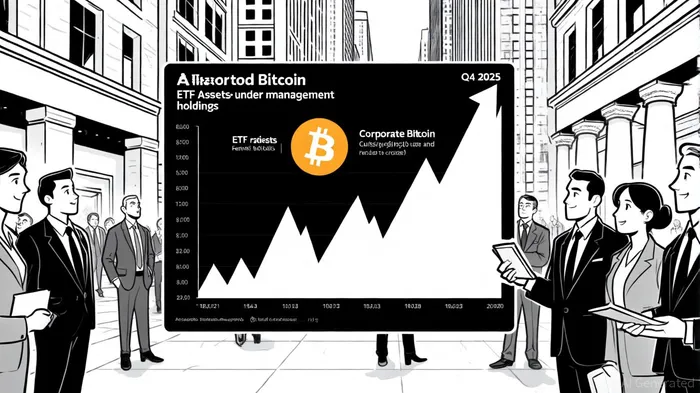
Bitcoin's institutional adoption in 2025 has transformed it from a speculative asset into a core component of global portfolios. By October 2025, institutions accounted for 59% of Bitcoin holdings, with exchange-traded products (ETPs) and publicly traded companies collectively acquiring 944,330 BTC-surpassing 2024's total, according to Bitcoinist. This surge is driven by three key factors:
- Regulatory Clarity: The approval of spot Bitcoin ETFs in January 2024 removed a major barrier, enabling registered investment advisers, pension funds, and hedge funds to allocate Bitcoin as part of diversified portfolios. BlackRock's IBIT alone attracted $18 billion in assets under management by early 2025, per Bitcoin Info News.
- Corporate Treasury Strategies: Businesses now hold 6.2% of the total Bitcoin supply (1.30M BTC), with $12.5 billion in new inflows recorded in eight months of 2025, according to a Business Initiative analysis. Companies are treating Bitcoin as a strategic reserve asset, hedging against inflation and currency devaluation.
- Reduced Volatility: Institutional buying has stabilized Bitcoin's price, reducing volatility by up to 75% compared to retail-driven cycles, per Bitcoin Info News. This maturation has made Bitcoin a viable alternative to gold and other traditional safe-haven assets.
The result is a self-reinforcing cycle: as institutions allocate more capital, Bitcoin's liquidity and price stability improve, attracting further institutional interest.
Monetary Policy Shifts: The Fed's Dovish Turn Fuels Bitcoin's Ascent
The Federal Reserve's September 2025 rate cut-a 0.25 percentage point reduction to a 4–4.25% target range-has already catalyzed Bitcoin's rise to $125,700, a new all-time high, according to a MarketMinute report. This dovish pivot reflects a broader shift in global monetary policy, with central banks prioritizing economic growth over aggressive inflation suppression.
Key implications for Bitcoin:
- Lower Opportunity Cost: With U.S. Treasury yields declining post-rate cut, the opportunity cost of holding Bitcoin (which offers no yield) diminishes. Investors are increasingly allocating to Bitcoin as a hedge against fiat currency erosion (per the MarketMinute report).
- Risk-On Environment: Dovish central banks have created a "risk-on" climate, where high-volatility assets like Bitcoin are seen as strategic plays rather than speculative bets. This is evident in the 7% Q3 2025 price surge for Bitcoin and EthereumETH--, noted in Schroders' Q3 2025 review.
- Global Liquidity Injection: The Fed's forward guidance of two additional 2025 rate cuts signals prolonged liquidity expansion, which historically favors assets with low correlation to traditional markets (as covered in the MarketMinute report).
The U.S. government's proposed Strategic Bitcoin Reserve further amplifies this dynamic. While no official accumulation has occurred yet, the mere possibility of sovereign Bitcoin holdings has already boosted institutional confidence, according to Bitcoinist.
The Strategic Case for Immediate Investment Positioning
Bitcoin's next phase of growth hinges on three interlocking trends:
- Capital Avalanche Dynamics: Mow's prediction of "gradual, then sudden" adoption is materializing. Latin American nations, grappling with currency instability, are leading the charge in sovereign Bitcoin acquisition, which could trigger a global cascade of institutional and state-level Bitcoin purchases (as discussed by Bitcoinist).
- Supply-Side Constraints: With seven times more Bitcoin bought by institutions in 2025 than mined, the market is transitioning from a supply-driven to a demand-driven paradigm. This imbalance will accelerate as halving events reduce new supply and institutional demand outpaces mining output (see the Business Initiative analysis).
- Regulatory Momentum: The pending Digital Asset Market Clarity Act of 2025 and the Trump administration's rejection of CBDCs are creating a pro-Bitcoin regulatory environment, which market observers and corporate treasury studies say will unlock further institutional inflows.
Investors who position now-whether through ETFs, futures, or direct holdings-stand to benefit from a compounding effect: as Bitcoin's institutional footprint grows, its price will increasingly reflect macroeconomic trends rather than retail sentiment.
Conclusion: A $1M+ Future is Inevitable
While short-term volatility remains, the macroeconomic and capital inflow dynamics are irrefutable. Samson Mow's revised 2026 timeline aligns with the maturation of Bitcoin's institutional infrastructure and the Fed's dovish trajectory. For investors, the question is no longer if Bitcoin will reach $1 million, but when and how to position for the inevitable avalanche.
The market is already pricing in this future. The time to act is now.





Comentarios
Aún no hay comentarios