
Bitcoin's Leap into Traditional Finance: The Rise of BTC-Backed Credit Facilities
The integration of BitcoinBTC-- into traditional finance (TradFi) has reached a pivotal inflection point. What was once dismissed as a speculative asset is now being treated as a legitimate collateral class by some of the world's most influential financial institutions. In 2025, major banks like JPMorganJPM--, Wells FargoWFC--, and BNY Mellon have launched Bitcoin-backed credit facilities, signaling a paradigm shift in how digital assets are perceived and utilized. This development not only unlocks liquidity for institutional and retail investors but also redefines Bitcoin's role as a productive, collateralized asset within the global financial system.
JPMorgan: From Skepticism to Strategic Adoption
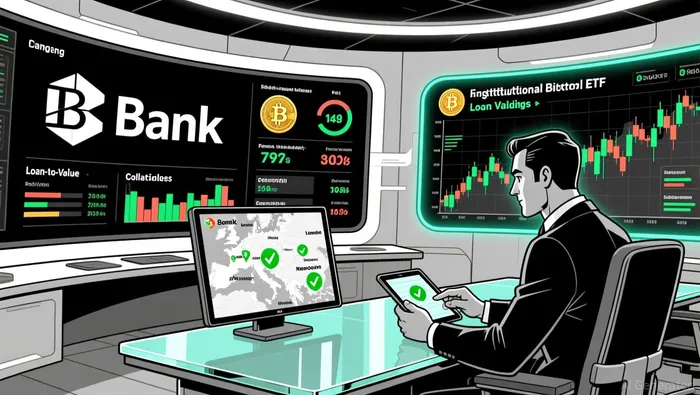
JPMorgan Chase, once a vocal critic of cryptocurrencies, has emerged as a leader in Bitcoin-backed lending. In October 2025, the bankBANK-- announced a $10 billion credit facility allowing institutional clients to use Bitcoin ETFs as collateral for margin loans, derivatives financing, and tailored credit lines according to JPMorgan. This initiative aligns with broader regulatory shifts, including the Financial Innovation and Technology for the 21st Century Act (FIT21), which classifies Bitcoin and Ethereum as commodities.
To mitigate volatility risks, JPMorgan applies conservative haircuts of 30–50%, effectively capping loan-to-value (LTV) ratios at 50–70%. The bank does not hold crypto assets directly but relies on third-party custodians like Fidelity Digital Assets and Coinbase Custody, with real-time oracle feeds from ChainlinkLINK-- to value collateral according to industry reports. This approach balances innovation with risk management, reflecting JPMorgan's pragmatic pivot from outright skepticism to strategic adoption.
Wells Fargo and BNY Mellon: Expanding the Collateral Universe
Wells Fargo and BNY Mellon followed suit in Q4 2025, offering credit programs backed by Bitcoin ETFs and direct holdings. These initiatives were enabled by Basel III regulatory updates, which permitted banks to structure such programs without compromising capital adequacy. BNY Mellon, a long-standing custodian of digital assets since 2022, expanded its services to include lending against Bitcoin, leveraging its expertise in tokenizing BTCBTC-- holdings for instant settlement and collateral use.
The loan terms across these institutions reflect a cautious approach. Conservative LTV ratios (50–70%) are standard, ensuring that even in a downturn, collateral remains sufficient to cover loan obligations. This prudence is critical given Bitcoin's historical volatility, which has historically led to sharp liquidation events in decentralized finance (DeFi) platforms.
Institutional Adoption: A Tipping Point
The rise of BTC-backed credit facilities is underpinned by a surge in institutional adoption. By 2025, 68% of institutional investors had or planned to invest in Bitcoin exchange-traded products (ETPs), while 86% of institutional investors either held or intended to allocate to digital assets. This shift is driven by Bitcoin's maturation as an asset class, its dominance in the crypto market (65% of total value), and regulatory clarity, including the approval of spot Bitcoin ETFs.
Regulatory developments have been instrumental. The OCC's Interpretive Letter 1184 in March 2025 permitted banks to custody and execute BTC trades, while the GENIUS Act mandated that stablecoins be fully backed by cash or cash equivalents. These frameworks have created a legal and operational foundation for banks to integrate Bitcoin into their lending portfolios.
The risk-reward dynamics of Bitcoin-collateralized lending vary significantly between centralized and decentralized platforms. Centralized lenders like Ledn and Nexo offer institutional-grade security, including audited proof of reserves and multi-layered custody, but introduce counterparty risk. In contrast, decentralized platforms like AaveAAVE-- and CompoundCOMP-- provide on-chain transparency and autonomy but require technical expertise and face smart contract vulnerabilities according to industry analysis.
For example, liquidation events on DeFi protocols often result in collateral being sold at a 7.6% discount during auctions, underscoring the need for dynamic LTV thresholds and automated risk management. Meanwhile, centralized platforms like Coinbase and Strike offer competitive rates and real-time collateral verification, enabling borrowers to access liquidity while maintaining their Bitcoin positions.
Implications for investors and the broader financial system are profound. Bitcoin-backed loans present a compelling opportunity for investors to preserve long-term exposure to Bitcoin while accessing liquidity. This dual benefit is particularly valuable for institutional treasuries, which can now leverage BTC to extend operational runways and reduce reliance on traditional financing. For example, Voltage uses Lightning Network liquidity to support internal operations, avoiding the need for conventional loans.
However, risks remain. Volatility and regulatory uncertainty continue to pose challenges, with late-2025 market drawdowns highlighting the fragility of crypto-collateralized assets. Additionally, the proposed inclusion of Bitcoin as mortgage collateral has sparked controversy, with critics warning of parallels to the 2008 financial crisis.
The Road Ahead: Integration or Disruption?
The integration of Bitcoin into TradFi is not without its complexities. While the current regulatory environment supports cautious adoption, systemic risks could emerge if crypto-collateralized lending expands too rapidly. The 2022 crypto crisis serves as a cautionary tale, emphasizing the need for robust risk management frameworks.
Nonetheless, the trajectory is clear: Bitcoin is evolving from a speculative asset to a functional component of the global financial system. As banks like JPMorgan, Wells Fargo, and BNY Mellon continue to innovate, the line between crypto and TradFi will blur, creating new opportunities-and challenges-for investors, regulators, and market participants alike.





Comentarios
Aún no hay comentarios