
Bitcoin's Institutional Sell-Off and DAT Strategy Resilience: Navigating Investor Sentiment Divergence and Bear Market Risks
The Institutional Sell-Off: Macro Factors and Portfolio Rebalancing
Bitcoin's plunge from $124,000 to $101,000 in early November 2025 was not a standalone event but a symptom of broader macroeconomic pressures. The Federal Reserve's hawkish stance, sticky inflation data, and geopolitical tensions created a risk-off environment, forcing institutions to offload lower-yield assets like BitcoinBTC-- in favor of higher-growth opportunities. Over $379.9 million in crypto longs were liquidated in a single day, with Bitcoin accounting for $81.43 million of these losses according to Bitget.
Institutional players, such as Kayne Anderson BDC, shifted capital to private credit and altcoins, signaling a strategic pivot away from Bitcoin's perceived stagnation. However, this sell-off was not a rejection of Bitcoin's long-term value. By mid-November, the asset had rebounded to $106,000, buoyed by ETF inflows and institutional confidence in its role as a macroeconomic hedge. The key question remains: Will these stabilizing forces hold, or will the bearish momentumMMT-- intensify?
DAT StrategyMSTR-- Resilience: A Contrarian Play
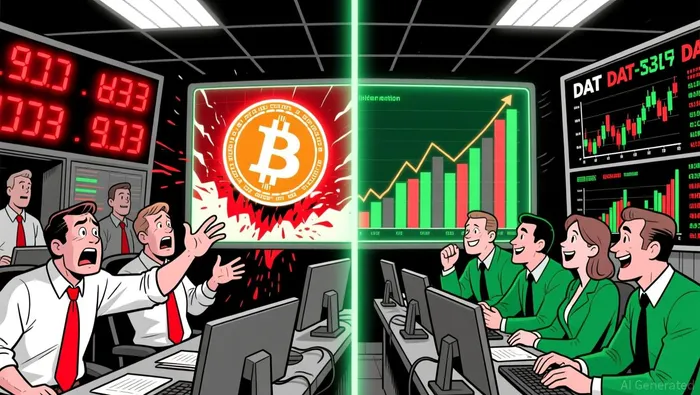
While Bitcoin's price action has been volatile, DAT strategies have defied expectations. Companies like Galaxy DigitalGLXY-- and Strategy Inc. have maintained strong balance sheets, with Galaxy Digital up 73.4% year-to-date and Strategy Inc. holding a BTC stack of 641,692-making it a pure Bitcoin proxy. These entities, which focus on Bitcoin treasury management, have outperformed the broader market, even as DAT stocks like Metaplanet and SharpLink plummeted 80% and 90% from their 2025 peaks according to Yahoo Finance.
The resilience of Bitcoin-focused DATs underscores a critical insight: Institutions that maintain a long-term, concentrated Bitcoin exposure are better positioned to weather short-term volatility. This contrasts sharply with multi-asset DATs, which chase higher-risk tokens and face greater liquidity challenges. As market-net-asset-value (mNAV) ratios approach or fall below 1, the ability of DATs to raise capital through stock issuance has weakened, further amplifying the divide between well-capitalized and speculative players.
Investor Sentiment Divergence: Institutions vs. Retail
The sell-off has exposed a widening gap between institutional and retail sentiment. Institutional demand for Bitcoin has waned, with US spot Bitcoin ETFs recording net outflows of $278 million on November 12, 2025, contributing to cumulative redemptions of $961 million for the month. This outflow removed a key stabilizing force, leaving the market vulnerable to derivatives-driven volatility.
Retail investors, meanwhile, have exhibited signs of capitulation. Glassnode data reveals that over 80% of realized value in the sub-$100,000 range came from coins sold at a loss-a pattern more intense than previous major sell-offs according to CryptoSlate. Perpetual futures funding rates and open interest have also trended downward since October, reflecting a lack of aggressive positioning and market hesitation according to CryptoSlate. This divergence suggests that while institutions are strategically exiting, retail traders are emotionally driven, exacerbating short-term volatility.
Bear Market Risks: Parallels to 2021–2022
The current correction bears eerie similarities to the 2021–2022 bear market, where Bitcoin fell from $64,000 to $16,000. Key indicators-such as the Extreme Fear Index hitting record levels as Bitcoin fell below $98,000 -signal a growing risk of a deeper downturn. Analysts warn that without a catalyst like a Fed rate cut or improved U.S. inflation data, the market could spiral further.
However, Bitcoin's institutional adoption offers a counterpoint. Ether ETFs attracted $9.6 billion in inflows in Q3 2025, and JPMorgan increased its Bitcoin holdings via BlackRock's iShares Bitcoin Trust by 64%. These developments highlight Bitcoin's evolving role as a macro hedge, even as short-term risks persist.
Conclusion: A Long-Term Play Amid Short-Term Noise
Bitcoin's institutional sell-off and DAT strategy resilience reveal a market at a crossroads. While macroeconomic headwinds and sentiment divergence pose bearish risks, the underlying fundamentals-ETF adoption, institutional confidence, and Bitcoin's safe-haven appeal-remain intact. For investors, the key is to distinguish between short-term volatility and long-term value. As the market navigates this correction, those with a concentrated, long-term Bitcoin thesis may find opportunity in the chaos.





Comentarios
Aún no hay comentarios