
Bitcoin's Institutional Revolution: Outperforming Traditional Markets in 2025 and Beyond
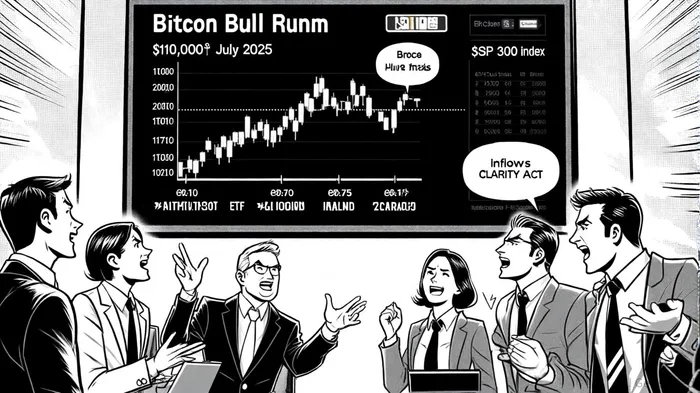
The institutional adoption of BitcoinBTC-- has reached a tipping point in 2025, driven by macroeconomic tailwinds, regulatory clarity, and the relentless vision of pioneers like Michael Saylor. As corporations and financial institutionsFISI-- reclassify Bitcoin from speculative asset to strategic reserve, its potential to outperform traditional markets—particularly the S&P 500—has become a compelling narrative for long-term investors.
MicroStrategy's Bold Bet: A Case Study in Institutional Conviction
MicroStrategy's transformation into the largest corporate holder of Bitcoin—now holding 638,460 BTCBTC-- valued at $71.15 billion—has been a masterclass in institutional allocation. Michael Saylor's strategy of leveraging low-interest debt to acquire Bitcoin at scale has not only diversified the company's treasury but also signaled to the market that Bitcoin is a superior hedge against inflation and currency debasement [1]. Despite a brief pause in new purchases in early 2025, MicroStrategy's resumption of buying 1,955 BTC for $217 million in September underscores its unwavering commitment [2].
Saylor's public assertions that Bitcoin could outperform the S&P 500 by 29% annually over the next two decades are not mere speculation. They are rooted in Bitcoin's structural advantages: a fixed supply cap, its role as a global store of value, and its ability to absorb capital flows from traditional assets like gold and real estate [3]. His prediction of a $21 million price target by 2045, based on a 21-year monetary transformation timeline, further challenges conventional financial models [4].
Institutional Adoption: From Niche to Mainstream
MicroStrategy's actions are emblematic of a broader institutional shift. By mid-2025, 59% of institutional investors allocate at least 10% of their portfolios to Bitcoin, a figure that reflects both strategic diversification and macroeconomic necessity [5]. The approval of spot Bitcoin ETFs—most notably BlackRock's iShares Bitcoin Trust (IBIT), which has attracted $18 billion in assets under management—has provided institutions with a familiar, regulated vehicle to access the asset [6].
Regulatory tailwinds have further accelerated adoption. The U.S. CLARITY and GENIUS Acts, passed in July 2025, have resolved jurisdictional ambiguities between the SEC and CFTC, while mandating stablecoin transparency and fostering innovation in crypto-backed financial products [7]. These reforms, coupled with the U.S. Treasury's establishment of a Strategic Bitcoin Reserve, have normalized Bitcoin's role in institutional portfolios [8].
Emerging Markets and the Global Bitcoin Boom
While U.S. institutions lead the charge, emerging markets are rapidly catching up. India, for instance, tops Chainalysis' 2025 Global Crypto Adoption Index, driven by institutional flows into DeFi and stablecoins [9]. Nigeria and Indonesia, despite regulatory hurdles, continue to leverage Bitcoin for remittances and inflation hedging, with per capita adoption rates rivaling those of developed economies [10]. This global diversification of demand ensures Bitcoin's resilience against regional economic shocks.
Price Projections and the Path to $8.5M
Saylor's $8.5 million price target for Bitcoin by September 2025, while ambitious, is not without precedent. Historical logarithmic growth curves and exponential adoption trends suggest that Bitcoin's price is far from its peak [11]. Moreover, the asset's volatility has decreased by 75% compared to earlier cycles, a sign that early adopters are locking in gains while institutions build deeper positions [12]. Analysts project Bitcoin could reach $210,000 within 18 months, fueled by ETF inflows and a $3 trillion institutional demand pool [13].
Conclusion: A New Paradigm in Asset Allocation
Bitcoin's journey from fringe asset to institutional cornerstone is far from complete. As regulatory frameworks mature and global adoption accelerates, its potential to outperform traditional markets—both in absolute returns and risk-adjusted terms—becomes increasingly undeniable. For investors, the question is no longer if Bitcoin will disrupt finance, but how quickly institutions will reallocate trillions into this new digital paradigm.






Comentarios
Aún no hay comentarios