
Bitcoin's Institutional Onboarding and Volatility Amid Macroeconomic Shifts in Q4 2025
Institutional Adoption: A Structural Shift
Bitcoin's institutional adoption has transitioned from speculative curiosity to a core component of diversified portfolios. By Q4 2025, institutions held 6% of the total BitcoinBTC-- supply through ETFs, with U.S. spot ETFs alone accumulating 1.3 million BTC in Q3 2025. This trend is underpinned by regulatory tailwinds, including the U.S. 401(k) retirement plan eligibility and the passage of the GENIUS Act in July 2025. The U.S. Bitcoin ETF market grew 45% to $103 billion in AUM by year-end, with BlackRock's IBITIBIT-- dominating 48.5% of the market share.
Institutional participation has also diversified beyond ETFs. Tokenized real-world assets, such as BlackRock's BUIDL fund, reached $2.3 billion in AUM, while decentralized perpetuals captured 16–20% of the perpetual futures market. Notably, 86% of institutional investors now allocate to crypto, with 65% of Bitcoin's $1.65 trillion market cap attributed to institutional demand. This shift reflects a broader acceptance of Bitcoin as a hedge against inflation and a diversifier in an era of monetary expansion, with global M2 money supply exceeding $90 trillion.
Macroeconomic Uncertainty and Volatility Dynamics
Despite institutional tailwinds, Bitcoin's volatility in Q4 2025 was shaped by macroeconomic headwinds. The Bitcoin-to-gold ratio fell by 50% year-over-year, from 40 ounces per BTC in December 2024 to 20 ounces per BTC in Q4 2025. This decline underscores gold's dominance as a store of value amid geopolitical risks and elevated real yields, which increased the opportunity cost of holding Bitcoin. Central banks added 254 tonnes of gold in 2025, while global gold ETFs gained 397 tonnes in the first half of the year.
Interest rate adjustments further complicated Bitcoin's investment case. The U.S. Federal Reserve cut rates three times in 2025 by 75 basis points, while the ECB reduced rates eight times since June 2024. However, inflation remained stubbornly high at 5.33% in 2025, with the Americas projecting a slight uptick to 4.43%. These conditions fueled profit-taking among long-term Bitcoin holders, who sold over 500,000 BTC in the second half of 2025. On-chain data revealed aggressive selling, with 300,000 BTC liquidated in October alone.
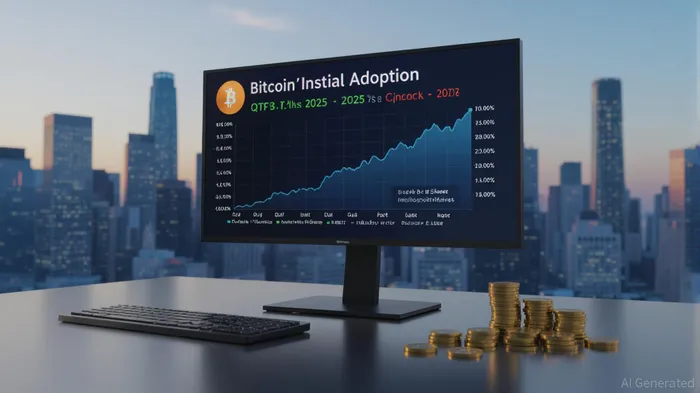 Geopolitical risks also amplified market volatility. The VIX Volatility Index averaged 18.2 in 2025, up from 14.3 in 2024, while geopolitical risk indexes climbed 34% year-over-year. J.P. Morgan Research warned of a 40% probability of a U.S. recession in the second half of 2025, driven by trade policy uncertainties and elevated tariffs. These factors contributed to Bitcoin's relative underperformance compared to gold, though analysts argue this reflects cyclical repricing rather than a breakdown of its long-term thesis.
Volatility and Institutional Resilience
Bitcoin's volatility metrics have improved as institutional participation deepened. One-year realized volatility dropped from 84.4% to 43.0% in Q4 2025, reflecting enhanced liquidity and reduced speculative trading. Daily trading volumes stabilized between $8B and $22B, with futures open interest reaching $67.9B and CME accounting for 30% of total activity. This maturation of market structure has enabled institutions to manage risk more effectively, even amid macroeconomic turbulence.
However, volatility remains a double-edged sword. While Bitcoin's price surged 80% year-over-year, driven by institutional buying and regulatory clarity, its correlation with equities and gold fluctuated. For example, Bitcoin's inverse relationship with the U.S. dollar weakened as global liquidity expanded, while its positive correlation with gold strengthened during periods of geopolitical stress. These dynamics highlight the importance of macroeconomic context in institutional investment decisions.
Conclusion: A New Equilibrium
Bitcoin's Q4 2025 performance illustrates a delicate balance between institutional adoption and macroeconomic uncertainty. Regulatory advancements and infrastructure improvements have cemented Bitcoin's role as a legitimate asset class, yet its volatility and competition with gold remain challenges. For investors, the key takeaway is that Bitcoin's long-term appeal lies in its structural adoption by institutions, which is likely to persist despite cyclical headwinds. As global liquidity remains elevated and tokenization expands, Bitcoin's market structure will continue to evolve, offering both opportunities and risks in an increasingly complex macroeconomic landscape.





Comentarios
Aún no hay comentarios