
Bitcoin as Institutional-Grade Collateral: Bank of America's BTC-Backed Loans Signal a New Era of Legitimacy and Utility
The launch of Bitcoin-collateralized credit loans by Bank of AmericaBAC-- in December 2025 marks a watershed moment in the evolution of cryptocurrency from speculative asset to institutional-grade collateral. By offering clients the ability to secure USD loans against their BitcoinBTC-- holdings without selling the underlying asset, the bank has not only addressed a critical liquidity challenge for cryptoBTC-- investors but also signaled broader acceptance of Bitcoin within traditional finance. This development, part of a growing trend among major U.S. banks, underscores a paradigm shift in how institutional players view Bitcoin's utility and risk profile.
Reshaping Bitcoin's Role in Traditional Finance
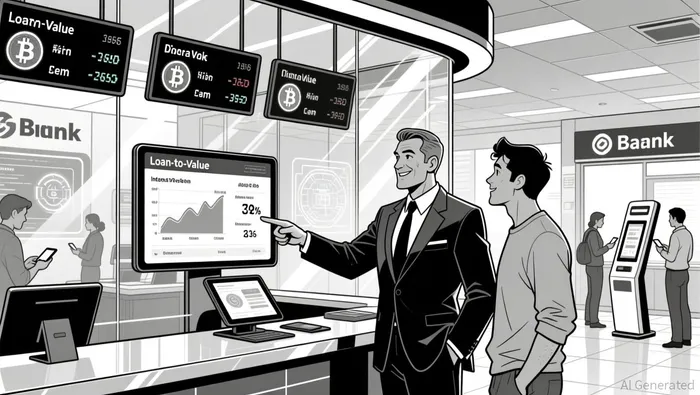
Bank of America's product allows clients to leverage their Bitcoin holdings as collateral for cash loans with loan-to-value (LTV) ratios ranging from 50-70% and interest rates between 4-6%. These terms, competitive with both traditional and decentralized finance (DeFi) alternatives, reflect a calculated approach to mitigating Bitcoin's volatility while offering tangible value to holders. The bank's decision to provide FDIC-insured custody for the collateralized Bitcoin further distinguishes it from crypto-native platforms, which often lack such regulatory safeguards.
This move aligns with a broader industry trend: eight of the top 10 U.S. banks now offer Bitcoin-backed lending products, signaling a collective re-evaluation of crypto's role in credit markets. For decades, traditional finance has treated Bitcoin as a speculative asset with limited utility. Bank of America's product challenges that narrative by treating Bitcoin as a legitimate collateral asset, one that can generate liquidity while preserving exposure to its long-term price appreciation.
Enhancing Liquidity for Bitcoin Holders
The primary appeal of Bank of America's offering lies in its ability to unlock liquidity without forcing holders to liquidate their Bitcoin. For investors who view Bitcoin as a long-term store of value-akin to gold or real estate-this product provides a critical on-ramp to access cash while retaining ownership of the asset. For example, a Bitcoin holder with $1 million in BTC could secure a $500,000 loan (at a 50% LTV ratio) to fund business expansion or other capital needs, all while maintaining their position in Bitcoin.
This liquidity solution is particularly valuable in a market environment where volatility remains a concern. By setting liquidation thresholds (e.g., LTV exceeding 80%), Bank of America ensures that borrowers are incentivized to manage their risk exposure, while the bank itself retains a buffer against sharp price declines. Such structured risk management is a hallmark of traditional finance and a stark contrast to the often opaque mechanisms of DeFi lending platforms.
Positioning Crypto as Mainstream Collateral
The institutionalization of Bitcoin as collateral is not merely a product of regulatory compliance-it reflects a deeper shift in how capital markets perceive the asset. Bank of America's entry into this space, alongside peers like JPMorgan and Goldman Sachs, suggests that Bitcoin is increasingly being viewed through the lens of credit risk rather than speculative risk. This distinction is critical: collateralized loans are a cornerstone of traditional finance, and their application to Bitcoin signals a normalization of the asset's role in capital formation.
Moreover, the FDIC-insured custody model addresses a key barrier to adoption-security. By offering institutional-grade safeguards, Bank of America reduces the perceived risk of holding Bitcoin as collateral, a concern that has historically limited its use in mainstream finance. This development also aligns with broader regulatory clarity efforts in the U.S., where agencies like the SEC and CFTC are working to define frameworks for crypto assets.
A Strategic Reassessment for Investors
For investors, Bank of America's product compels a re-evaluation of Bitcoin's strategic value. Beyond its role as a speculative asset or hedge against inflation, Bitcoin is now demonstrating utility as a liquidity-generating tool. This dual functionality-retaining upside potential while enabling capital deployment-could attract a new class of institutional and retail investors who previously viewed Bitcoin as too volatile or illiquid for practical use.
The implications extend beyond individual investors. As more banks adopt similar models, Bitcoin's integration into traditional finance will accelerate, potentially leading to broader adoption in sectors like real estate, venture capital, and private equity. For example, a venture capital firm could use Bitcoin as collateral to secure loans for portfolio investments, diversifying its capital sources while maintaining exposure to crypto's growth trajectory.
Conclusion
Bank of America's Bitcoin-collateralized credit loans are more than a product-they are a harbinger of a new era in which crypto assets are treated as legitimate components of traditional finance. By addressing liquidity, security, and regulatory compliance, the bank has laid the groundwork for Bitcoin to transition from speculative asset to institutional-grade collateral. For investors, this development offers a compelling case to reassess Bitcoin's role in their portfolios, not just as a high-risk bet but as a strategic tool for capital efficiency and risk management.
As the lines between crypto and traditional finance continue to blurBLUR--, the question is no longer whether Bitcoin has value-it is how quickly institutions will integrate it into the fabric of global capital markets.





Comentarios
Aún no hay comentarios