
Bitcoin's Institutional Ascendancy: A New Era for Portfolio Diversification and Risk-Adjusted Returns
In the ever-evolving landscape of modern finance, BitcoinBTC-- has transitioned from a speculative curiosity to a cornerstone of institutional strategy. This transformation is underscored by BlackRock's Larry Fink, who has recently redefined the narrative around Bitcoin, positioning it as a "digital gold" and a critical tool for portfolio diversification in an era of geopolitical and monetary instability. Fink's remarks, coupled with surging institutional inflows and academic validation, signal a paradigm shift in how investors perceive risk, return, and asset allocation.
Institutional Validation: From Skepticism to Strategic Allocation
Larry Fink's 2024 earnings call comments marked a watershed moment. By labeling Bitcoin a "standalone asset class" and drawing parallels to gold, Fink acknowledged its role as a hedge against currency devaluation and systemic risk, as reported by Brave New Coin. BlackRock's Bitcoin ETF, IBIT, has already attracted $23 billion in inflows, reflecting a broader institutional embrace of the asset, according to that same report. Fink's bold price prediction-$500,000 to $700,000 if sovereign wealth funds allocate 2%–5% of their portfolios to Bitcoin-rests on the premise that institutional adoption will scale exponentially. This aligns with the passage of the GENIUS Act in July 2025, which provided regulatory clarity and accelerated Bitcoin's integration into traditional financial frameworks, as highlighted in the Bitcoin Outlook 2025 analysis.
The institutional momentum is not confined to BlackRockBLK--. Corporate treasuries now hold 6.2% of the total Bitcoin supply (1.30M BTC), with small businesses emerging as unexpected adopters. These firms, often with fewer than 50 employees, allocate a median of 10% of their net income to Bitcoin, treating it as a strategic reserve asset, the Permutable outlook notes. This trend underscores Bitcoin's growing utility as a macroeconomic hedge, particularly in environments of soft dollar policies and dovish central bank stances, as that outlook also describes.
Risk-Adjusted Returns: Bitcoin's Sharpe Ratio Superiority
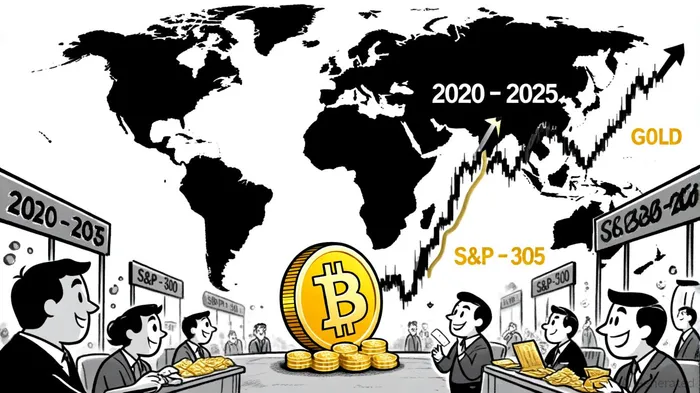
Bitcoin's risk-adjusted returns, measured through the Sharpe ratio, have historically outperformed equities, bonds, and even gold over its 15-year lifespan, according to a Brock Capital analysis. Despite its volatility, Bitcoin's engineered scarcity-reinforced by the four-year halving cycle-creates supply shocks that reward long-term holders. Institutional studies confirm that even modest Bitcoin allocations can enhance portfolio Sharpe ratios without compromising solvency; for instance, a 2025 analysis by Brock Capital demonstrated that portfolios with 5% Bitcoin exposure saw a 20% improvement in risk-return metrics compared to traditional benchmarks, as that analysis details.
This performance is further amplified by Bitcoin's unique properties. Unlike equities or bonds, Bitcoin's value is decoupled from corporate earnings or interest rate cycles. Its decentralized, non-sovereign nature makes it a potential "flight to safety" asset during geopolitical disruptions, a trait BlackRock has highlighted as increasingly relevant in 2025.
Diversification Dynamics: Correlation, Contagion, and Context
Bitcoin's role in diversification remains a nuanced debate. A 2025 study reveals a weak but positive correlation with ESG indices under stable market conditions, though this relationship intensifies during downturns, with region-specific variations. For example, U.S. portfolios benefit more from Bitcoin's low correlation with equities, while European and Chinese portfolios see mixed results due to regulatory and macroeconomic differences, as that study documents.
Critically, Bitcoin's environmental and governance challenges-rooted in its energy consumption and decentralized governance-complicate its ESG alignment. However, its ability to diversify against traditional risk assets remains robust. A 2019 diversification study found that Bitcoin's inclusion in portfolios with industry indices and bond indices reduced dynamic conditional correlations, enhancing overall resilience. More recent data from 2025 corroborates this, showing that Bitcoin's minimum variance model can reduce portfolio risk by up to 15% when paired with cryptocurrencies, consistent with the earlier findings.
The Road Ahead: Institutional Momentum and Macro Drivers
Bitcoin's trajectory in 2025 is being shaped by three macro forces: regulatory clarity, declining volatility, and rising institutional demand. The GENIUS Act's passage has normalized Bitcoin's role in corporate treasuries, with firms acquiring nearly 1,400 BTC daily, the Permutable analysis reports. Meanwhile, ETF inflows exceeding $50 billion across U.S. vehicles signal a maturation of the asset class, according to that outlook.
Fink's vision-a world where Bitcoin competes with gold as a store of value-gains credibility as institutional allocations scale. If sovereign wealth funds and pension funds follow through on even a fraction of their stated interest, Bitcoin's price could see multi-year tailwinds. However, investors must remain mindful of its volatility and the evolving regulatory landscape.
Conclusion
Bitcoin's journey from fringe asset to institutional staple is a testament to its unique risk-return profile and macroeconomic utility. Larry Fink's endorsement, coupled with academic validation and corporate adoption, has cemented its role in modern portfolio theory. While challenges remain-particularly around ESG alignment and volatility-Bitcoin's ability to enhance diversification and deliver superior risk-adjusted returns positions it as a strategic asset for forward-thinking investors.





Comentarios
Aún no hay comentarios