
Bitcoin's Institutional Adoption as a Treasury Asset: A Game Changer for Long-Term Value and Institutional Confidence
Strategic Corporate Allocation: A New Paradigm
The most striking evidence of Bitcoin's institutional adoption lies in its integration into corporate treasuries. Coinbase, for instance, , , according to FinanceFeeds. CEO has framed this as a "foundational asset for the future of finance," emphasizing Bitcoin's role as a hedge against inflation and a store of value, as reported by Bitbo. Similarly, Strategy Inc., outperforming industry giants like Tesla, Meta, and Nvidia, according to Blockchain Magazine. These moves signal a departure from short-term speculation, with institutions treating Bitcoin as a long-term reserve asset akin to gold or sovereign debt.
The trend extends beyond tech-centric firms. Jiuzi Holdings has launched a $1 billion Bitcoin treasury in partnership with SOLVSOLV--, deploying 10,000 BTC into yield-bearing vaults secured by institutional-grade risk controls, per Morningstar. This initiative underscores Bitcoin's growing appeal as a tool for generating passive income while mitigating liquidity risks. Meanwhile, MicroStrategy-which holds over 640,000 BTC-has opted to focus on internal growth and credit expansion rather than acquiring Bitcoin treasury firms, reflecting confidence in its existing allocation strategyMSTR--, according to Coinotag.
Risk-Adjusted Returns: Bitcoin's Competitive Edge
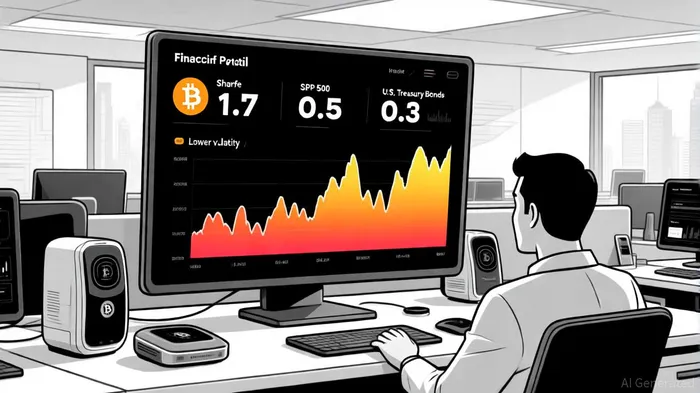
Bitcoin's allure for institutional investors is further amplified by its superior risk-adjusted returns. As of September 2025, , , according to Blockchain Reporter. This metric, which measures returns relative to volatility, highlights Bitcoin's ability to deliver alpha while managing downside risk-a critical consideration in an era of macroeconomic uncertainty.
The cryptocurrency's performance is also bolstered by its low with traditional markets. While Bitcoin and the S&P 500 exhibit a moderate positive correlation of 0.26 (see https://en.coinotag.com/bitcoin-etf-inflows-rise-as-gold-faces-correction-signaling-potential-shift/), it remains distinct from equities during periods of systemic stress. For example, during Q4 2025's earnings season, Bitcoin's price remained resilient despite volatility in the S&P 500 and Nasdaq, driven by concerns over tech firms' capital expenditures, as shown in a ScienceDirect paper. This decoupling reinforces Bitcoin's role as a , particularly in portfolios seeking to hedge against equity market downturns.
Institutional Accumulation: A Signal of Confidence
Bitcoin's institutional adoption has accelerated during stable price ranges, with whales and corporations accumulating strategically. , . This trend is mirrored by entities like American Bitcoin, , signaling confidence in Bitcoin's long-term trajectory, according to FXStreet.
. Unlike speculative cycles driven by FOMO, this phase reflects disciplined buying by institutions prioritizing over short-term gains. As one analyst noted, "Bitcoin's current phase resembles a '' strategy executed by institutional players, who view volatility as an opportunity rather than a risk" (see https://en.coinotag.com/institutional-investors-may-alter-bitcoins-traditional-4-year-cycles/).
The Road Ahead: A Treasury Asset for the Digital Age
Bitcoin's institutional adoption is not merely a financial trend but a structural shift in how corporations and investors approach value storage. By treating Bitcoin as a non-correlated, high-conviction asset, institutions are unlocking new avenues for risk-adjusted returns and portfolio resilience. The success of companies like Coinbase and Strategy Inc. demonstrates that Bitcoin can coexist with traditional treasuries while offering unique advantages in an inflationary and digitally transforming world.
As the ecosystem matures, the integration of Bitcoin into institutional portfolios will likely accelerate, driven by regulatory clarity, yield innovation, and the growing acceptance of digital assets as a legitimate asset class. For investors, the message is clear: Bitcoin's role as a treasury asset is no longer speculative-it is a strategic imperative.





Comentarios
Aún no hay comentarios