
Bitcoin's Institutional Adoption and Price Potential: A Macro-Driven Revolution
Bitcoin is no longer a fringe asset. By 2025, it has become a cornerstone of institutional portfolios, driven by a confluence of macroeconomic tailwinds and capital inflow dynamics. The cryptocurrency's journey from speculative curiosity to strategic reserve asset reflects a broader shift in how global markets perceive its role in diversification, inflation hedging, and liquidity management.
Macroeconomic Tailwinds: Inflation, Rates, and Liquidity
Bitcoin's institutional adoption is being turbocharged by macroeconomic conditions that favor alternative assets. Global inflation, while declining in some regions (e.g., Europe to 3.71% in Q3 2025), remains elevated in others, particularly the Americas and Asia-Pacific[1]. Central banks, including the U.S. Federal Reserve, have responded with rate cuts—most notably a 25-basis-point reduction in September 2025[2]. These cuts weaken the U.S. dollar and lower the opportunity cost of holding non-yielding assets like BitcoinBTC--, which is increasingly viewed as a hedge against fiat devaluation[2].
The U.S. Strategic Bitcoin Reserve, signed into law in March 2025, and similar initiatives in Texas and Arizona, further cement Bitcoin's status as a strategic asset[1]. Meanwhile, global liquidity has expanded, with M2 money supply surpassing $90 trillion, creating fertile ground for Bitcoin's adoption as a store of value[3].
Capital Inflows: ETFs, Corporate Treasuries, and Institutional Allocations
The most transformative development in 2025 has been the approval of spot Bitcoin ETFs. These products have attracted over $11 billion in inflows in the last three months alone, with UTXO forecasts projecting $120 billion in institutional inflows by year-end 2025[1]. BlackRock's iShares Bitcoin Trust (IBIT) alone has amassed $18 billion in assets under management, reflecting a seismic shift in institutional confidence[3].
Corporate treasuries are also playing a pivotal role. Companies like MicroStrategy and state-owned entities are expected to hold over 1 million BTC by 2026, treating Bitcoin as a long-term hedge against inflation and monetary debasement[1]. Institutional ownership of U.S. spot Bitcoin ETFs now accounts for 22.9% of total ETF assets[1], signaling a structural shift from retail-driven to institution-led market dynamics.
Correlation with Traditional Markets: Bitcoin as Amplified Beta
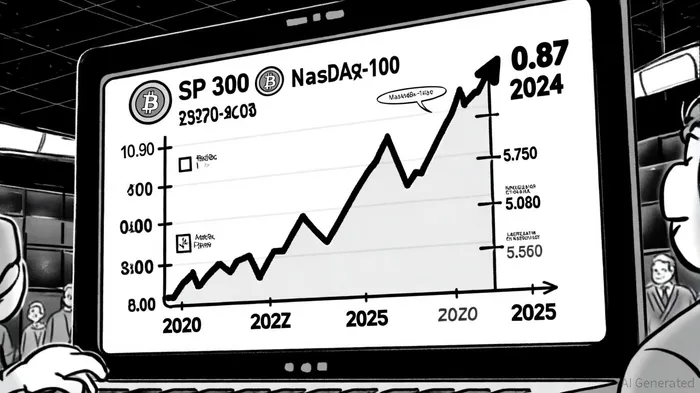
Bitcoin's relationship with traditional equities has evolved dramatically. A 2024 academic paper found a 0.87 correlation between Bitcoin and the Nasdaq-100 and S&P 500[1], a stark departure from its earlier role as a standalone inflation hedge. This shift is driven by three factors:
1. Institutional Portfolio Integration: Bitcoin is now treated as a high-risk, high-reward asset alongside equities, amplifying its beta exposure[2].
2. Supply Dynamics: Reduced exchange-held supply and increased institutional custody have aligned Bitcoin's price action with broader market sentiment[2].
3. Derivatives and ETFs: Futures, options, and ETFs have created a feedback loop where Bitcoin's price moves in tandem with equities during periods of volatility[2].
Regulatory and Political Legitimacy
Regulatory clarity has been a critical enabler. The Trump administration's executive order allowing 401(k) accounts to invest in Bitcoin unlocked an $8.9 trillion capital pool[3], while the Genius Act and U.S. Strategic Digital Asset Reserve legislation added institutional legitimacy[4]. These developments have normalized Bitcoin as a retirement asset and corporate treasury tool, further accelerating adoption.
Challenges and Risks
Despite the bullish momentum, risks persist. Bitcoin's volatility—its daily standard deviation is three to five times higher than equities—remains a hurdle for conservative investors[2]. A 20% price correction in early 2025 (from $109,000 to $88,000) underscored this fragility[1]. Additionally, mining centralization, with 67% of hash power controlled by a few pools, raises concerns about network security[1].
The Road Ahead
Bitcoin's price trajectory in 2025 is poised for continued growth, albeit with short-term volatility. UTXO forecasts project $300 billion in institutional inflows by 2026[1], while the U.S. Strategic Bitcoin Reserve and global liquidity trends create a tailwind for long-term appreciation. However, investors must balance optimism with caution, recognizing that Bitcoin's role as a “digital gold” is still evolving.





Comentarios
Aún no hay comentarios