
Bitcoin's Institutional Adoption and Price Momentum: A Stark Contrast to Warren Buffett's Skepticism
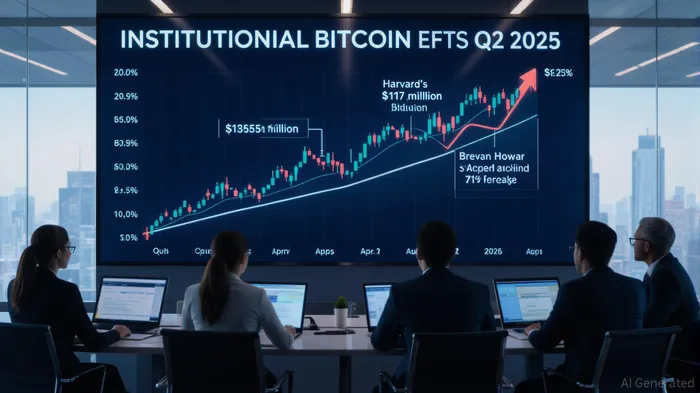
The cryptocurrency market in 2025 has witnessed a seismic shift in institutional adoption, with BitcoinBTC-- emerging as a cornerstone of diversified portfolios. According to a report by BitcoinStrategy, institutional investors now hold over 410,000 BTC through ETFs, a 33% increase in U.S. Bitcoin ETF holdings from Q1 to Q2 2025 [1]. This surge is driven by regulated products like the BlackRockBLK-- iShares Bitcoin Trust (IBIT), which attracted $18 billion in assets under management by Q1 2025, and corporate treasuries adopting Bitcoin as a strategic reserve asset—MicroStrategy's holdings alone surpassed 461,000 BTC by early 2025 [2].
Price Momentum and Macroeconomic Drivers
Bitcoin's price performance in 2025 has defied historical volatility patterns. By May 2025, the cryptocurrency reached an all-time high of $111,900, driven by macroeconomic factors such as rising M2 money supply and expectations of Federal Reserve rate cuts [3]. On-chain metrics further reinforce this bullish narrative: the MVRV Z-Score indicates a healthy bull cycle, while the Value Days Destroyed (VDD) Multiple shows long-term holders accumulating Bitcoin at lower prices [4]. Analysts like Ether Wizz predict continued momentum, with price targets of $140,000–$145,000 by Q3 2025, fueled by ETF inflows and post-halving supply shocks [5].
Warren Buffett's Stance: A Relic of Traditional Finance?
Warren Buffett's skepticism toward Bitcoin remains a stark contrast to this institutional enthusiasm. The Oracle of Omaha has repeatedly dismissed Bitcoin as “rat poison squared,” emphasizing its lack of intrinsic value and utility [6]. Despite his criticism, Buffett's own strategies have indirectly acknowledged Bitcoin's potential. For instance, Berkshire Hathaway's investment in Nu Holdings—a Brazilian digital bank offering crypto services—suggests a nuanced stance, even as Buffett personally rejects direct Bitcoin exposure [7].
The financial implications of Buffett's caution are striking. By August 2025, Berkshire's $100.49 billion cash reserves could have generated $850 million in unrealized gains with a mere 5% allocation to Bitcoin, given its 16.85% year-to-date return [8]. Meanwhile, institutional investors have leveraged Bitcoin's role as an inflation hedge and strategic asset, with Capital Group turning a $1 billion investment into $6 billion by backing companies holding Bitcoin [9].
A Generational Divide in Investment Philosophy
Buffett's traditional emphasis on tangible assets with predictable cash flows—such as farmlandFPI-- or stable businesses—clashes with Bitcoin's digital, speculative nature [10]. Yet, as Coin360 notes, institutional adoption in 2025 reflects a broader shift toward recognizing Bitcoin as a legitimate store of value, particularly in volatile markets [11]. This divergence highlights a generational and philosophical divide: while Buffett warns of Bitcoin's volatility, institutions are increasingly viewing it as a hedge against geopolitical risks and monetary devaluation [12].
Conclusion: The Future of Finance
The institutional embrace of Bitcoin in 2025 underscores its maturation as a financial asset, even as critics like Buffett cling to traditional paradigms. With over $33.6 billion in institutional inflows during Q2 2025 alone and a growing number of 13F filings disclosing Bitcoin holdings, the cryptocurrency's integration into mainstream finance is irreversible [13]. Whether Buffett's successor, Greg Abel, will pivot Berkshire's stance remains uncertain, but the market's trajectory suggests that Bitcoin's role as a strategic reserve asset will only expand.





Comentarios
Aún no hay comentarios