
Bitcoin's Institutional Adoption and October Price Surge: A Strategic Asset Class Emerges
Bitcoin's journey from a speculative digital asset to a strategic institutional asset class has gained undeniable momentum in 2025. The cryptocurrency's institutional adoption has accelerated at an unprecedented pace, driven by regulatory clarity, macroeconomic tailwinds, and a growing recognition of its role in diversified portfolios. This transformation is now being reflected in Bitcoin's price action, with October 2025 marking a pivotal moment as institutional demand fueled a historic surge above $120,000.
Institutional Adoption: A Structural Shift
According to a Business Initiative report, corporations and governments now hold 6.2% of the total BitcoinBTC-- supply (1.30M BTC), a 21x increase since 2020 and $12.5 billion in business Bitcoin inflows in just eight months. This shift is notNOT-- merely speculative but strategic: 59% of institutional portfolios have allocated at least 5% to crypto, with major firms like MicroStrategy (rebranded as Strategy) treating Bitcoin as a core treasury asset, according to an Albion Crypto report.
The rise of spot Bitcoin ETFs has further institutionalized the asset. By Q2 2025, institutional ETF holdings reached 410,000 BTC, with institutions owning over 33% of U.S. Bitcoin ETF holdings, as noted in a Forbes article. Regulatory milestones, including the establishment of a U.S. Strategic Bitcoin Reserve and the approval of spot ETFs, have provided the infrastructure for large-scale adoption. For instance, BlackRock's iShares Bitcoin Trust (IBIT) alone amassed $61.38 billion in cumulative inflows by October 1, 2025, according to Pinnacle Digest.
October 2025: A Price Surge Driven by Institutional Demand
Bitcoin's October 2025 price surge, which pushed the asset above $120,000, was not a mere market anomaly but a direct consequence of sustained institutional buying. On October 1, 2025, U.S. spot Bitcoin ETFs recorded net inflows of $676 million, with BlackRock's IBIT leading the charge with $405 million and Fidelity's FBTC adding $179 million. These inflows coincided with Bitcoin clearing the $120,000 level, a critical psychological barrier.
The mechanics of institutional demand further amplified the price action. As noted by Cryptonomist, ETF inflows led to concentrated buying that tightened available supply, pulling liquidity from exchange order books and OTC desks. For example, Fidelity's acquisition of 1,570 BTC (~$179 million) on October 1 removed significant inventory from exchanges, creating upward pressure. On-chain data from Glassnode also revealed a correlation between ETF net flows and declining exchange reserves during major inflow events.
Macroeconomic factors compounded this demand. Declining U.S. private payrolls and expectations of Federal Reserve rate cuts positioned Bitcoin as a risk-on asset in a low-yield environment. Meanwhile, the Coinbase Premium Index, a gauge of U.S. investor demand, surged, reflecting robust domestic participation.
Bitcoin as a Strategic Asset: Implications and Projections
The institutionalization of Bitcoin has not only stabilized its volatility but also redefined its role in global finance. By mid-2025, realized volatility had dropped by 75% from historical peaks, a trend attributed to the influx of long-term institutional capital. This maturation has attracted even traditional financial institutions: Vanguard, for instance, is reconsidering its stance on offering crypto ETFs to its 50 million customers.
Bitcoin's market capitalization now reflects its growing legitimacy. As of October 2025, spot Bitcoin ETFs represented 6.74% of Bitcoin's total market cap, a metric that underscores its integration into mainstream asset allocation. Analysts project that sustained institutional demand could push Bitcoin toward $200,000 to $210,000 within 12 to 18 months, driven by continued ETF inflows and a broader reevaluation of its utility as a hedge against macroeconomic uncertainties.
Conclusion
Bitcoin's October 2025 price surge is a testament to its evolution into a strategic asset class. The confluence of regulatory clarity, institutional infrastructure, and macroeconomic dynamics has created a self-reinforcing cycle of demand and price appreciation. As corporations, governments, and traditional financial institutions deepen their Bitcoin holdings, the cryptocurrency's role in global portfolios is no longer a question of if but how fast.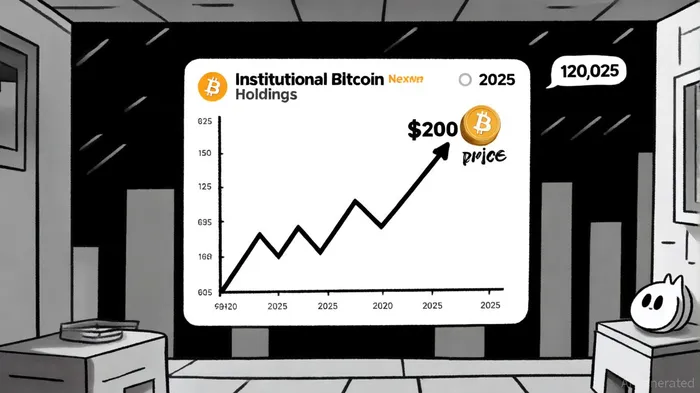





Comentarios
Aún no hay comentarios